

Articles


For progressive technical enterprises, engineering team leadership and career paths have undergone a fundamental shift over the past several decades. Historically, organizations relied on a singular vertical career ladder where the only pathway to advanced compensation, professional status, and organizational authority was a transition into personnel management. This traditional structure frequently produced the “Peter Principle,” wherein exceptional individual technical contributors were promoted to managerial positions for which they lacked natural aptitude, interest, or training. The result was dual organizational failure: firms lost their most productive hands-on engineers while simultaneously gaining ineffective, frustrated managers.
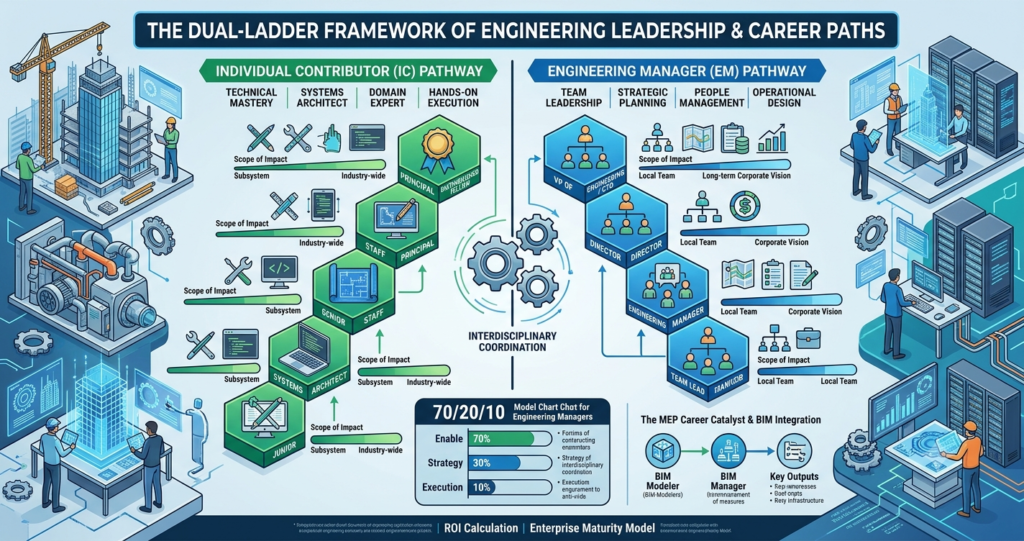
To mitigate this structural bottleneck, modern technology and multi-disciplinary design firms—such as the specialized engineering consultancy EngrTeam—increasingly utilize a dual-ladder progression framework. This paradigm decouples technical expertise from people management, establishing two parallel tracks: the Individual Contributor (IC) track and the Engineering Manager (EM) track. By offering equivalent compensation, corporate prestige, and strategic influence across both tracks, enterprises retain their deepest technical minds while systematically cultivating strong organizational leaders.
Paradigm Shifts in Modern Engineering Organizations
The transition to a dual-ladder system represents a fundamental maturation of organizational design, particularly within complex, high-consequence technical fields such as software engineering, aerospace, and Mechanical, Electrical, and Plumbing (MEP) systems. When a technical department scales beyond its initial operational boundaries, the sheer volume of coordination, strategic planning, and compliance monitoring increases exponentially. In this environment, technical decisions compound over decades, making architectural mistakes incredibly costly.
The dual-ladder system addresses this structural reality by redefining how technical value is recognized and rewarded. Rather than evaluating an engineer’s career progression based on the size of their reporting team, progressive organizations measure their impact, scope of influence, and system ownership. An individual developer or mechanical specialist who designs a foundational system pattern that reduces operational failures across an entire facility portfolio is demonstrating leadership just as significantly as an operations manager overseeing multiple cross-functional teams.
Structural Taxonomy of the Dual Ladder Matrix
The modern dual-ladder framework organizes career progression into structured parallel levels, typically ranging from entry-level apprentices to executive-grade subject matter experts. While exact titles vary by industry and corporate culture, the fundamental mapping maintains equivalent salary bands and authority metrics at corresponding tiers.
| Career Level | Individual Contributor (IC) Pathway | Engineering Manager (EM) Pathway | Expected Scope of Organizational Impact | Typical Industry Tenure |
| Level 1–2 | Junior / Associate Engineer | Not Applicable[cite: 13] | Subsystem tasks, structured execution, localized implementation. | 0–2 Years |
| Level 3–4 | Senior Engineer / Lead Specialist | Tech Lead / Team Lead | Full system ownership, interdisciplinary coordination, peer coaching. | 3–7 Years |
| Level 5 | Staff Engineer | Engineering Manager | Multi-system domain authority, multi-team operations, operational design. | 5–10 Years |
| Level 6 | Principal Engineer | Director of Engineering | Cross-organizational technical strategy, departmental budget control. | 8–12+ Years |
| Level 7+ | Distinguished Fellow / Specialist | Vice President of Engineering / CTO | Industry-wide technical influence, long-term corporate vision execution. | 12+ Years |
The alignment of salary bands across both tracks is critical to preventing the “management tax”. If an engineer must transition into management to achieve a wage increase, the dual-ladder is purely theoretical. Market data indicates that when these pathways are properly calibrated, high-level ICs can earn a premium due to the extreme scarcity of specialized technical problem-solvers.
Deep Dive into the Individual Contributor Track
The Individual Contributor track is designed for engineering professionals who choose to expand their organizational value by deepening their hands-on mastery of systems, processes, and tools. Rather than delegating technical execution to others, ICs remain actively involved in the craft, taking direct ownership of the most complex, high-risk components of a project.
As the professional progresses through the IC levels, the primary expectation shifts from tactical execution under close supervision to strategic influence over multi-disciplinary frameworks.
Junior (L1)
Senior (L3)
Staff (L5)
Principal (L6)
Entry and Mid-Levels: Tactical Execution and Skill Acquisition
At the Junior (Level 1) and Associate (Level 2) tiers, the engineer’s core focus is the acquisition of foundational domain skills. These professionals operate within highly structured environments, executing well-scoped tasks such as running calculations, generating 2D and 3D system drawings, and writing tests. Success is measured by accuracy, speed of execution, and the ability to proactively unblock oneself.
Senior Level: Full Domain Autonomy and Design Integration
At the Senior (Level 3-4) tier, the IC becomes fully autonomous, managing entire systems or major sections of large-scale projects without daily oversight. Senior Engineers evaluate trade-offs, identify system deficiencies, and define technical patterns that reduce structural debt. Furthermore, they take on direct responsibility for mentoring junior team members, conducting detailed design reviews, and collaborating directly with cross-functional partners.
Staff and Principal Levels: Strategic System Governance
Upon reaching the Staff (Level 5) and Principal (Level 6) tiers, the IC’s impact expands from individual projects to the broader technical ecosystem of the company. These professionals act as domain authorities, translating high-level business goals into scalable, reliable technical systems. Staff and Principal Engineers do not wait for tasks to be assigned; they proactively identify systemic risks, establish corporate engineering standards, and drive multi-team initiatives. They represent the firm in high-consequence client consultations, and their decisions compound over decades to dictate the organization’s operational margins.
Decoupling Management and Craft in Engineering Team Leadership and Career Paths
Developing an effective framework for engineering team leadership and career paths requires recognizing that management is an entirely separate craft, demanding a distinct suite of human, operational, and strategic competencies. While an IC is primarily evaluated on their individual or system-level output, an engineering manager is evaluated on the collective performance, operational health, and retention of their team.
To optimize leadership structures, organizations utilize several operational frameworks. One such standard is the 70/20/10 model:
• Unblocking Team Pipelines
• Performance Appraisals
• Architecture
• Budgeting
• Code
• Calc
Managers demonstrate leadership by designing high-performing teams, establishing predictable delivery cadences, and structuring the organizational boundaries that allow engineers to focus deeply on their technical specialties. At the Tech Lead or Team Lead level (Level 4), professionals often split their time between direct technical contribution and team coordination. However, at the Engineering Manager (Level 5) and Director (Level 6) tiers, direct technical execution drops to near zero.
A highly prevalent organizational trap is the “Tech Lead Manager” role, where an individual is expected to manage a team of direct reports while simultaneously acting as the primary system architect and individual developer. This structure introduces severe cognitive context-switching, leading to delayed project delivery, administrative backlogs, and rapid burnout. To avoid this, successful firms separate technical oversight from operational leadership, ensuring that each role has a clear scope of responsibility.
| Leadership Dimension | Individual Contributor (IC) Track Expectation | Engineering Manager (EM) Track Expectation |
| System Decisions | Direct architectural design, component selection, structural calculations. | Facilitates design alignment, reviews business case, secures project funding. |
| Operational Control | Identifies technical debt, suggests refactoring sprints, tests workflows. | Allocates team headcount, coordinates schedules, manages multi-department dependencies. |
| Growth & Talent | Upskills peers through active technical mentoring, pair programming, code/design feedback. | Executes formal performance appraisals, manages promotion loops, drives hiring pipelines. |
| Stakeholder Liaison | Translates technical trade-offs, calculations, and architectural limits to stakeholders. | Communicates project milestones, structural risks, and delivery dates to executives. |
The Integration of BIM in MEP Engineering Career Roadmaps
The rapid digitization of the architecture, engineering, and construction (AEC) industries has fundamentally transformed the pathway of Mechanical, Electrical, and Plumbing (MEP) specialists. Historically focused on 2D CAD drafting, modern MEP career structures are deeply intertwined with Building Information Modeling (BIM). For comprehensive systems coordination, firms rely heavily on integrated MEP plan services to ensure seamless collaboration between structural, architectural, and engineering layouts.
The modern MEP career path leverages BIM modeling as both a technical tool and a career catalyst, allowing engineers to transition from simple detailers to high-value systems coordinators.
| Role Title | Core Technical Competencies | Software and Tool Mastery | Primary Organizational Deliverable |
| BIM Modeler | 3D system modeling, basic spatial routing, annotations. | Revit MEP, AutoCAD. | Single-discipline 3D coordinated models. |
| MEP Design Engineer | Load calculations, component sizing, system schematics. | Revit MEP, HAP, Hevacomp. | Stamped engineering plans, technical specifications. |
| BIM Coordinator | Multi-discipline model federation, interdisciplinary clash review. | Navisworks Manage, BIM 360, Solibri. | Consolidated clash detection reports, design resolutions. |
| BIM Manager | Standards development, template creation, client consultation. | ACC Docs, Dynamo, Excel automation. | BIM Execution Plans (BEP), multi-project workflows. |
This technological shift demands that engineers understand not only their individual discipline but also how physical components interact in three-dimensional space. By mastering Revit MEP and advanced model collaboration platforms, junior engineers accelerate their transition to senior, high-paying design and management roles.
HVAC Design Engineering and Thermodynamic Systems Leadership
Within the broader MEP landscape, HVAC design represents an exceptionally complex and technically demanding engineering specialization. As modern structures prioritize energy efficiency, decarbonization, and indoor environmental quality (IEQ), the engineering leadership of HVAC systems has evolved from basic heating and cooling design into highly advanced building science.
To prevent physical installation errors and optimize airflow within restricted structural clearances, the execution of detailed HVAC layout plans is a mandatory phase of preconstruction planning.
At its core, HVAC engineering leadership demands an absolute command of thermodynamic principles and fluid dynamics. Engineers routinely perform complex sensible and latent heat load calculations to determine the exact thermal capacity requirements of a facility. The total rate of sensible heat transfer within an airflow is modeled mathematically as:
Sensible Heat Equation
qₛ = ṁ × Cₚ × ΔT
Additionally, when calculating the total volumetric flow rate (Q) required to offset a specific sensible heat gain (qₛ) while operating at sea-level atmospheric pressure, the formula simplifies to:
Q = qₛ ÷ (1.08 × ΔT)
where:
ΔT = temperature differential across the conditioned space (°F)
qₛ = sensible heat transfer rate (BTU/hr)
Q = airflow rate (CFM)
To advance into senior and lead roles, an HVAC designer must supplement their academic foundation with professional licensure and highly recognized credentials. Passing the Fundamentals of Engineering (FE) exam to secure Engineer-in-Training (EIT) status is the baseline entry metric.
Following approximately four years of supervised practice, engineers can sit for the Professional Engineer (PE) license. Senior leaders often differentiate themselves by securing specialized credentials from the American Society of Heating, Refrigerating and Air-Conditioning Engineers (ASHRAE):
- Certified HVAC Designer (CHD): Validates the engineer’s comprehensive skill set in designing HVAC systems for commercial and residential sectors.
- High-Performance Building Design Professional (HBDP): Recognizes the ability to integrate sustainable building systems, optimizing energy efficiency while maintaining indoor comfort.
- Building Energy Modeling Professional (BEMP): Certifies expertise in modeling building energy consumption patterns to satisfy green certifications such as LEED.
Electrical Engineering Specializations and Infrastructure Power Distribution
Electrical engineering within modern building design is responsible for powering every operational asset, from high-load mechanical equipment and data center servers to emergency life safety systems and communication networks. The career path of an MEP electrical engineer is characterized by a gradual transition from simple localized circuit drafting to the design and commissioning of massive high-voltage power distribution systems.
Given the extreme risks of arc flash hazards and electrical failures, utilizing certified electrical engineering services is paramount to guaranteeing spatial safety, structural compliance, and continuous power redundancy.
• Circuiting
• Site Surveys
• Shop Drawings
• System Coordination
• High-Load Systems
• Technical Board Review
• Emergency Systems
• Master Planning
The career roadmap for an electrical designer involves mastering several key developmental stages:
Junior Designer (0-2 Years)
Focuses on executing basic load calculations, drafting single-line power distribution diagrams, and circuiting receptacle and lighting layouts under the oversight of a senior engineer. They learn to apply the National Electrical Code (NEC) to practical scenarios and conduct initial site surveys.
Design Engineer and EIT (2-4 Years)
Begins taking independent ownership of electrical systems on small-to-medium commercial facilities. This role involves managing construction administration tasks, responding to Requests for Information (RFIs), evaluating equipment submittals, and executing detailed lighting and fault-current analysis.
Professional Engineer and Lead Designer (4-8 Years)
Secures the Professional Engineer (PE) license in Power, allowing them to legally sign and stamp construction documents. Licensed PEs design complex power distribution systems, establish selectivity for overcurrent protection devices, coordinate utility service entrances, and integrate standby emergency generator arrays.
Senior Principal Specialist or Project Manager (8+ Years)
The career path splits, allowing the professional to either remain a senior technical specialist—focusing on highly complex data centers, industrial plants, or hospital systems—or transition into operational management to coordinate cross-disciplinary teams and drive business development.
Clash Detection Mechanics and Interdisciplinary BIM Governance
As architectural designs push the boundaries of spatial geometry and building envelopes become more highly integrated, physical space inside mechanical plenums and structural cavities has become extremely scarce. To prevent catastrophic design overlaps before breaking ground, engineering teams rely heavily on automated BIM clash detection workflows.
This process, managed by BIM Coordinators, utilizes advanced software to aggregate independent structural, architectural, and MEP models into a single federated view.
Clash detection rules must be highly customized, setting specific tolerance boundaries to differentiate between actual physical collisions and negligible installation offsets.
| Clash Typology | Physical Characteristic | Real-World Example | Primary Resolution Strategy |
| Hard Clash | Two or more physical components occupy the same space. | A 24-inch supply air duct intersecting a primary structural steel column. | Reroute the flexible ductwork or modify the structural layout if permitted. |
| Soft Clash | A component violates the spatial clearance or maintenance buffer zone of another object. | An electrical main switchboard placed directly beneath a pressurized wet sprinkler pipe. | Reposition the electrical panel to satisfy code clearances and protect against leaks. |
| Workflow Clash | A sequence conflict that impedes the practical timeline of construction activities. | Designing structural floor slabs to be poured before underground conduit runs are installed. | Adjust the project schedule and install conduit infrastructure prior to concrete work. |
To maximize modeling efficiency, advanced design teams balance reactive clash detection with proactive clash avoidance. While clash detection focuses on identifying conflicts after individual discipline designs are completed, clash avoidance leverages close interdisciplinary communication to prevent conflicts from ever being modeled.
By establishing strict coordination zones early in the design phase—allocating specific vertical layers of a plenum to ductwork, plumbing, and electrical conduits—engineers eliminate up to 80% of potential clashes, ensuring a smooth, highly predictive construction process.
Strategic Enterprise Rollout and Organizational Maturity
Implementing a robust dual-ladder career framework requires a highly structured strategic rollout. It is not merely a human resources exercise; rather, it represents a deep cultural adjustment that must be supported by the highest levels of technology and engineering leadership.
To successfully establish these tracks, organizations can align their rollout with a structured five-step implementation process:
|
1. Audit (30d)
|
2. Define (60d)
|
3. Scale (90d)
|
4. Embed (180d)
|
|---|---|---|---|
|
• Map current roles
• Interview key talent |
• Establish competency matrix
• Benchmark pay |
• Standardize assessment protocols
• Training loops |
• Integrate with promotion & compensation
• Review cycles |
During this strategic rollout, organizations can benchmark their leveling structures against open-source industry libraries—such as the Progression.fyi library—to ensure their roles, skill definitions, and competencies align with competitive, world-class engineering organizations.
To measure the institutional effectiveness of these career frameworks, executive teams reference the Dual-Track Career Framework Maturity Model:
| Maturity Level | Operational Characteristics | Percentage of Firms | Key Retention Outcome |
|---|---|---|---|
| Level 1: Initial | No formal career structures exist; promotions and salaries are determined on an ad-hoc basis. | 14% of firms | High attrition of senior technical talent. |
| Level 2: Developing | Basic distinction between individual contributor (IC) and management roles, but applied inconsistently. | 29% of firms | Moderate role confusion; occasional “forced management.” |
| Level 3: Defined | Fully documented dual-track career matrices integrated into organizational hiring and performance reviews. | 43% of firms | High baseline role clarity and equitable career development. |
| Level 4: Managed | Career advancement and competency development are actively calibrated against project delivery and performance metrics. | 57% of firms | Strong alignment between performance and compensation. |
| Level 5: Optimized | Continuous evolution of career pathways based on industry standards, organizational learning, and peer feedback. | 71% of firms | Highly resilient talent retention and robust technical expertise. |
Financial and Operational ROI of Structured Career Progression
The economic justification for implementing parallel career paths extends far beyond human resources metrics, manifesting directly in project delivery margins and operational efficiency. When organizations fail to provide a viable advancement path for technical specialists, the subsequent attrition of senior talent induces substantial financial damage.
The financial return on investment (ROI) of implementing a dual-ladder progression framework can be modeled mathematically by comparing the cost of implementation against the savings realized through improved talent retention and reduced design errors:
ROI = ((Cₐₜₜ + Cᵣₑw) − Cᵢₘₚₗ) ÷ Cᵢₘₚₗ
where Cₐₜₜ represents the annualized cost of technical talent attrition saved, Cᵣₑw represents the reduction in project rework costs due to higher technical design continuity, and Cᵢₘₚₗ represents the total cost to design, document, and roll out the career progression framework.
To calculate the cost of technical talent attrition saved (Cₐₜₜ), organizations utilize the following formulation:
Cₐₜₜ = N × R × H × M
where N represents the total number of senior technical staff, R represents the reduction in annual attrition rate (expressed as a decimal), H represents the average replacement hiring cost per senior specialist (typically 1.5× to 2.0× the annual salary band), and M represents the organizational productivity ramp-up multiplier.
Additionally, the reduction in project rework costs (Cᵣₑw) can be modeled as:
Cᵣₑw = P × Dₐᵥᵍ × RER
where P is the total number of projects executed annually, Dₐᵥᵍ is the baseline average cost of system rework per project due to engineering design omissions, and RER is the Rework Elimination Rate achieved by retaining senior technical architects and coordinators.
When a company transitions from an ad-hoc structure to a Level 3 “Defined” progression model, the average annualized attrition rate typically falls by 15% to 30%. This preservation of domain expertise directly correlates with a 40% reduction in design coordination errors and a 3× increase in project delivery frequency.
Across mid-to-large-scale engineering consultancies, properly executed dual-ladder systems yield an expected ROI ranging from 2× to 5× the initial implementation cost within twelve to eighteen months of institutional rollout, driven by a dramatic stabilization of high-performing technical talent.
Actionable Strategic Synthesis for Technical Directors
To construct a resilient engineering organization that systematically retains elite technical experts while cultivating capable organizational managers, technical directors must execute a series of targeted strategic shifts. Rather than relying on rigid, bureaucratic checklist models that stifle individual creativity, leaders should construct flexible, behavioral-focused career maps that prioritize continuous feedback and demonstrated organizational impact.
| Core Strategic Focus | High-Impact Action Items for Leadership Teams | Expected Organizational Outcome |
| Abolish Single-Ladder Hierarchies | Establish formal, written technical pathways (Staff, Principal, Fellow) with absolute salary and title parity to management tracks. | Eliminates the “management tax”; protects elite technical talent from being forced into administrative roles. |
| Mitigate Context-Switching Traps | Formally separate the dual roles of Tech Lead and Team Manager; ensure managers operate on an interrupt-driven cadence while ICs maintain long focus blocks. | Accelerates system design cycles; prevents operational burnout among leadership staff. |
| Standardize BIM and Design Paths | Integrate clear software, calculation, and coordination milestones into MEP and HVAC engineering ladders. | Enhances the constructability of mechanical, electrical, and plumbing layouts. |
| Implement Quantitative Baseline Assessments | Conduct structured, cross-discipline self-assessments and peer reviews to evaluate individual levels against documented competency matrices. | Establishes a transparent, objective roadmap for promotions, reducing friction during compensation discussions. |
| Sustain High Operational Redundancy | Regularly analyze team skill gaps, plan multi-year headcounts, and execute structured onboarding programs. | Minimizes the organizational “bus factor”; ensures consistent project delivery margins across complex portfolios. |
Ultimately, professional growth is not a static destination but a continuous organizational process. By aligning career progression with individual strengths, technical passions, and modern structural frameworks, engineering enterprises create a highly predictable environment where both technical masters and strategic managers can perform at their highest operational potential. This balanced ecosystem is the ultimate hallmark of a mature, future-proof engineering organization