
Articles


Optimizing organizational structure and coordination in engineering teams represents the ultimate objective of modern industrial design and execution. As physical, electrical, and software systems become increasingly integrated, traditional departmental boundaries continue to dissolve. This convergence requires a transition from the rigid, vertical hierarchies of the past toward more dynamic, flexible structures that balance steady execution with rapid, cross-functional adaptability.
Industry studies show that poor collaboration and structural misalignment account for up to 30% of project delays and failures in engineering fields. Conversely, enterprises that utilize highly collaborative, structurally aligned organizations are 20% more likely to achieve performance goals and adhere to strict development timelines.
To build and maintain high-performing teams, engineering leaders must understand the structural typologies, socio-technical dynamics, and digital frameworks that dictate organizational effectiveness. This research report analyzes the foundational dynamics of engineering team design, evaluates the variables governing coordination, and outlines how unified technological frameworks mitigate physical and logical conflicts in multidisciplinary environments.
Structural Typologies in Engineering Enterprises
The architecture of an engineering department defines its reporting lines, outlines its span of control, and shapes its internal communication pathways. Selecting a structural framework is a contingency-based decision that must align with the complexity of the product, the stability of the external market, and the overall scale of the enterprise.
| Structural Model | Hierarchical Configuration | Decision-Making Authority | Primary Coordination Basis | Key Strength | Primary Weakness |
| Functional | Multi-layered vertical pyramid | Highly centralized at executive levels | Technical discipline and specialized skill sets | Fosters deep technical specialization and clear career paths | Creates departmental silos and handoff delays |
| Divisional | Semi-autonomous product or regional units | Hybrid; decentralized within divisions | Product lines, target markets, or geographic regions | High division autonomy and rapid local decisions | Promotes duplication of resources and activities |
| Matrix | Dual reporting lines (vertical & horizontal) | Hybrid; shared across functional & project leads | Simultaneous grouping by skill and project | Efficient resource sharing and cross-discipline collaboration | Causes priority conflicts and reporting confusion |
| Flat / Horizontal | Minimal vertical layers; horizontal self-management | Decentralized; distributed autonomy | Broad, fluid job descriptions and skills | Rapid communication and fast adaptation | Difficult to sustain at scale; lacks promotion paths |
| Holacratic | Circle-based, non-hierarchical peer networks | Decentralized; self-governing circles | Dynamic roles aligned with specific objectives | High transparency and rapid, autonomous adjustments | High implementation complexity; lacks clear hierarchy |
The Functional Archetype
The functional structure groups engineering personnel based on their specific technical domain, such as mechanical design, thermodynamic analysis, or software development. Authority flows vertically from executive leadership down through functional department heads to individual contributors. This model excels at fostering deep technical expertise and providing clear, predictable career progression within a specific discipline.
However, functional configurations inherently encourage departmental siloing. Because departments are typically isolated from one another, interdepartmental communication is restricted, resulting in poor coordination across functional interfaces. When a project requires sequential handoffs between separate functional divisions, work queues inevitably form, causing significant latency and extending the project’s time-to-market.
The Divisional Configuration
When an engineering organization scales its offerings, a divisional structure becomes a practical adaptation. In this model, the organization divides into semi-autonomous units categorized by product line, target customer, or geographic market. Each division maintains its own dedicated engineering staff, production operations, and support functions, allowing for rapid decision-making.
This structural independence ensures that each division can pursue its unique objectives without competing for shared corporate resources. The primary drawback of the divisional structure is the widespread duplication of activities. Operating duplicate testing labs, CAD modeling teams, and quality assurance personnel across several autonomous divisions increases overhead costs and can dilute the core organizational culture.
The Matrix Integration Model
The matrix structure attempts to resolve the tension between functional specialization and cross-disciplinary project delivery. Under this framework, vertical lines of command (governed by functional managers) intersect with horizontal lines of command (governed by project or product managers). Engineers remain anchored in their home functional departments for professional development, standards compliance, and performance evaluation, but are allocated to cross-functional project teams to perform their day-to-day duties.
Despite these benefits, matrix structures are inherently complex to administer. Dual reporting lines can lead to conflict regarding resource prioritization, leaving individual engineers to navigate contradictory instructions from functional and project managers.
Flat and Horizontal Structures
Popularized by high-growth startups and technology firms, flat structures eliminate middle management layers to connect executive leaders directly with frontline engineering staff. These organizations recruit based on broad, adaptable skill sets rather than hyper-specialized roles, granting engineers significant autonomy.
Flat structures speed up decision-making and foster an open, collaborative working environment. However, horizontal models become difficult to sustain as an organization expands beyond a critical size. The lack of a defined hierarchy can lead to role confusion, informal power structures, and higher employee turnover, as technical professionals find fewer opportunities for formal career advancement.
The Strategic Importance of Organizational Structure and Coordination in Engineering Teams
To understand how organizational structure and coordination in engineering teams influences technical performance, one must look closely at the underlying socio-technical dynamics. Systems engineering theory indicates that team structure does not directly generate technical outputs; instead, it establishes the operational boundaries that allow for effective coordination, which subsequently drives overall project performance.
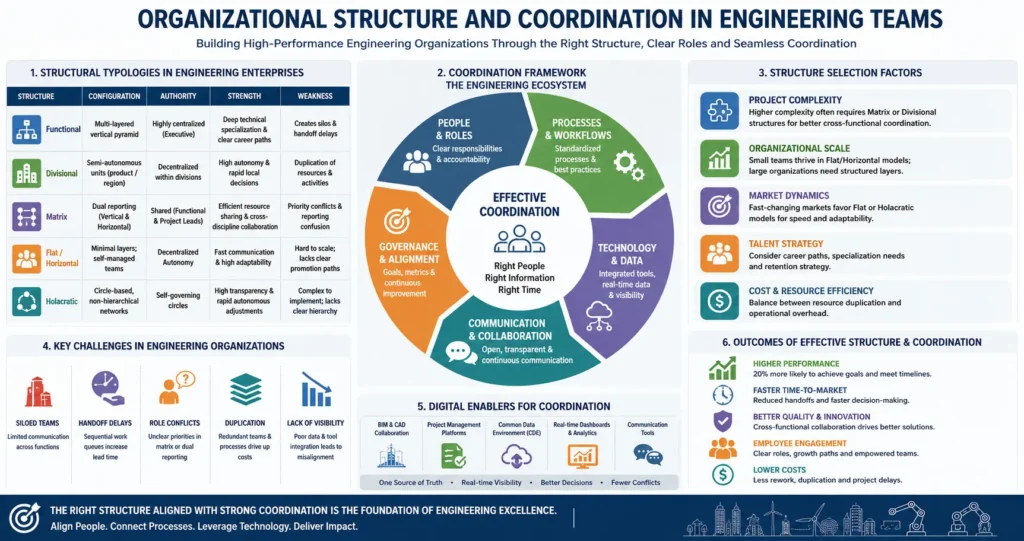
The structural definition of any engineering team relies on three primary variables: specialization (the division of labor), hierarchy (clearly defined leadership roles), and formalization (standardized work routines and procedures). When these three elements are carefully defined, they establish three key operational states:
- Accountability: By defining clear domains of technical specialization, teams reduce ambiguity regarding task ownership. Leaders within the hierarchy can easily track and adjust performance, minimizing the risk of overlooked technical requirements or redundant efforts.
- Predictability: High formalization—manifested through standardized schedules, code review checklists, and milestone gates—makes team behavior predictable. Engineers can anticipate when upstream design files will be delivered, how validation processes will unfold, and in what sequence tasks must occur, reducing friction throughout the development lifecycle.
- Common Understanding: Structured processes and standardized vocabularies provide consistent informational cues. This shared framework helps engineers align their individual work with the broader goals of the project.
These structural benefits are highly dependent on team longevity, defined as the average tenure of the team’s members. Empirical research shows that the positive relationship between team structure and coordination is significantly stronger in teams with high longevity.
When a team has worked together for a long period, members have already resolved basic interpersonal friction and established implicit communication patterns. In these mature groups, explicit structural frameworks act as an organizing force that streamlines workflow execution. In contrast, in newly formed teams, rigid structures can sometimes feel like administrative overhead, as members are still adjusting to one another’s working styles.
To model these dynamics mathematically, team performance (Ep) can be expressed as an integration of structural definition (Sd), coordination effectiveness (Ce), and team longevity (Lg) over the project duration (T):
Ep = ∫₀ᵀ (Sd · Ce · Lg) dt
Where coordination effectiveness is itself a function of formalization (Fm), hierarchical clarity (Hc), and role specialization (Rs) established by the organizational design:
Ce = f(Fm, Hc, Rs)
Furthermore, the economic impact of coordination failures can be quantified. Left unchecked, strategic mismatch and coordination gaps can cost organizations up to 25% of their annual revenue. When a team’s information, resources, and individual skills are integrated into an efficient temporal workflow, team members can direct their efforts toward collective goals rather than individual interests, which ultimately enhances overall performance.
Tactical Execution Units: Product-Based vs. Technology-Based Alignment
At the product development level, engineering leaders must decide how to organize cross-functional assets. This choice generally falls into three models: technology-based (horizontal), product-based (vertical), or hybrid matrix configurations.
| Architectural Parameter | Technology-Based (Horizontal Stack) | Product-Based (Vertical Squads) | Mixed Matrix / Hybrid Model |
| Organizational Alignment | Aligned with technical layers (e.g., frontend, backend) | Aligned with business areas (e.g., checkout, search) | Simultaneous alignment with technical skills & product lines |
| Reporting Lines | Single line manager who is a technical specialist in that domain | Single line manager focused on product delivery | Dual reporting lines to both functional & project managers |
| Collaboration Pattern | Focused within the same technical skill area | Cross-functional across different engineering disciplines | Dynamically allocated cross-functional teams |
| Speed to Market | Slower; work backs up at boundaries between teams | Faster; autonomous teams minimize handoffs | Moderate; requires continuous alignment across groups |
| Technical Quality | Highly consistent; deep technical peer review | Risk of code inconsistency & isolated technical debt | Balanced; maintains technical standards across projects |
Technology-Based (Horizontal) Team Structure
The technology-based approach organizes engineering teams along the layers of the technical stack or by discipline—such as frontend development, firmware engineering, or database administration. All members of a given team report to a manager who is highly skilled in that specific technology.
The primary strength of the technology-based structure is technical excellence, which is often higher than in other models. Competent managers can evaluate developers based on merit, provide detailed technical coaching, and help maintain high architectural standards.
However, this structure can lead to slow delivery times. Because features typically require contributions from multiple layers of the stack, work must pass sequentially from one team to another. If the frontend team is waiting on backend API changes, work piles up at the boundaries between teams, leading to handoff delays and occasional “us-versus-them” cultural divisions.
Product-Based (Vertical) Team Structure
Product-based configurations align teams around specific business areas, customer personas, or product features. Each team is cross-functional and contains all the skills required to deliver a complete feature end-to-end—typically integrating frontend, backend, QA, and product management personnel under a single line manager.
This horizontal alignment with customer value streams streamlines feedback loops and accelerates iteration cycles. Teams spend less time managing schedules and handoffs and more time focusing on customer needs.
The primary drawback of this model is the risk of architectural fragmentation and technical debt. Isolated product teams may select different workflows, library versions, or architectural patterns, leading to inconsistencies across the company’s broader product portfolio. Additionally, engineers can become isolated from peers in their same discipline, limiting opportunities for cross-project knowledge sharing.
Hybrid and Spotify-Inspired Matrix Models
To balance technical excellence with rapid feature delivery, organizations often turn to hybrid structures. The widely discussed “Spotify Model” organizes engineers into cross-functional, autonomous “Squads” to drive vertical feature delivery, while maintaining horizontal “Chapters” to preserve functional discipline, tool standardization, and professional growth.
Similarly, Meta (Facebook) uses a flat matrix model that combines product-focused and geographic divisions with horizontal technical functions to encourage rapid, cross-functional collaboration. While these models are highly flexible, they require significant effort to maintain, as clear communication is essential to prevent conflicts regarding priorities and double-reporting lines.
Multidisciplinary Synthesis and Spatial Coordination in MEP Systems
The challenges of organizational structure and coordination in engineering teams are particularly visible in multidisciplinary Building Information Modeling (BIM) and Mechanical, Electrical, and Plumbing (MEP) projects. In commercial and industrial construction, MEP systems typically represent 40% to 60% of the overall construction cost and occupy a significant portion of the building’s physical envelope. When mechanical, electrical, and plumbing systems are designed by separate engineering groups working in isolation, spatial and physical conflicts are almost inevitable.
Spatial and System Interferences in MEP Coordination
Historically, MEP coordination was a manual process that involved overlaying 2D paper drawings on a light table to spot conflicts. In modern, fast-track projects, this approach is insufficient, often leading to unresolved interferences that reach the field.
These conflicts generally fall into three categories:
- Hard Clashes: Direct geometric intersections, such as a large air supply duct passing directly through a structural concrete beam or a fire sprinkler pipe.
- Soft Clashes: Violations of spatial buffers required for code compliance, safety clearances, or maintenance access—such as placing a high-voltage cable tray directly adjacent to a wet plumbing line or blocking an access panel.
- Workflow (Time) Clashes: Chronological sequencing conflicts where the installation of one system blocks the path or access required to install another.
The financial consequences of failing to coordinate these systems early in the design phase are substantial. Industry studies show that unresolved design conflicts are responsible for up to 40% of all construction-phase Requests for Information (RFIs) and are a primary driver of field rework.
A field-resolved MEP clash costs an average of $1,500 to $4,200 to resolve—including the costs of halting trade workflows, drafting RFIs, engineering a redesign, and executing the physical rework. Major coordination failures can delay projects by three to five weeks, risking significant liquidated damages.
Implementing an Effective Coordination Priority Matrix
To systematically resolve spatial conflicts, multidisciplinary engineering teams must establish a clear routing priority matrix based on system flexibility and physical constraints. This matrix guides the resolution of conflicts by prioritizing systems that are difficult or expensive to reroute:
| Routing Priority | System Component | Flexibility Level | Routing Constraints and Coordination Directives |
| Priority 1 | Structural Elements (Beams, columns, load-bearing walls) | Rigid / Fixed | Treated as fixed structures; any modifications require formal structural engineering approval and can impact building integrity. |
| Priority 2 | HVAC Ductwork & Equipment (Air handlers, exhausts, supply lines) | Low Flexibility | Requires large physical volumes and has limited routing flexibility; must be coordinated early to fit within ceiling plenums. |
| Priority 3 | Gravity Drainage Pipes (Sanitary sewers, storm drains) | Moderate/Low Flexibility | Must maintain continuous, precise sloped gradients to function; cannot be looped or easily diverted to avoid obstacles. |
| Priority 4 | Pressurized Piping Systems (Domestic water, fire suppression) | High Flexibility | Pressurized systems can route around obstacles using elbows and tees, but must maintain code clearances from electrical lines. |
| Priority 5 | Electrical & Control Systems (Conduits, cable trays) | Maximum Flexibility | Highly flexible and can adapt to tight spaces; routed last to avoid conflicts with mechanical and plumbing systems. |
Leveraging Advanced Coordination and Engineering Services
To address these coordination challenges, firms often engage specialized engineering services that utilize advanced 3D coordination tools. For instance, utilizing the comprehensive MEP plan services provided by Engrteam helps ensure that spatial and systems alignment is achieved during the pre-construction design phase.
Developing an optimized HVAC layout plan early in the design cycle allows teams to verify duct routes, coordinate structural penetrations, and preserve necessary maintenance clearances before any physical components are fabricated.
Simultaneously, leveraging specialized electrical engineering services from a unified partner ensures that high-voltage power distributions and cable trays are routed safely, avoiding both wet piping runs and high-temperature exhaust ducts. These integrated workflows can be explored through the primary platform at Engrteam, which serves as a central hub for multidisciplinary project delivery.
The Quantitative Return on BIM Clash Detection
In the architecture, engineering, and construction (AEC) sector, BIM-enabled clash detection provides a clear, data-driven return on investment. By utilizing federated models to aggregate architectural, structural, and MEP designs into a single collaborative workspace, engineering teams can identify and resolve physical interferences before construction begins.
Case studies and financial analyses of major infrastructure initiatives demonstrate the economic value of these tools:
- Direct Cost Reductions: Implementing automated BIM-based clash detection reduces total construction rework expenses by 20% to 40%. On large-scale commercial developments, this reduction can save up to 20% of the overall contract value.
- High Financial Viability: Comprehensive cost-benefit analyses show a positive Net Present Value (NPV), a Benefit-Cost Ratio (BCR) significantly greater than 1.0, and an average return on investment (ROI) of 634% for BIM coordination workflows.
- Operational Performance Metrics: Resolving system interferences during the design phase (at Level of Development 300 to 350) reduces the volume of construction-phase RFIs by approximately 60%. This proactive approach also minimizes change orders and helps prevent schedule overruns.
According to academic evaluations published in the National Center for Biotechnology Information database, the effectiveness of these workflows depends heavily on the structured coordination mechanisms established within the project team. When a team’s information, resources, and tools are integrated into a single collaborative platform, project delivery quality improves significantly.
Unified Digital Infrastructure: Integrating ALM, PLM, and BIM
To sustain organizational structure and coordination in engineering teams, modern enterprises rely on a suite of digital lifecycle management platforms. These systems act as a single source of truth, aligning diverse technical contributions and ensuring full requirements traceability across a product or building’s lifecycle.
| Architectural Domain | Application Lifecycle Management (ALM) | Product Lifecycle Management (PLM) | Building Information Modeling (BIM) | Enterprise Resource Planning (ERP) |
| Primary System Focus | Software systems, embedded firmware, and codebases | Physical, mechanical, and electrical hardware components | Spatial design, MEP coordination, and building construction | Business operations, procurement, logistics, and finance |
| Key Users | Software developers, system engineers, and QA analysts | Mechanical, electrical, systems, and manufacturing engineers | Architects, MEP coordinators, and structural engineers | Supply chain managers, financial analysts, and executives |
| Primary Managed Data | Source code, test cases, software requirements, and bugs | CAD models, Bills of Materials (BOMs), and change orders | 3D models, spatial coordinates, and smart asset metadata | Cost calculations, material inventory, and production schedules |
| Lifecycle Phases | Requirements gathering, coding, testing, release, and maintenance | Conceptual design, prototyping, manufacturing, and retirement | Architectural design, MEP modeling, construction, and FM handover | Order processing, supply procurement, and financial reporting |
| Methodologies Supported | Agile, DevOps, Scrum, and continuous integration | Stage-gate, Lean Product Development, and Six Sigma | OpenBIM, BIM Execution Plans (BEP), and Lean Construction | Just-In-Time (JIT) manufacturing and resource planning |
Establishing the Digital Thread
As products evolve into complex, software-defined systems, managing hardware and software development in isolation introduces significant operational risk. If physical parameters defined in a PLM system drift from the software requirements tracked in an ALM platform, the resulting misalignment can lead to integration failures and costly late-stage rework.
To prevent these disconnects, modern engineering organizations are prioritizing the integration of ALM and PLM workflows. This integration establishes a continuous “digital thread” that links requirements, design decisions, and validation activities across both domains.

A robust digital thread ensures that any engineering change made to a physical hardware component (such as a sensor update tracked in PLM) automatically triggers a corresponding alert in the software system (such as driver updates tracked in ALM). This cross-disciplinary coordination speeds up development cycles, improves compliance, and reduces integration errors during testing.
Human Dynamics and Change Management in Engineering Organizations
While digital management platforms and structural charts provide a logical framework, engineering teams are ultimately composed of human beings. Therefore, successful team design must account for cognitive limits, team behaviors, and the cultural shifts required to support new ways of working.
Conway’s Law and Cognitive-First Design
Conway’s Law suggests that the technical architecture of a system will naturally mirror the communication structures of the organization that designed it. If an engineering department is divided into isolated, siloed teams, the resulting product will likely be modular and fragmented.
To prevent this, progressive engineering leaders apply the “Inverse Conway Maneuver”. This practice involves intentionally structuring teams to mirror the desired architecture of the product.
For example, if an organization wants to deliver a cohesive, unified customer experience across two distinct product features, those features should be assigned to the same cross-functional team. This alignment helps ensure that the product’s design flows naturally from the team’s daily collaboration.
Cognitive load theory also plays a key role in team performance. To prevent burnout and maintain focus, organizations should limit the size of direct-delivery teams to a “two-pizza” limit (typically five to nine members). These small, focused units are given full lifecycle responsibility for a single, well-defined area of the product, minimizing the cognitive load associated with context switching and complex, cross-team approvals.
Shifting from Command-and-Control to Collaborative Leadership
For organizational changes to be effective, leadership styles must evolve from traditional “command-and-control” models to “context-first” collaborative approaches. In a context-first model, leaders do not focus on micromanaging tasks; instead, they provide the clear strategic context, metrics, and resources needed to empower autonomous teams.
This leadership transition is critical: if a team leader remains stuck in a rigid, top-down mindset, the team’s ability to self-organize and adapt drops significantly, regardless of any formal structural changes.
To support this shift, organizations can implement structured feedback loops, such as 360-degree reviews, targeted leadership coaching, and regular retrospectives. These practices help leaders transition from gatekeepers to enablers of high-performing teams.
A Framework for Changing Team Structures
When restructuring an engineering department, organizations should follow a structured change management process to minimize disruption:
- Strategic Intent: The process begins by defining the core goals the change is intended to address—such as accelerating time-to-market, reducing technical debt, or improving quality.
- Structural Design: Next, leaders design the formal organization and define cross-functional boundaries without focusing immediately on specific personalities.
- People Alignment: Finally, leadership maps individual skills to the new structure, taking care to minimize disruption and assign experienced leaders to guide the new teams.
Throughout this transition, engineering leaders should establish data-driven practices to measure and optimize team performance. By utilizing Software Engineering Intelligence (SEI) programs, teams can move away from subjective, gut-feel assessments and align on clear, quantitative metrics to guide continuous improvement.
Strategic Directives for Engineering Leaders
Selecting the right organizational structure and coordination model is a dynamic, ongoing challenge. There is no single “perfect” design; instead, organizations must choose the configuration that best balances their strategic trade-offs—whether they are optimizing for deep technical specialization, rapid product delivery, or complex multidisciplinary integration.
To build and sustain a high-performing engineering organization, leaders should focus on several key priorities:
- Align Team Structure with Strategy: If rapid innovation and speed-to-market are the primary goals, transition toward vertical, cross-functional product teams. If maintaining technical standards and deep expertise is critical, utilize a balanced matrix or hybrid model.
- Implement Early Coordination in Complex Projects: On multidisciplinary projects, such as those involving complex MEP systems, establish a clear routing priority matrix and begin cross-discipline coordination during the early design phases to prevent expensive, field-discovered rework.
- Prioritize Requirements Traceability and Tool Integration: Break down operational silos by integrating key engineering platforms—such as ALM, PLM, and BIM systems—to establish a continuous digital thread across hardware and software lifecycles.
- Empower Autonomy and Develop Leadership: Move away from rigid, top-down management structures toward collaborative, context-first leadership models that grant small, focused teams the autonomy to execute effectively.
By systematically aligning structural design with technological tools and supportive leadership, engineering organizations can navigate market volatility, improve execution predictability, and deliver complex systems with consistent success.