

Articles
Mechanical and Electrical Design Consultants: Engineering the Core Infrastructure of High-Performance Buildings

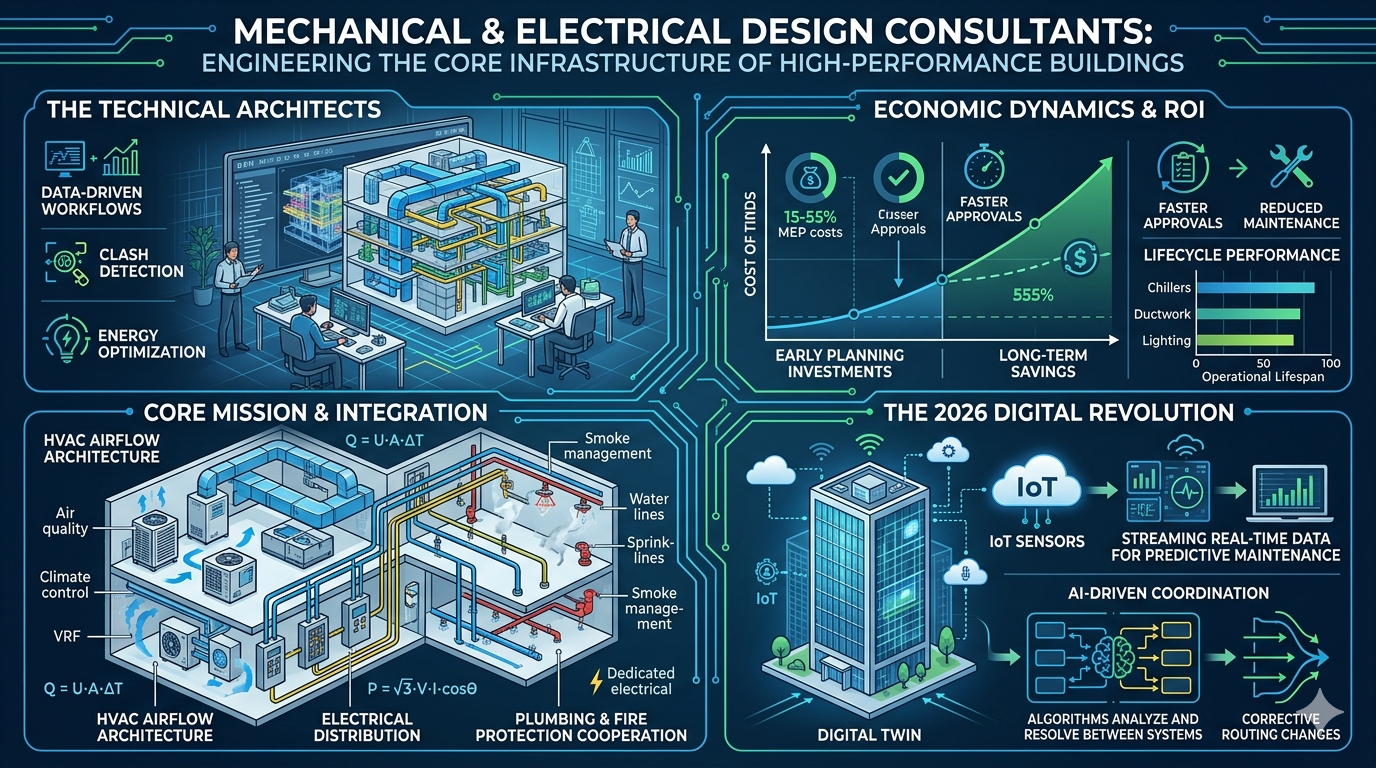
Mechanical and electrical design consultants serve as the technical architects behind the active, living systems of modern architecture. While structural
Table of Contents
Mechanical and electrical design consultants serve as the technical architects behind the active, living systems of modern architecture. While structural elements define a building’s shape, active building systems determine its ultimate performance, occupant safety, and spatial functionality. These systems, integrated under the broader umbrella of Mechanical, Electrical, and Plumbing (MEP) engineering, represent a significant portion of modern capital expenditures, accounting for 15% to 55% of total construction costs depending on system complexity. For complex facilities like laboratories, hospitals, and data centers, these systems demand unparalleled precision, coordination, and code adherence from the very beginning of the design process.
With modern energy codes tightening and building lifecycles being monitored closely, the role of mechanical and electrical consultants has evolved. These professionals translate architectural visions into functional, code-compliant, and energy-efficient spaces. By implementing data-driven engineering workflows, mechanical and electrical consultants resolve physical clashes, optimize operational performance, and control construction risk before physical work begins. For developers seeking optimized asset values and streamlined municipal approvals, partnering with a specialized multidisciplinary engineering group like the(https://engrteam.com/) ensures that complex mechanical and electrical networks are designed for seamless constructability.
The Core Mission of Mechanical and Electrical Design Consultants
The primary responsibility of mechanical and electrical design consultants is to devise structural pathways for utility networks, calculate complex energy and fluid loads, select equipment, and ensure that every circuit, duct, and pipe conforms to national, state, and local standards. Their duties are not confined to simple drafting. They evaluate existing infrastructure, estimate construction costs, generate high-fidelity 2D and 3D schematics, and coordinate with contractors during the physical installation phase to ensure that actual construction matches theoretical parameters.
Mechanical systems generally regulate thermal dynamics, ventilation rates, humidity levels, and indoor air quality. Simultaneously, electrical systems supply power for active machinery, illumination, low-voltage control loops, and critical emergency services. The intersection of these fields governs how well a building performs. Without deep collaboration between mechanical and electrical disciplines, building environments are prone to spatial interference, structural compromises, energy inefficiencies, and operational failures.
Integrated Engineering: Plumbing and Fire Protection Cooperation
Modern building projects are highly interconnected, which makes isolated system designs impractical. Comprehensive MEP consulting coordinates these systems through comprehensive MEP plan services, integrating plumbing networks and fire protection frameworks directly with primary mechanical and electrical structures. For example, booster pumps used to maintain consistent water pressure in high-rise plumbing require dedicated electrical circuits, and modern hot water loops are often coupled with central mechanical heat exchangers.
Furthermore, fire protection systems require direct integration with electrical and ventilation networks. Water sprinkler lines (NFPA 13) must be designed alongside electrical cabling trays to prevent hazards. Additionally, automated smoke management and pressurization systems (governed by mechanical engineering) must coordinate with emergency backup generators (designed by electrical engineering) and primary fire alarm panels (NFPA 72). This level of multi-discipline coordination minimizes spatial conflicts during construction and ensures that life-safety infrastructure performs flawlessly during emergencies.
Advanced Mechanical System Design and Thermodynamic Analysis
At the core of professional mechanical consulting is the calculation of thermodynamic loads to size equipment accurately. Under-sizing systems results in poor climate control and high humidity, while over-sizing leads to cycling issues, premature equipment wear, and unnecessary capital expenses. Consultants perform detailed peak heating and cooling load calculations using Carrier’s Hourly Analysis Program (HAP) and Trace 700.
Thermodynamic load calculations
In these dynamic load models, structural heat transfer is calculated using the fundamental conduction equation:
$$Q = U \cdot A \cdot \Delta T$$
In this equation, $Q$ represents the heat transfer rate in Watts, $U$ represents the overall heat transfer coefficient of the building envelope materials, $A$ represents the surface area of the envelope, and $\Delta T$ represents the temperature difference between the outdoor design condition and the target indoor comfort level. Consultants evaluate these parameters alongside transient thermal loads, including solar heat gain, building orientation, occupancy schedules, lighting power density, and internal appliance loads.
HVAC Layout and Airflow Architecture
Once load parameters are established, mechanical engineers develop a custom HVAC layout plan. This work involves sizing and routing ductwork, selecting materials, and analyzing static pressure using methodologies like ACCA Manual J and Manual D. This design ensures that clean air is distributed quietly, leaks are minimized, and static pressure drops are controlled.
Consultants select the optimal equipment configuration for the building type. Modern solutions range from Variable Refrigerant Flow (VRF) and chilled water systems to Direct Expansion (DX) configurations and green technologies like solar integrations and smart sensors.
For older buildings, specialists use small-duct high-velocity (SDHV) systems to retrofit spaces without compromising historical architectural styles. On the other hand, commercial offices demand complex variable air volume (VAV) systems, exhaust fan calculations, and precise outdoor air ventilation designs based on ASHRAE 62.1 and 62.2 standards to maintain indoor air quality.
Mechanical Codes and Regional Regulations
Mechanical systems must comply with various regional standards, which consultants integrate directly into their designs.
| Jurisdiction | Primary Mechanical & Energy Standards | Governing Codes & Focus Areas |
| United States | ASHRAE 90.1, ASHRAE 62.1, SMACNA, IMC, IECC | Focuses on energy efficiency, indoor air quality, and sheet metal duct installation standards. |
| United Kingdom | CIBSE Guide A, Part L Building Regulations | Regulates environmental design parameters, conservation of fuel, and power efficiency. |
| Canada | NBC (National Building Code), CSA B52 | Focuses on building safety, refrigeration system design, and environmental control. |
| Australia | NCC (National Construction Code), AS/NZS 3666, AS 4254 | Sets requirements for mechanical ventilation, indoor air quality, microbial control, and ductwork. |
Electrical Engineering, Distribution, and Infrastructure Design
Electrical engineering design transforms empty structures into powered workspaces. Designers calculate power requirements to size utility service connections, primary transformers, and power distribution systems.
Power Systems and Sizing Calculations
For balanced three-phase commercial distribution networks, the electrical power is calculated using the following equation:
$$P = \sqrt{3} \cdot V \cdot I \cdot \cos(\theta)$$
In this equation, $P$ is the active electrical power in Watts, $V$ represents the line-to-line voltage in Volts, $I$ is the current in Amperes, and $\cos(\theta)$ represents the power factor of the connected load. By calculating these values, electrical consultants size and configure high-tension (HT) substations, low-voltage (LV) main panels, and overcurrent protection devices. This work ensures that power flows reliably to mechanical units, lighting systems, and office electronics while preventing dangerous overcurrents and voltage drops.
Infrastructure, Safety, and Low-Voltage Integration
In addition to primary power routing, electrical designs incorporate a variety of sub-systems to support daily operations and maintain building safety.
- Emergency and Standby Power: Systems designed with automatic transfer switches (ATS) and emergency generators to support life-safety and critical operations during outages, complying with NFPA 70 Articles 700/701 and NFPA 110.
- Essential and Non-Essential Load Segregation: Designs that separate systems to prioritize critical hardware and medical equipment over general building loads during power outages.
- Low-Voltage and ELV Infrastructures: Dedicated cable trays and pathways designed for telecommunications, high-speed data networks, access control, security systems, and audio-visual lines.
- Earthing and Lightning Protection: High-conductivity grounding paths designed to protect buildings and sensitive computing systems from high-voltage surges and atmospheric discharges.
- Illumination and Automation Controls: Specialized lighting layouts and automated control panels configured to reduce power demand while meeting standard lux requirements.
Economic Dynamics, Capital Expenditure, and Lifecycle ROI
The economic impact of MEP systems extends well beyond their initial design fees. Selecting and coordinating mechanical and electrical systems during early planning has a significant influence on both upfront construction costs and ongoing operating expenses over the life of the building.
MEP Design Fees and Construction Costs
Designing modern buildings requires a realistic understanding of spatial coordination and baseline costs. While design fees are a small part of the total project budget, they direct the construction costs of major building systems.
| Real Estate Class / Building Type | Typical MEP Construction Cost (% of Total Build) | Estimated Design Cost (per Sq. Ft.) | Typical System Turnaround Times |
| Residential Units & Multifamily | 15% to 25% of total construction costs. | $1.00 to $2.50 per square foot. | 2 to 4 business days to draft. |
| Commercial Offices & Retail Malls | 25% to 35% of total construction costs. | $2.50 to $4.00 per square foot. | 4 to 7 business days to draft. |
| High-Performance Labs, Clinics, & Data Centers | 35% to 55% of total construction costs. | Highly variable, subject to complex calculations. | 1 to 2 weeks for complete engineering package. |
Early involvement by specialized firms, such as the(https://engrteam.com/), allows for rapid turnaround times and clear, cost-effective layouts. This prevents the budget creep that often occurs when systems are designed late in the development cycle.
Project Cost Controls and Coordination Revisions
In project development, delays and late changes are major drivers of budget overruns. Incomplete coordination or late updates to occupancy requirements can cause design reversals, requiring engineers to recalculate loads, redo mechanical layouts, and reconfigure electrical power systems.
These late revisions add design hours, lead to conservative system over-sizing, and increase project risk. Furthermore, poor system coordination can cause physical interferences in the field, leading to construction delays, emergency material purchases at premium rates, and expensive structural modifications.
Long-Term Operational Savings and Lifecycle Performance
The true value of investing in high-quality mechanical and electrical design is realized over the building’s operating lifecycle.
| Infrastructure Component | Typical Operational Lifespan | Automated Control Cycle | Preventive Maintenance Impact |
| Major Mechanical (Chillers, Boilers) | 20 to 25 years. | Replaced/updated every 7 years. | Extends operating life by 20% to 40%. |
| Ductwork and Static Air Paths | 30 to 40 years. | Static pressure balancing. | Reductions in annual fan energy consumption. |
| Electrical Power Panels & Switchboards | 25 to 35 years. | Real-time monitoring. | Prevents localized overloads and system failures. |
| Advanced LED & Low-Voltage Lighting | 10 to 15 years. | Motion-activated and sensor-controlled. | Reduces lighting power consumption by 20% to 50%. |
Investing in high-performance advanced HVAC system design services and intelligent electrical distribution reduces utility expenses, limits maintenance demands, and minimizes the risk of system failures. These benefits protect the property’s financial performance and safeguard it against future energy price spikes and environmental penalties.
Specialized Sector Engineering: Medical and Institutional Projects
Standard engineering methodologies are often insufficient for specialized projects like healthcare facilities, research laboratories, and university buildings, which are governed by strict safety regulations. For outpatient clinics, medical centers, and science facilities, the mechanical and electrical designs directly impact occupant health, safety, and operational continuity.
Critical Healthcare Environments
Engineering for medical spaces requires close attention to spatial limitations, dense equipment layouts, and complex regulatory compliance. Mechanical designs must incorporate strict contamination-control protocols, using precise mechanical air change rates, high-efficiency HEPA filtration systems, and custom exhaust setups to isolate pathogens.
Plumbing systems must maintain strict hygiene standards with specialized domestic hot water loops to prevent bacterial growth. Additionally, medical spaces require custom pipelines for life-critical medical gases, such as medical oxygen, nitrogen, medical vacuum, and nitrous oxide.
On the electrical side, these systems demand reliable load segregation. Electrical consultants must design isolated power systems and automated backup pathways to ensure that life-support systems, surgical lights, and critical monitoring arrays remain powered during main grid outages.
Institutional and Laboratory Standards
For university and laboratory projects, design consultants must follow strict building safety standards.
       │
       ├─► NFPA 45 Compliance (Chemical storage, isolated exhaust systems)
       │
       ├─► ASHRAE Standard 62.1 (Minimum fresh-air ventilation, fume hood exhaust coordination)
       │
       └─► NFPA 4 Compliance (Early-stage integrated life safety testing coordination)
Chemical research laboratories must comply with NFPA 45, which regulates exhaust routing, chemical storage, and chemical-resistant hood installations. Under these guidelines, exhaust air from hoods must be vented directly to the exterior of the building and cannot be recirculated into general HVAC ductwork.
Additionally, engineers must follow NFPA 4, which mandates early-stage coordination and integrated testing of fire suppression systems, emergency lighting, fire alarms, and smoke barrier operations. Designing these spaces requires close collaboration with structural and architectural teams to accommodate heavy equipment and meet clearance requirements while staying within strict spatial limits.
The 2026 Digital Revolution: BIM, Generative AI, and Digital Twins
In 2026, the building design industry has moved away from static, manual modeling toward smart digital ecosystems that combine data, processes, and collaborative tools throughout the building lifecycle.
Cloud-Based BIM and ISO 19650
Building Information Modeling (BIM), primarily using Revit MEP, has become the digital foundation for modern construction projects. Consultants use cloud-based platforms to work on shared 3D models from different physical locations.
These workflows follow the global ISO 19650 standards, which establish clear guidelines for managing information flows and sharing data among architects, structural designers, and contractors. This digital collaboration makes it easier to track changes, coordinate designs, and maintain accurate records throughout the project.
AI-Driven Coordination, Clash Detection, and Analytics
In 2026, the integration of Artificial Intelligence (AI) has streamlined traditional BIM workflows. Instead of relying on manual reviews to identify system clashes, consultants utilize AI-driven coordination software.
These machine learning models analyze structural geometry, HVAC duct layouts, plumbing lines, and electrical conduits to identify interference issues. The AI highlights these system clashes and suggests corrective routing changes.
Furthermore, AI algorithms automate time-consuming processes like generating structural quantities, checking code compliance, and estimating project costs. This automation helps project managers monitor performance by tracking coordination cycle durations, clash recurrence rates, and field rework.
Digital Twins and Operational Asset Lifecycle
A significant trend in 2026 is the use of Digital Twins—virtual models of finished buildings that are linked to real-time data from IoT sensors, smart meters, and mechanical controls.
──► Real-Time Performance Data ──► ──► Predictive Maintenance
This live connection allows facility managers to monitor energy consumption, track mechanical wear, and perform predictive maintenance before equipment fails. Managing these complex information ecosystems has created new professional roles, such as Digital Construction Managers, AI Coordinators, and AEC Data Analysts. These specialists focus on optimizing building operations, reducing emissions, and maximizing asset value throughout the building lifecycle.
Engineering Synthesis and Strategic Direction
The complexity of modern building systems requires a transition from isolated, discipline-specific layouts toward collaborative, integrated engineering solutions. As shown by the high costs of late-stage change orders, delayed decisions during early planning are major drivers of construction risk and budget overruns. By partnering with an expert multidisciplinary engineering team early in the design phase, developers and architects can align spatial layouts, mechanical capacities, and electrical infrastructure with structural goals.
Furthermore, modern engineering methods leverage advanced technology. The use of cloud-based BIM, AI-driven clash detection, and digital twins allows mechanical and electrical consultants to identify construction risks, optimize system performance, and lower long-term operating costs. This integrated, digital approach ensures that modern building systems are safe, efficient, regulatory compliant, and financially optimized throughout their entire lifecycle.
What is the primary difference between MEP design and standard HVAC layout?
MEP design is a comprehensive discipline that covers all mechanical systems (including heating, cooling, and ventilation), electrical networks (including primary power, backup power, lighting, and low-voltage), and plumbing networks (including water supply, drainage, and medical gas systems). In contrast, an HVAC layout is a specialized subset of mechanical engineering that focuses on duct routing, air distribution, and load calculations to regulate climate and humidity within a building.
How do mechanical and electrical design consultants reduce overall construction risks?
Design consultants reduce project risk by performing detailed system coordination, automated clash detection, and accurate load calculations before construction begins. Resolving system conflicts on a digital model prevents expensive change orders, physical field adjustments, material waste, and scheduling delays during construction.
What are the key regulatory standards governing mechanical and electrical designs?
Mechanical systems must comply with standards like ASHRAE 90.1, ASHRAE 62.1, and CIBSE guidelines, which regulate ventilation, indoor air quality, and energy efficiency. Electrical systems must follow safety standards like NFPA 70 (NEC) for wiring and overcurrent protection, and NFPA 110 for standby and emergency power systems.
How does the integration of AI alter building modeling workflows?
In modern engineering workflows, AI helps automate time-consuming, repetitive tasks. Instead of manually reviewing 3D models to find system clashes, AI-driven software automatically identifies spatial conflicts, suggests routing alternatives, checks code compliance, and generates construction cost estimates.
Why is early coordination between structural, mechanical, and electrical teams critical?
Early coordination ensures that spatial pathways for major HVAC ducts, large plumbing pipes, and heavy electrical conduit are integrated into the master structural design. This planning prevents spatial conflicts, ensures adequate clearance heights, optimizes structural supports, and avoids late-stage design reversals that can inflate project costs.
Recent Posts
- HVAC BIM Services Transform: Streamlining Building Performance, Efficiency, and Coordination
- MEP Design for Office Spaces: The Ultimate Engineering Guide to Workspace Comfort, Safety, and Efficiency
- HVAC Load Calculation Service: The Ultimate Guide to Accurate Equipment Sizing and Energy Efficiency
- 3D M and E Coordination: The Ultimate Guide to Modern Building Services Integration
- What is a MEP Consultant?