

Articles

The global civil engineering market, valued at approximately $8.6 billion in 2022, serves as the primary backbone for municipal utility, transport, and structural infrastructure development. When property developers, municipal boards, and commercial asset managers execute localized search queries such as “small civil engineering companies near me,” the underlying strategic driver extends far beyond simple geographical proximity. Rather, this search intent represents an effort to procure agile partners capable of navigating localized land-use policies, regional environmental conditions, and municipal zoning frameworks.
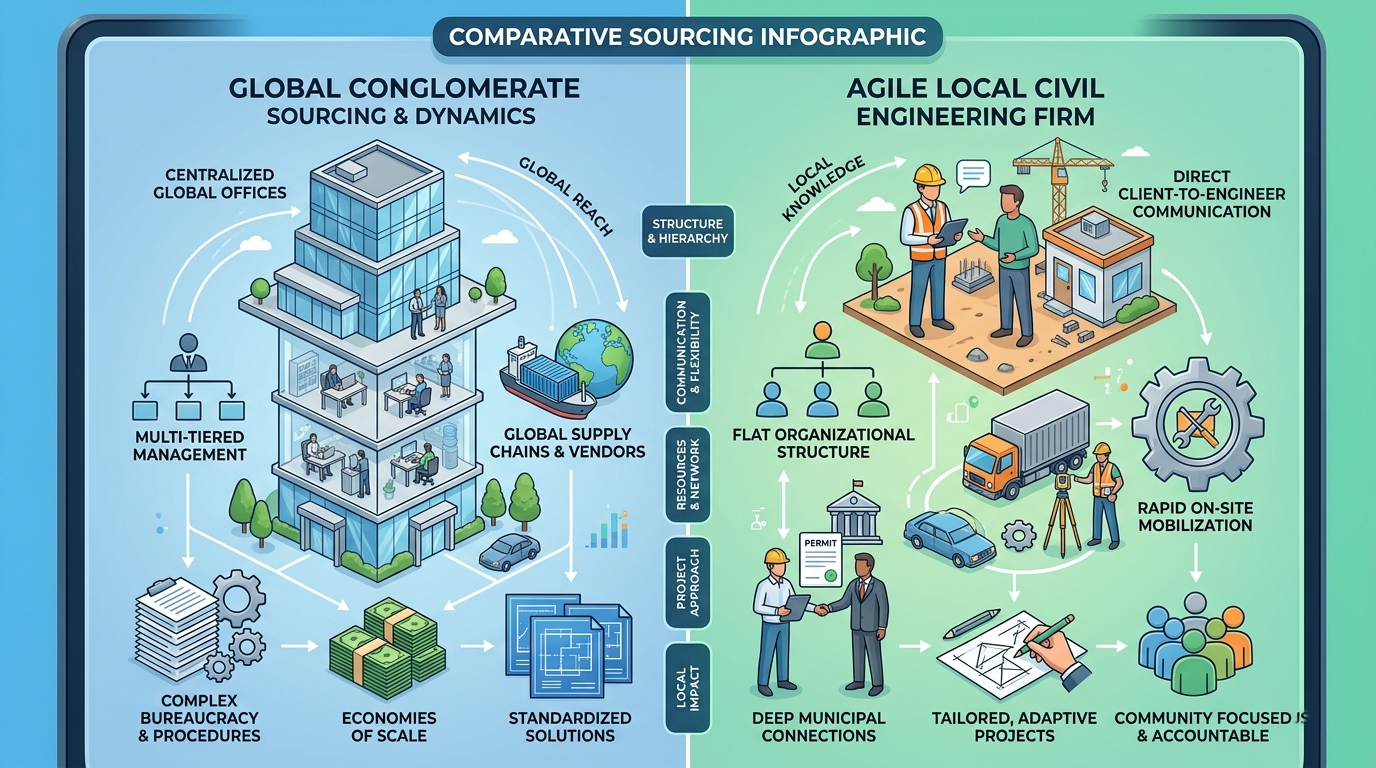
While multinational conglomerates manage massive global programs , they are often structurally misaligned with the localized execution requirements of small-to-medium residential, commercial, and municipal developments. For regional projects, boutique civil engineering companies offer a combination of specialized land-use expertise, direct principal-level communication, and high operational agility.
Comparative Analysis: Boutique Regional Firms Versus Global Conglomerates
To optimize procurement strategies, developers must contrast the operational mechanics of regional firms with those of global engineering corporations. Multinational engineering firms bring vast capital resources but often suffer from bureaucratic friction, elevated overhead margins, and a transactional relationship with local regulatory agencies. Conversely, boutique firms thrive on localized expertise, rapid mobilization, and direct collaboration.
These structural differences directly influence project speed, design relevance, and overall execution safety.
| Operational Parameter | Boutique Regional Firms (e.g., Muller Engineering) | Global Conglomerates (e.g., Bechtel, KBR) |
| Operational Agility & Lead Times | High; decisions are made locally with minimal management tiers, reducing engineering turnaround times. | Low; multi-layered corporate approvals introduce communication bottlenecks and project delays. |
| Local Permitting & Agency Relations | Deep, historical relationships with local municipal boards, county regulators, and site inspectors. | Transactional; limited experience with specific township boards or local utility providers. |
| Employee Engagement Metrics | High; average of 42% employee engagement in firms with 10 or fewer staff, fostering design innovation. | Lower; average of 30% employee engagement in large-scale corporate structures. |
| Overhead and Pricing Structures | Competitive billing rates due to lower corporate overhead and localized delivery networks. | High billing rates driven by extensive corporate infrastructure and shareholder return demands. |
| Design Customization Capability | High flexibility to design bespoke components or adapt rapidly to site-specific changes. | Standardized engineering templates; lower tolerance for adopting non-standard project risks. |
Core Operational Benefits of Localized Civil Engineering Sourcing
Land-Use Knowledge and Permit Navigation
The success of any structural development is rooted in the engineering team’s understanding of regional land-use policies, soil mechanics, and local environmental hydrology. Local civil engineers possess historical data regarding regional soil bearing capacities, groundwater tables, and seismic activity. This localized familiarity ensures that foundation and earthworks designs are neither under-engineered, which risks structural failure, nor excessively over-engineered, which inflates material costs.
Furthermore, local firms understand the unwritten nuances of municipal planning departments. They are adept at preparing site plans that align with specific county or council expectations, leading to accelerated approval timelines and fewer request-for-information (RFI) cycles during the permitting phase.
Turnaround Speed and Operational Agility
Distance introduces project delays. When unforeseen site conditions arise—such as the discovery of unmapped utility lines or unexpected subgrade instability—having an engineering partner close to the site minimizes project downtime. Local engineers can execute immediate site visits, perform on-the-spot assessments, and issue revised, stamped drawings within hours, whereas national suppliers often operate on multi-day response cycles.
Corporate Social Responsibility and Regional Economic Growth
Procuring engineering services locally aligns with Corporate Social Responsibility (CSR) and Environmental, Social, and Governance (ESG) procurement frameworks. Sourcing local talent keeps project capital within the community, supports regional employment, and minimizes the carbon footprint associated with excessive site-travel logistics.
The Intersecting Lifelines: Civil Engineering and MEP Collaboration
An infrastructure asset cannot function as an isolated structural shell. The structural and site-civil designs executed by civil engineers must integrate with the mechanical, electrical, and plumbing (MEP) systems designed to keep the building habitable and functional.
Civil engineers design the structural framing, concrete slabs, load-bearing walls, and external utility connections. MEP engineers design the HVAC distribution, power layouts, lighting plans, and sanitary sewer configurations. If these two disciplines operate in silos, major coordination failures occur, such as wet services clashing with load-bearing structural beams, or HVAC ductwork exceeding the physical dimensions of the structural ceiling plenum.
To eliminate these structural-MEP conflicts, progressive developers utilize comprehensive(https://engrteam.com/mep-plan-services/) right from the early planning phases. This guarantees that horizontal and vertical utility spaces are systematically allocated within the structural envelope before any construction begins.
& Clash Prevention
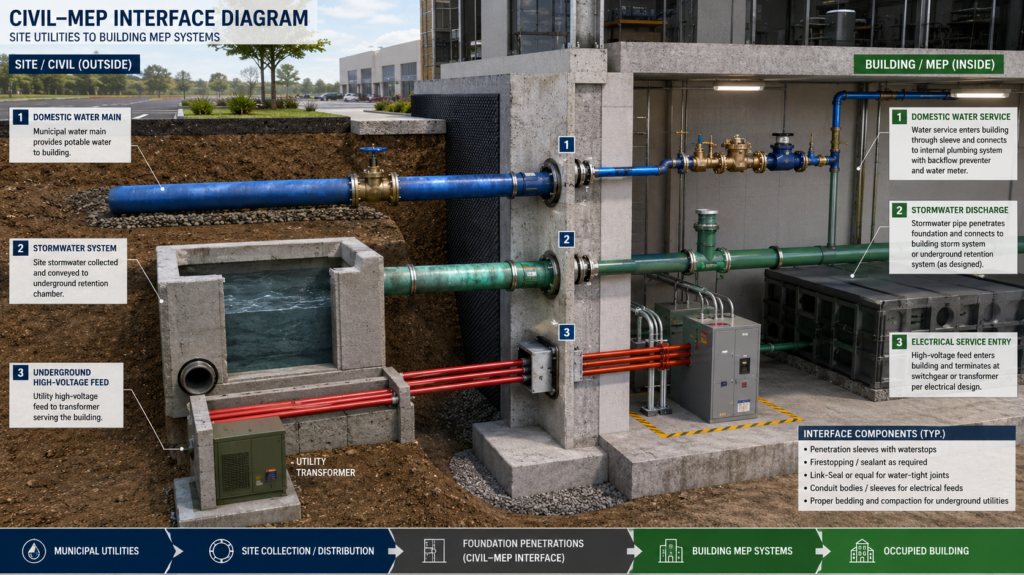
External site works also require deep coordination between civil and MEP designs. Civil engineers plan the roadways, parking lots, and site grading, while MEP engineers design the external water supply lines, storm drainage systems, sewage networks, and incoming electrical connections. Integrating these systems early via meticulous site plan utility coordination prevents trenching conflicts, utility damage, and failed municipal inspections.
To support these complex digital structures, civil designers integrate specialized(https://engrteam.com/hvac-system-design-services/) to ensure that massive duct networks, air handling units, and chiller layouts are spatially coordinated within the project workspace. Simultaneously, the deployment of(https://engrteam.com/electrical-engineering-services/) prevents high-voltage cable runs from clashing with plumbing risers or fire protection piping.
Technological Advancements in Site Planning and Utility Coordination
Historically, small civil engineering companies struggled to compete with the technology suites of global conglomerates. Today, cloud-enabled Building Information Modeling (BIM) has leveled the playing field, allowing regional boutiques to execute highly complex, collaborative designs.
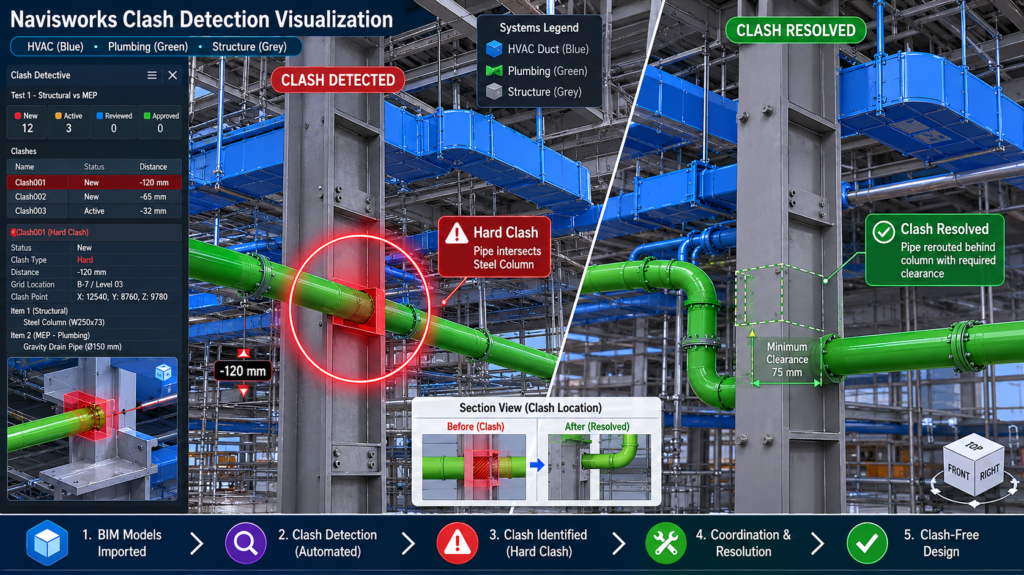
By utilizing BIM software such as Autodesk Revit and Navisworks, small firms can aggregate architectural, structural, and MEP designs into a unified, federated digital model. This virtual environment allows automated algorithms to detect physical clashes before ground is broken on-site.
The Financial Returns of Automated Coordination
In modern construction, resolving a conflict on-site during framing or rough-in can cost ten times more than resolving it digitally during the design phase. Integrating multidisciplinary engineering disciplines yields high financial returns.
The economic returns of digital clash resolution are illustrated by the following financial return formula :
This analysis demonstrates that a modern, software-driven approach to coordination prevents major on-site rework, keeps projects on schedule, and eliminates unexpected change orders.
| Clash Severity | System Conflict Example | Resolution Method | Risk Level |
| Critical | Heavy HVAC duct clashing with structural concrete foundation beams. | Duct routing modified or beam penetrations engineered during design. | High; threatens structural integrity if unresolved. |
| Major | Pressurized plumbing lines intersecting high-voltage electrical cable trays. | Rerouting plumbing routes or relocating electrical trays to maintain clearance. | Medium; poses safety hazards and maintenance blocks. |
| Minor | Cosmetic ceiling finishes clashing with access panels or lighting fixtures. | Adjusting interior architectural layout to accommodate access requirements. | Low; resolves via minor aesthetic field changes. |
Overcoming Boutique Constraints through Engineering Outsourcing
While local civil firms offer site knowledge, they often operate with limited in-house MEP capacity or struggle with resource bottlenecks during peak backlogs. Strategic outsourcing of CAD and BIM tasks allows boutique firms to operate with the capacity of a global corporation.
Operating on a 24-Hour Design Cycle
By partnering with offshore engineering service providers, a regional firm can implement a 24-hour design cycle. While the local team is offline, remote teams draft layouts, update revisions, and execute clash detections, ensuring next-day delivery of refined drawings. This outsourcing strategy also gives small firms access to advanced modeling tools (e.g., Revit, EnergyPro, Dialux, HAP, AGI-32) without substantial upfront software capital.
Crucially, offshore partners adhere to strict data security frameworks and ensure code compliance across international borders, including the International Building Code (IBC), International Plumbing Code (IPC), and standards of ASHRAE, NFPA, SMACNA, and ANSI.
A Strategic Procurement Framework for Sourcing Local Civil Engineering Firms
When selecting an engineering partner, project developers should use a structured qualification process rather than relying on cost bids alone. The lowest-priced proposal often translates to vague plans, which can lead to inflated contractor bids and expensive field change orders.
The following selection framework outlines the key verification steps required when sourcing a local civil engineering firm:
1. RFQ and Technical Requirements
- Objective: Evaluate technical capabilities, historical performance, and staffing capacities.
- Verification Actions: Request a detailed breakdown of estimated staff hours, CVs of primary engineers, and a list of comparable completed projects.
2. Land-Use and Environmental Competence
- Objective: Ensure the firm understands localized geological, zoning, and environmental constraints.
- Verification Actions: Review the firm’s historical record of navigating local conservation boards, flood plains, and regional soil settlement issues.
3. Credential and Reference Audits
- Objective: Authenticate professional standing and past client satisfaction.
- Verification Actions: Request direct references from municipal planning boards, regional utility coordinators, and past private developers.
4. Insurance and Liability Verification
- Objective: Protect the project owner from structural liability and design-error risks.
- Verification Actions: Verify Professional Indemnity/Errors and Omissions (E&O) insurance directly with the issuing carrier to confirm coverage limits meet the project’s scale.
5. Quality Control and BIM Standards
- Objective: Ensure design precision to minimize field-rework expenses.
- Verification Actions: Inquire about internal quality control policies, clash detection workflows, and familiarity with collaborative BIM execution protocols.
6. Communication Protocols
- Objective: Set clear service level agreements (SLAs) for design turnarounds and on-site troubleshooting.
- Verification Actions: Define response time expectations for RFIs, emails, and phone calls to ensure clear communication during active construction phases.
Why is a local civil engineering firm preferable to a global conglomerate for property developments?
Local firms possess specialized knowledge of regional geology, local utility networks, and municipal zoning regulations. They maintain direct relationships with local code inspectors and utility coordinators, which helps accelerate the permitting and site-approval process. Additionally, local firms are highly agile, providing faster on-site response times and principal-level engagement.
How can a small civil engineering company manage complex MEP engineering requirements?
Small civil firms can scale their technical offerings by partnering with professional, outsourced MEP engineering service providers. This approach allows them to deliver coordinated mechanical, electrical, plumbing, and fire protection systems that integrate with their structural designs without expanding their full-time payroll.
How does digital clash detection in BIM save money on regional construction projects?
Digital clash detection locates physical conflicts—such as a structural beam clashing with an HVAC duct—within a 3D Revit model before construction starts. Resolving these issues digitally during design is significantly cheaper than modifying completed structural frameworks or routing ductwork around unexpected blockages in the field.
What standard building codes must small civil and MEP engineering firms adhere to?
In the US, designs must comply with the International Building Code (IBC) and International Plumbing Code (IPC). MEP services must also follow ASHRAE standards for energy efficiency and indoor air quality, the National Electrical Code (NEC/NFPA 70), and NFPA fire safety standards. Equivalent national standards (such as BS in the UK and AS in Australia) apply in other regional jurisdictions.
Why is site plan utility coordination critical during the early conceptual design phase?
Early utility coordination ensures that external systems, such as stormwater management, sewer connections, and incoming electrical grids, are aligned with the grading and pavement plans designed by civil engineers. This early planning prevents conflicts with existing underground utilities, avoids failed inspections, and eliminates expensive utility relocations during the construction phase.