

Articles
How to Hire MEP Engineer Professionals for Capital Construction Projects

In the contemporary construction sector how to Hire MEP Engineer, structural integrity and aesthetic quality are insufficient to guarantee a
Table of Contents
In the contemporary construction sector how to Hire MEP Engineer, structural integrity and aesthetic quality are insufficient to guarantee a building’s commercial or operational viability. Modern structures depend heavily on their internal systems, which function as the central nervous system of any facility. Mechanical, Electrical, and Plumbing (MEP) systems bring physical structures to life, regulating thermal environments, managing power grids, supplying potable water, and ensuring public health and safety. For developers, general contractors, and corporate capital allocators, the decision to hire MEP engineer specialists is one of the most critical determinants of a project’s financial and functional performance.
With modern commercial developments requiring unprecedented levels of digital coordination, carbon-neutral tracking, and system complexity, selecting the appropriate engineering partner directly impacts both upfront capital expenditures and long-term facility lifecycle costs. To address these multidimensional requirements, project developers often leverage professional MEP plan services during pre-construction to establish a comprehensive blueprint for system integration. A detailed analysis of the modern engineering landscape reveals how strategic technical placements, cutting-edge software workflows, and structured vetting practices prevent project failure, minimize change orders, and maximize asset value.
The Essential Role of MEP Engineering and how to Hire MEP Engineer
Capital construction projects operate in a highly regulated and technically demanding environment. Historically, the installation of mechanical, electrical, and plumbing infrastructure was treated as secondary to architectural and structural planning. However, in modern construction, systems integration must occur during the conceptual design phase. Without well-designed MEP systems, modern facilities would remain non-functional.
Defining the Core Mechanical, Electrical, and Plumbing Pillars
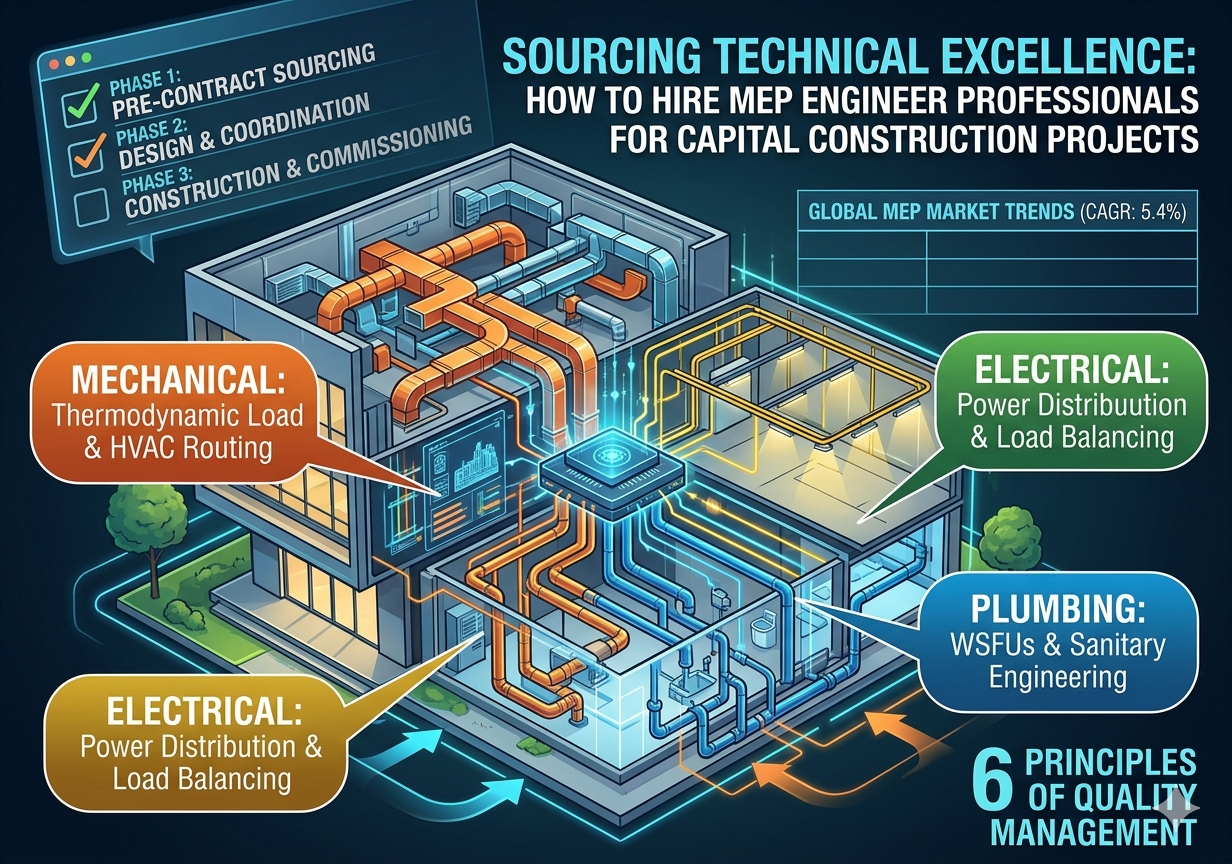
The scope of MEP engineering is divided into three highly specialized yet interdependent disciplines :
- Mechanical Engineering: This discipline governs human comfort, indoor air quality, and thermal regulation. Mechanical designers plan, specify, and optimize heating, ventilation, and air conditioning (HVAC) systems. Their responsibilities include thermodynamic load calculations, ductwork routing, mechanical room layouts, and the integration of energy-recovery ventilation systems to balance building pressurization and reduce energy consumption.
- Electrical Engineering: Electrical designers develop safe, scalable, and code-compliant power distribution systems. Their work covers main electrical service entries, high-voltage transforming systems, secondary distribution panels, emergency backup generators, Uninterruptible Power Supplies (UPS), indoor and outdoor architectural lighting, and safety systems such as fire alarms and access control systems.
- Plumbing Engineering: Plumbing designers design efficient water delivery, drainage, gas piping, and sanitation systems. Their work includes potable cold and hot water lines, stormwater management, sanitary drainage, backflow prevention, and fire suppression systems. These plans prevent water contamination, structural moisture damage, and premature pipe corrosion.
Engineering the Central Nervous System of Modern Infrastructure
The combination of these three engineering disciplines creates a cohesive operational ecosystem. For example, a commercial HVAC chiller requires a dedicated electrical power supply, chemical water treatment from the plumbing grid, and digital connection to a central Building Automation System (BAS). A failure in any individual system can trigger failures across others, illustrating why developers benefit from hiring comprehensive MEP consulting teams rather than coordinating separate, isolated designers.
Global Market Trends and the 2026 Turning Point
The global market for MEP services is expanding due to increasing building complexity, urbanization, and a global focus on sustainable building practices. Valued at US $810.2 Million in 2024, the global MEP services market is projected to reach US $1.1 Billion by 2030, representing a compound annual growth rate (CAGR) of 5.4%.
Global MEP Services Market Valuation and Segments
The distribution of market growth and valuation across regions and end-use sectors highlights the scale of this industry.
| Market Segment | 2024 Valuation (US $) | 2030 Projection (US $) | Projected CAGR (2024–2030) |
| Global Overall Market | $810.2 Million | $1.1 Billion | 5.4% |
| United States National Market | $223.7 Million | Not Disclosed | Positive Growth |
| China National Market | Not Disclosed | $175.1 Million | 5.1% |
| Commercial End-Use Segment | Not Disclosed | $408.6 Million | 6.2% |
| Residential End-Use Segment | Not Disclosed | Not Disclosed | 5.0% |
Rising Material Costs and the Low-Hire Low-Fire Labor Market
The construction and engineering industries face economic challenges. Rising raw material costs, particularly for structural steel and copper, have put pressure on project budgets. At the same time, the engineering workforce operates in a “low-hire, low-fire” environment.
Firms are retaining their existing technical staff but find it difficult to scale their design teams internally due to labor shortages. This talent constraint has driven many architectural and engineering firms to outsource MEP design to dedicated external teams that can scale up quickly to meet project deadlines.
Environmental Regulations and Smart Building Integration
Environmental policies are also reshaping standard design practices. State and local regulations, such as California’s Title 24 energy efficiency mandates, require designers to perform highly detailed energy modeling before a project is approved.
At the same time, HVAC systems are transitioning toward low-global-warming-potential (GWP) A2L refrigerants. This transition requires custom-engineered mechanical rooms to comply with updated safety and ventilation standards.
Additionally, modern high-performance buildings are increasingly designed with integrated smart technologies. IoT sensor networks, smart electrical panels with dynamic load management, and electric vehicle (EV) charging stations require advanced coordination during the electrical design phase.
Another critical challenge is the rising risk of cybersecurity vulnerabilities in connected building systems. Because modern HVAC and building automation systems (BMS) are connected to local networks and the cloud, unsecured control loops can expose properties to unauthorized digital access.
Consequently, modern MEP engineers must design systems that protect these digital connections and defend against potential cyber threats.
Financial Modeling: In-House Versus Outsourced Engineering
For developers and project owners, deciding whether to maintain an in-house engineering team or outsource design to an external consultancy requires a thorough cost-benefit analysis. This comparison must account for recruitment costs, baseline salaries, benefits, and specialized software overhead.
Direct and Indirect Overhead Sourcing Analysis
The financial commitment required to support full-time design personnel varies by experience and software needs.
| Staffing and Overhead Category | In-House Engineering Roster (Direct Hire) | Outsourced Professional MEP Firm |
| Average Salary Range | Junior: $62k–$75k; Mid-level: $75k–$90k; Senior: $90k–$115k | None (Replaced by project-based deliverables) |
| Benefits & Payroll Tax Overhead | 25% to 30% addition to base salary ($24k to $36k per senior engineer) | None |
| Specialized Software Licensing | Revit, AutoCAD, HAP, TRACE, ETAP ($3,000 to $6,000 per user seat annually) | Absorbed within the consulting firm’s operational overhead |
| Workforce Scalability | Rigid; high financial carrying cost during construction downtime | Elastic; scale up or down based on variable project pipelines |
| Liability & Design Insurance | Internal Professional Liability (E&O) premiums paid directly by the firm | Covered by the outsourced engineering firm’s corporate E&O insurance |
Maintaining a full-time, in-house team is often most viable for enterprise-level developers with a steady, continuous pipeline of complex projects. However, for small to mid-sized firms facing fluctuating project volumes, outsourcing to a dedicated consultancy offers a more flexible model. This approach converts high fixed payroll expenses into variable project-specific costs, helping to insulate developers from market downturns.
Contractual Pricing Structures and Sizing-Based Fee Metrics
Consulting engineering firms offer several distinct commercial fee structures. Understanding these options helps developers align contract terms with overall project risks.
- Percentage of Construction Cost: Fees are calculated as a set percentage, typically ranging from 5% to 15% of the total construction budget. This model is common for high-profile public, commercial, or institutional developments, such as hospitals or municipal centers, where the scope of work is likely to evolve.
- Square Footage Charging Rate: A widely used method where pricing is based on building size. For standard commercial and residential builds, this fee typically ranges from $0.50 to $3.00 per square foot. For highly complex developments like laboratories, medical clinics, or clean-room facilities, rates are adjusted upward to reflect the added density of the systems.
- Fixed/Flat Project Fee: This model is highly favored by developers seeking cost predictability. The engineering consultant provides a firm flat price for the entire scope of work, based on an initial review of the architectural plans and specifications. This model is best suited for projects with well-defined parameters, such as commercial tenant fit-outs or retail rollouts.
- Hourly Consulting Rates: Fees are billed based on actual hours worked. Typical hourly rates run from $75 per hour for design engineers to $150+ per hour for principal engineers. This pay-as-you-go approach is typically used for early feasibility studies, peer reviews, forensic investigations, and troubleshooting operational system failures.
Strategic Technical Execution and Design Integrity
Hiring a professional MEP engineer is critical because their decisions directly impact the physical performance and occupant comfort of a building. A detailed design prevents system failures, helps manage operational costs, and ensures long-term building performance.
Mechanical Design and Sensible Thermal Loads
To govern these interactions, mechanical designers draft a precise HVAC layout plan that coordinates thermodynamic calculations with spatial structural clearances. Mechanical engineers determine precise sizing calculations based on local climate data, building orientation, envelope insulation performance, and interior occupant loads.
The calculations for sensible thermal heat transfer are based on established thermodynamic principles:
Formula:
Q = 1.08 × CFM × ΔT
In this equation, Q represents the sensible heat transfer rate, measured in British Thermal Units (BTU) per hour. CFM represents the volumetric airflow rate in cubic feet per minute, and ΔT represents the temperature difference between the incoming supply air and the target indoor ambient temperature, measured in degrees Fahrenheit (°F).
Accurate calculations prevent the issues associated with oversized systems—such as short-cycling and poor humidity control—and ensure indoor air quality remains high.
Electrical Load Balancing and Distribution Infrastructure
Electrical engineers design the power infrastructure to safely handle demand while preventing overloading. The calculation of active electric power in a balanced three-phase industrial or commercial system is determined by the following formula:
Formula:
P = √3 × V × I × cos(θ)
In this equation, P represents active power in watts (W), V represents line-to-line voltage in volts (V), I represents line current in amperes (A), and cos(θ) represents the dimensionless power factor of the system. The symbol θ represents the phase angle between the voltage and current waveforms.
Applying these mathematical models ensures that main service panels, secondary distribution feeders, and branch circuiting are sized appropriately. This sizing prevents voltage drops, eliminates fire risks, and ensures clean power delivery to sensitive electronic systems.
Plumbing Hydraulics and Sanitary Engineering
Plumbing engineering involves managing fluid dynamics to ensure safe water supply and sanitation. Designers calculate water supply fixture units (WSFUs) and plumbing fixture units (PFUs) to determine the appropriate sizes for water distribution and drainage piping.
These calculations follow codes like the International Plumbing Code (IPC) and the Uniform Plumbing Code (UPC) to prevent system friction losses, maintain correct water pressures, and ensure wastewater is drained efficiently without contaminating clean water supplies.
Advanced Digital Coordination and Model-Driven Prefabrication
Modern construction projects are moving away from traditional two-dimensional drawings in favor of three-dimensional virtual coordination. To optimize spatial coordination and eliminate physical overlaps before construction, modern workflows leverage advanced(https://engrteam.com/bim-services/) to generate detailed virtual environments.
Virtual Design Coordination and AI-Driven Clash Detection
Historically, spatial conflicts between large HVAC ducts, gravity-fed plumbing lines, and structural steel beams were only discovered during on-site installation. These field conflicts required immediate work stoppages, redesigns, and expensive change orders.
Today, Virtual Design and Construction (VDC) workflows coordinate three-dimensional models to a high Level of Detail (LOD 350 to LOD 400). In these environments, components are modeled with precise manufacturing dimensions, including maintenance access clearances and structural hanger locations.
Key Digital Workflows in Modern Construction Projects
The adoption of digital modeling workflows significantly improves coordination and construction efficiency.
| Digital Workflow | Core Technology & Deliverables | Primary Project Benefit |
| BIM / VDC Coordination | Autodesk Revit MEP, Navisworks, detailed 3D federated models | Unifies architectural, structural, and building systems designs in a single, coordinate-aligned file. |
| AI Clash Detection | Cloud-based automated conflict checking, group clustering, risk evaluation | Automatically identifies spatial conflicts, grouping similar clashes to accelerate the design-review phase. |
| LOD 400 Prefabrication | Model-driven fabrication spools, modular rack layouts, off-site construction files | Allows mechanical corridor racks, pump skids, and piping assemblies to be built off-site in controlled conditions. |
| Digital Twin Realization | As-built laser scans, point-cloud-to-BIM modeling, COBie data delivery | Delivers a data-rich visual dashboard to facility teams, streamlining ongoing maintenance and operation. |
This digital coordination process is enhanced by AI-assisted clash detection, which automatically identifies and groups spatial conflicts within the virtual model. Instead of manually reviewing thousands of minor clashes, design teams can focus on high-priority issues, significantly accelerating pre-construction timelines.
Lifecycle Management and Digital Twin Realization
In addition to streamlining construction, data-rich BIM files play a key role in ongoing building operations. Using laser scanning, as-built systems are scanned on-site, and the data is integrated back into the virtual model. This coordinated model can then be delivered to facility operators as a functional digital twin.
By clicking on a component in the 3D dashboard—such as an electrical panel or a water pump—maintenance teams can instantly access equipment specifications, installation dates, service history, and operating manuals. This visual coordination approach reduces equipment downtime, lowers ongoing maintenance costs, and extends the overall lifecycle of the building’s physical systems.
Vetting and Interviewing Framework for Project Owners
Sourcing and vetting an engineering partner requires a structured evaluation framework. When interviewing MEP engineering firms, project owners should focus on the specific experience, workflows, and quality control procedures of the team members who will actually design the project.
Eliminating the Bait-and-Switch Risk
A common issue in engineering procurement is the “bait-and-switch” proposal team. In this scenario, client-facing executives and senior marketing directors represent the firm during initial interviews, but the actual design work is later handed off to junior, unvetted staff.
To prevent this, project owners should require the proposed project manager and lead engineers from each discipline to attend all design interviews. The contract should also list these key staff members by name and define their direct involvement in the project’s milestones.
Systematizing Quality Management and Verification Protocols
To verify an engineering firm’s commitment to quality control, project owners should ask for documented proof of their quality management processes. A reliable quality program begins at the proposal stage and continues through construction administration.
Firms like Williams Notaro (WNA), for instance, use structured quality control procedures, specialized design manuals, and CAD user guides to ensure consistent design delivery. Their team meets 35 to 40 times per year specifically to review quality control standards and update their internal design guidelines. WNA’s quality framework is based on six core principles designed to protect the client’s interests and deliver clean, buildable plans.
The Six Principles of Quality Management
- Uphold the Client’s Best Interests: Analyze design decisions from multiple angles to control costs, ensure constructability, and meet the end user’s operational needs.
- Be Responsive and Available: Commit to fast response times and actively coordinate with other design disciplines to keep construction on schedule.
- Value Every Team Member: Maintain regular communication with all design consultants to maximize team efficiency.
- Communicate Effectively: Keep communication clear and practical, ensuring all technical requirements are easily understood by all project participants.
- Manage Every Project Equally: Apply the same level of attention, precision, and care to every project, regardless of its overall size or budget.
- Never Settle for “Good Enough”: Strive for high standards and refuse to accept compromises that could negatively impact the client’s long-term interests.
Furthermore, project owners should verify if the engineering firm conducts thorough site visits during the design phase. For renovation or retrofit projects, engineers should physically check above-ceiling spaces and verify existing conditions rather than relying solely on older, potentially inaccurate as-built drawings.
Another red flag to watch out for is the use of generic, boilerplate details and specifications. Non-specific, boilerplate details confuse contractors, increase field inquiries, and often lead to improperly installed systems.
Tactical Scenario-Based Technical Testing
To evaluate an engineer’s design depth and problem-solving skills, hiring managers should present scenario-based questions during the interview process.
- Scenario A (Mechanical System Sizing): Ask the candidate to explain how they determine mechanical load sizes and what steps they take to prevent system over-sizing. The candidate’s response should describe their process for calculating sensible heat transfer rates, utilizing thermodynamic software like HAP or TRACE, and coordinating with the architect to optimize the building envelope’s thermal performance.
- Scenario B (Electrical Design & Safety): Ask the candidate to explain the physical difference between grounding and earthing, and how they size secondary distribution breakers for high-demand commercial loads. The candidate’s response should detail the use of three-phase power formulas and reference NEC load-balancing and safety standards to prevent electrical faults.
- Scenario C (Plumbing & Sanitation): Ask the candidate how they calculate sanitary drainage piping sizes and waste disposal requirements for high-density multi-family or office buildings. The candidate should reference the International Plumbing Code, describe plumbing fixture unit (PFU) load calculations, and explain how pipe slope and diameter are coordinated to ensure safe drainage and prevent system blockages.
Technical Standards, Codes, and Performance Metrics
Sourcing an MEP engineering partner requires validating their technical knowledge against standard industry codes. To support code compliance and simplify permitting, engineers must adhere to recognized national and international guidelines.
Baseline Technical Sizing and Industry Codes
Different engineering disciplines follow specialized codes and software programs to calculate system capacities.
| Design Parameter | Reference Technical Code | Primary Design Software | Sizing Method / Formula |
| HVAC Design | ASHRAE Standard 90.1 / Standard 62.1 | HAP, Trane TRACE 3D, Revit MEP | Thermodynamic load calculations based on outdoor ambient climate, occupant density, and building envelope |
| Electrical Safety | NFPA 70 / National Electrical Code (NEC) | ETAP, AutoCAD MEP, Revit | Three-phase power calculations to size main service entrance, backup power, and branch circuit protections |
| Sanitary & Drainage | International Plumbing Code (IPC) / UPC | Revit MEP, custom hydraulic spreadsheets | Pipe sizing based on total plumbing fixture units (PFUs) to ensure safe gravity drainage velocities |
| Fire Protection | NFPA 13 (Sprinklers) / NFPA 72 (Alarms) | Sprinkler CAD, Revit MEP | Hydraulic calculations of water flow and pressure requirements based on building hazard classifications |
| Energy Compliance | IECC / CA Title 24 | EnergyPro, eQuest | Comprehensive energy modeling and daylighting analysis to verify compliance with local green building codes |
Sourcing and Implementation Checklist for Project Owners
To maximize the performance, safety, and financial returns of a construction project, project owners should adopt a systematic approach to sourcing and managing their MEP engineering partners. This structured checklist outlines key milestones from early planning through system commissioning.
Phase 1: Pre-Contract Sourcing and Strategy
- Establish Detailed Project Requirements: Clearly define the project’s physical and environmental parameters, including target green certifications (LEED or Net-Zero), specific smart building features, and localized municipal code requirements.
- Conduct In-Depth Portfolio Reviews: Request and review detailed portfolios of similar projects completed by the prospective MEP firm within the past three to five years. Ensure the scale, complexity, and sector (e.g., healthcare, multi-family, or laboratory) align with the proposed build.
- Verify Professional Credentials: Confirm active, state-specific Professional Engineering (PE) licensures for all lead designers assigned to the project.
- Perform Contractor Reference Checks: Speak directly with mechanical, electrical, and plumbing contractors who have built from the engineer’s previous drawings. Verify that the designs are constructible, accurate, and free of chronic coordination errors.
Phase 2: Design and Coordination Phase
- Integrate the MEP Team Early: Engage the selected MEP engineering firm during the initial schematic design phase alongside the architect. This early involvement helps identify and prevent spatial coordination issues before the building footprint is finalized.
- Enforce Strict BIM Coordination Standards: Require the design team to use advanced BIM platforms like Revit and Navisworks, and mandate regular virtual coordination meetings to resolve physical conflicts early.
- Define Code Compliance Paths: Ensure the design team maps out compliance strategies for relevant energy codes (such as IECC or Title 24) and environmental regulations early in the design process.
- Review Design Milestones: Schedule structured design reviews at key milestones (e.g., 30%, 60%, and 90% completion) to verify that systems are properly integrated and align with the project budget.
Phase 3: Construction and Commissioning Oversight
- Include Comprehensive Construction Administration: Ensure the engineer’s scope of work covers active Construction Administration (CA) services, including submittal reviews, on-site progress inspections, and quick responses to contractor RFIs.
- Establish RFI and Submittal Timelines: Contractually mandate standard response windows, such as requiring RFI responses within 24 hours and submittal reviews within 5 business days, to keep construction moving forward smoothly.
- Verify Installation Quality: Ensure engineers perform regular site visits during construction to verify that systems are being installed in accordance with the approved drawings and specifications.
- Execute System Commissioning: Require independent commissioning of all major systems (HVAC, electrical panels, and emergency generators) to confirm they operate efficiently and safely before the building is occupied.
When is the best time to involve an MEP engineer in a construction project?
It is highly recommended to engage an MEP engineering firm during the initial schematic design phase alongside the architect. Early involvement allows the engineering team to optimize system layouts, coordinate space requirements, and identify potential coordination issues before the building footprint is finalized. This proactive integration prevents costly structural design changes and reduces the risk of construction delays and unexpected budget increases.
What are the primary cost differences between hiring in-house engineers and outsourcing?
Hiring full-time, in-house engineers requires significant overhead beyond baseline salaries (which typically range from $62,000 to $115,000 depending on seniority). Employers must also factor in benefits and payroll taxes (adding 25% to 30% or roughly $24,000 to $36,000 per senior engineer) as well as specialized software licenses. Outsourcing to an external MEP firm eliminates these fixed carrying costs and allows project owners to pay strictly for project-based deliverables, scaling engineering capacity up or down dynamically as project demands change.
How do MEP consultants structure their service fees?
MEP firms typically offer several billing models to match different project scales and risk levels :
Fixed/Flat Project Fee: Provides locked-in cost predictability for well-defined projects.
Square Footage Charging Rate: Billed based on building size, often ranging from $0.50 to $3.00 per square foot for standard residential and commercial spaces.
Percentage of Construction Cost: Commonly used for large-scale or complex public projects, where fees represent 5% to 15% of the total construction budget.
Hourly Consulting Rates: Billed according to actual hours worked, typically ranging from $75 per hour for design engineers to $150+ per hour for principal engineers.
How does BIM technology prevent construction errors and change orders?
Building Information Modeling (BIM) platforms like Revit MEP generate detailed, multi-trade 3D virtual models. This allows virtual coordination teams to run automated, AI-assisted clash detection, revealing spatial conflicts—such as a plumbing line crossing a major HVAC duct or structural steel beam—during the design phase rather than in the field. These models also support off-site modular prefabrication (LOD 400), which speeds up on-site installation, enhances accuracy, and minimizes expensive field-level rework.