

Articles
Understanding the Core Roles: Difference Between HVAC Designer and MEP Engineer

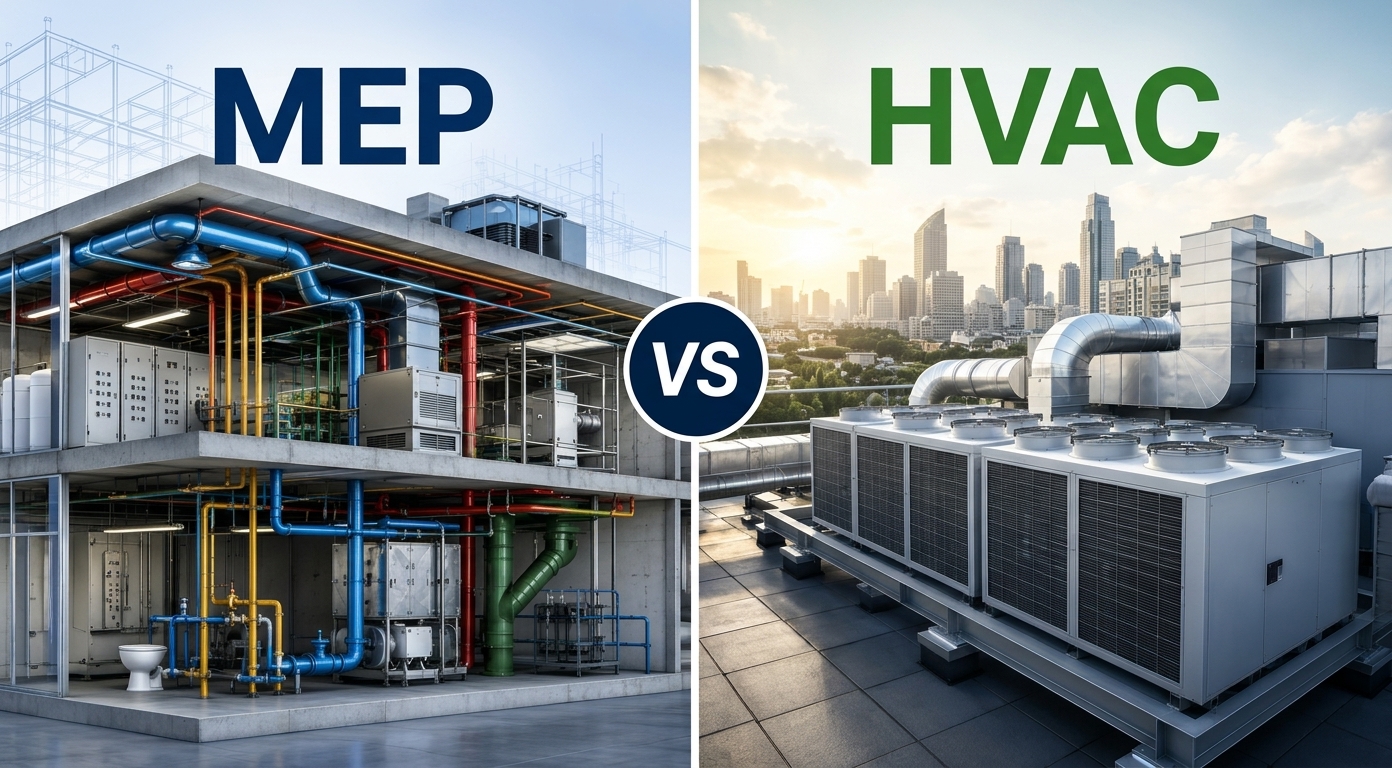
Parameter HVAC Designer MEP Engineer Primary Focus Thermal comfort, ventilation, and climate control systems Complete building services (Mechanical, Electrical, Plumbing)
Table of Contents
Difference between hvac designer and mep engineer distinctions dictate how modern commercial, industrial, and residential buildings are conceptualized, engineered, and executed. In the architecture, engineering, and construction (AEC) industry, clients and developers often use terms like “HVAC designer” and “MEP engineer” interchangeably. However, while both professionals work within the broader building services sector, their scope of work, technical responsibilities, licensing requirements, and engineering depth differ significantly.
This comprehensive guide breaks down the precise roles, educational backgrounds, software ecosystems, and project responsibilities that define each profession, helping you understand how they collaborate to deliver high-performance buildings.
1. Introduction to Building Systems and Engineering Specializations
Modern buildings are complex ecosystems requiring intricate networks of climate control, electrical power, lighting, plumbing, and fire safety. Designing these systems requires specialized engineering expertise.
When a construction project moves past the architectural schematic phase, technical consultants must translate architectural forms into functional, safe, and energy-efficient spaces. Within this multidisciplinary environment, specialized designers focus on specific thermodynamic and ventilation challenges, whereas comprehensive engineers oversee the entire building services infrastructure. To appreciate how these roles intersect, exploring professional MEP plan services
provides valuable context on how multi-disciplinary teams coordinate complex building packages.
2. Exploring the Fundamental Difference Between HVAC Designer and MEP Engineer
To understand the core difference between hvac designer and mep engineer, one must examine their scope of specialization versus their holistic oversight.
An HVAC designer is a domain specialist whose primary focus is thermal comfort, indoor air quality (IAQ), heating, ventilation, and air conditioning equipment sizing, and ductwork/piping distribution. Conversely, an MEP engineer is a broader professional who oversees Mechanical, Electrical, and Plumbing engineering disciplines simultaneously. While an MEP engineer may design HVAC systems, they are also legally and technically responsible for power distribution, lighting design, domestic water supply, sanitary drainage, fire protection, and inter-disciplinary clash coordination across the entire building.
3. What is an HVAC Designer? Roles, Responsibilities, and Expertise
An HVAC (Heating, Ventilation, and Air Conditioning) designer specializes exclusively in the thermal and atmospheric performance of a building. Their goal is to ensure occupants experience optimal temperature, humidity, and fresh air exchange while maintaining energy efficiency.
Scope of Work for HVAC Designers
- Thermal Load Calculations: Performing Manual J, Manual S, and Manual D calculations or utilizing advanced simulation software (such as Trane Trace 3D or Carrier HAP) to determine exact heating and cooling loads based on local climate data, building envelope insulation, solar heat gain, and occupancy profiles.
- Equipment Selection: Sizing chillers, boilers, air handling units (AHUs), fan coil units (FCUs), variable air volume (VAV) boxes, and condensing units. For specialized spatial and routing strategies, reviewing an optimized HVAC layout plan is essential.
- Ductwork and Piping Design: Routing supply, return, and exhaust duct networks, sizing diffusers, grilles, and balancing dampers to ensure proper airflow velocity and static pressure balance.
- Energy Compliance: Ensuring system designs adhere to ASHRAE standards, local energy codes, and environmental regulations. Industry benchmarks and technical standards published by ASHRAE guide much of this specialized thermal design work.
Software Proficiency
HVAC designers spend the majority of their time in specialized calculation tools and drafting software, including AutoCAD, Revit MEP, and thermodynamic modeling packages. Their focus is deep rather than broad—mastering fluid dynamics, psychrometrics, and heat transfer principles.
4. What is an MEP Engineer? Scope, Licensing, and Multi-Disciplinary Coordination
An MEP (Mechanical, Electrical, and Plumbing) engineer is a licensed professional engineer (PE or Chartered Engineer) who manages the complete spectrum of building services infrastructure.
The Three Pillars of MEP Engineering
- Mechanical: Encompassing HVAC systems, elevators, smoke extraction, and industrial ventilation.
- Electrical: Covering primary and secondary power distribution, transformer sizing, switchgear, emergency backup generators, lighting design, security systems, structured cabling, and fire alarm networks.
- Plumbing and Fire Protection: Managing domestic cold and hot water supplies, sanitary drainage, vent piping, storm water harvesting, fuel gas distribution, medical gases, and fire sprinkler grids.
Professional Licensing and Legal Liability
Unlike designers who may operate under the supervision of a licensed engineer, principal MEP engineers hold formal professional licenses. They bear legal liability for stamping and sealing construction documents submitted for municipal building permits. They sign off on code compliance, life safety systems, structural load interactions on slabs, and high-voltage electrical distribution safety.
5. Key Comparisons: HVAC Designer vs. MEP Engineer
| Parameter | HVAC Designer | MEP Engineer |
| Primary Focus | Thermal comfort, ventilation, and climate control systems | Complete building services (Mechanical, Electrical, Plumbing) |
| Licensing Requirement | Often holds technical certifications or degrees; may work under a PE | Typically holds a Professional Engineer (PE) license or Chartered status |
| Legal Liability | Generally does not stamp or seal final municipal permit drawings | Legally stamps and certifies construction documents and permit packages |
| System Scope | HVAC equipment, ductwork, hydronic piping, ventilation | Power, lighting, fire alarm, plumbing, drainage, HVAC, and gas systems |
| Coordination Role | Coordinates duct routes with architectural ceilings and structure | Leads multi-disciplinary BIM coordination, clash detection, and holistic design |
6. Educational Backgrounds and Professional Qualifications
The career pathways leading to HVAC design and MEP engineering reflect their differing scopes of responsibility.
HVAC Designer Education and Training
Many HVAC designers hold degrees in mechanical engineering, architectural engineering, or mechanical technology, or they graduate from specialized HVAC trade institutes and vocational colleges. Their training emphasizes thermodynamics, fluid mechanics, psychrometric chart analysis, and mechanical drafting standards. Certifications such as Certified HVAC Professional (CHP) or LEED Green Associate are common.
MEP Engineer Education and Training
MEP engineers typically hold a Bachelor of Science (B.Sc.) or Master of Science (M.Sc.) in Electrical Engineering, Mechanical Engineering, or Building Services Engineering. Following graduation, they complete years of supervised engineering experience before passing rigorous board examinations (such as the Fundamentals of Engineering – FE exam and the Principles and Practice of Engineering – PE exam) to earn their professional license. Continuing education is mandatory to maintain licensure and stay updated on evolving building codes.
7. Software Ecosystems: CAD, BIM, and Engineering Calculations
Both professionals utilize advanced software, but their application within a digital workflow varies.
3D Modeling and BIM Coordination
In contemporary engineering, both HVAC designers and MEP engineers operate within Building Information Modeling (BIM) environments such as Autodesk Revit. However, their roles in the model differ:
- The HVAC Designer models ducts, terminal units, pipes, and diffusers within their specific discipline zone, ensuring proper clearance and sizing.
- The MEP Engineer manages the federated BIM model, coordinating mechanical routes with electrical cable trays, plumbing drainage slopes, structural steel beams, and architectural partitions. Using tools like Autodesk Navisworks, the MEP engineer runs automated clash detection routines to resolve hard and soft clashes before construction begins.
8. Project Lifecycles: How They Interact During Construction
Understanding how HVAC designers and MEP engineers collaborate during a project lifecycle illustrates their complementary strengths.
Phase 1: Conceptual Design and Feasibility
The MEP engineer establishes high-level building parameters—calculating total electrical demand, total cooling tonnage, domestic water supply flow rates, and utility service connections. The HVAC designer then takes the mechanical parameters and begins detailed zoning, layout planning, and equipment selection.
Phase 2: Design Development and Detailing
The HVAC designer produces detailed duct sizing, diffuser layouts, and equipment schedules. Concurrently, electrical designers map lighting grids and panel schedules, while plumbing designers route sanitary stacks and water lines. The lead MEP engineer reviews all discipline packages to ensure internal consistency and code compliance.
Phase 3: Construction Administration and Commissioning
During construction, MEP engineers conduct site inspections, review contractor submittals, answer Requests for Information (RFIs), and oversee testing, adjusting, and balancing (TAB) procedures. HVAC designers may assist in reviewing air balancing reports or troubleshooting airflow discrepancies on site.
9. Career Pathways, Salaries, and Industry Demand
Both professions offer robust career growth, driven by the global push for smart, energy-efficient, and sustainable buildings.
- HVAC Designers enjoy strong demand from mechanical contracting firms, HVAC equipment manufacturers, architectural practices, and engineering consulting firms. They often advance into senior design lead roles, project management, or specialized energy auditing positions.
- MEP Engineers command leadership positions within engineering consulting firms, multidisciplinary design practices, and large construction enterprises. Licensed MEP engineers frequently advance to principal positions, directors of engineering, or firm owners.
For developers and property owners seeking expert technical execution, partnering with a seasoned engineering firm ensures that both detailed HVAC planning and comprehensive building services are seamlessly integrated. To explore professional engineering solutions and consultation packages, visit Engineer’s Team
.
10. Conclusion
Recognizing the difference between hvac designer and mep engineer ensures that construction projects are staffed with the appropriate level of technical expertise. While an HVAC designer provides specialized mastery over thermal comfort, airflow, and climate control systems, an MEP engineer delivers holistic, legally certified oversight across mechanical, electrical, and plumbing infrastructures. Together, these professionals bridge the gap between architectural vision and operational reality, delivering safe, sustainable, and high-performing buildings for the future.
- Tags: Building Codes, hvac design, MEP Engineer
Recent Posts
- Understanding the Core Roles: Difference Between HVAC Designer and MEP Engineer
- 3D Modeling and Rendering Services in UK: The Ultimate Architectural Guide
- MEP Engineering Services for Healthcare: The Ultimate Guide to Clinical Facility Design
- MEP Engineering Consultants: The Ultimate Guide to Building Performance and Systems Integration
- Modular Building MEP Engineering Design: Complete Guide to Offsite Systems