

Articles
8 Critical Advantages of Partnering with MEP Consultants in USA

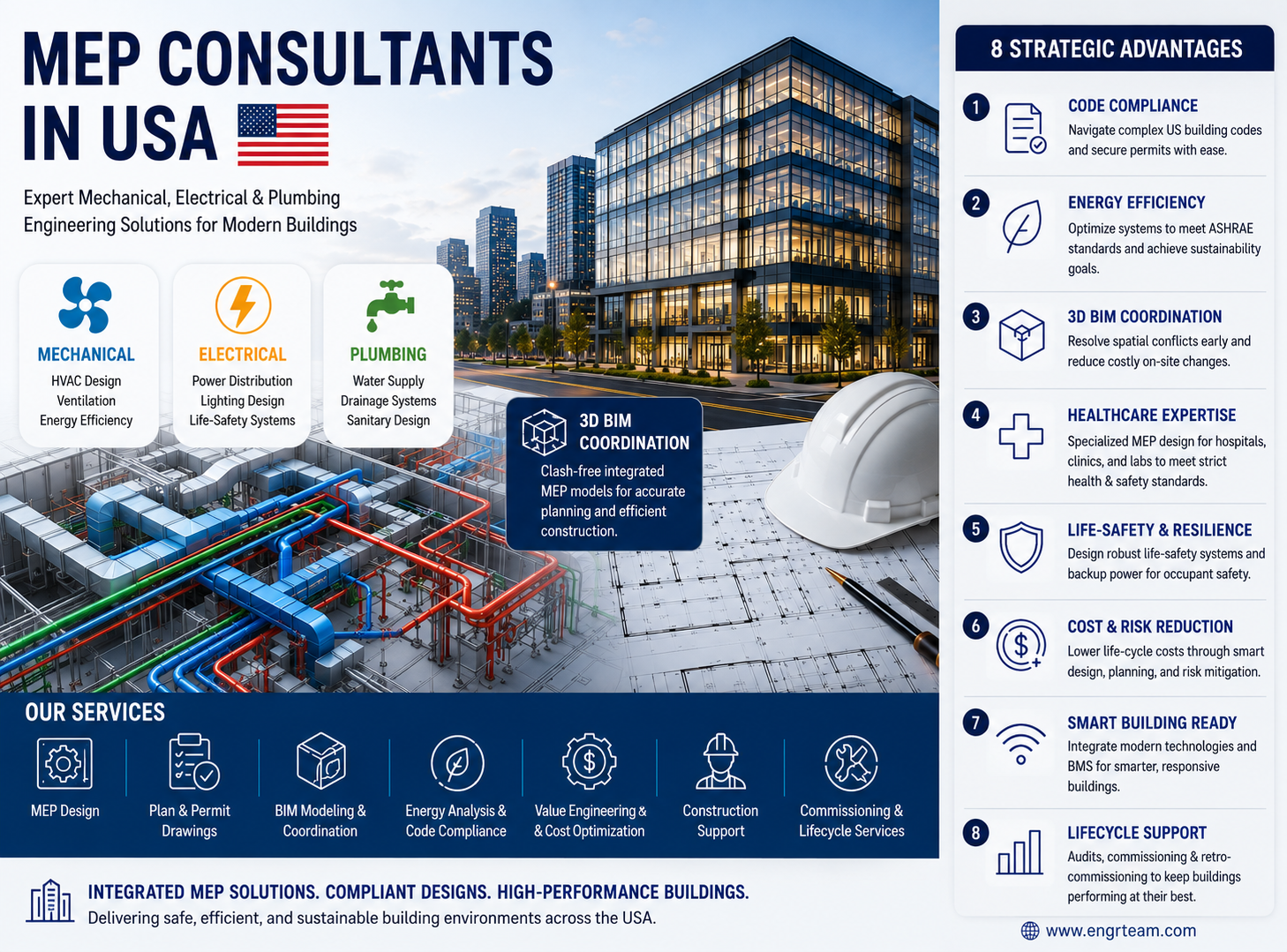
MEP Consultants in USA The modern built environment is a highly complex network of interconnected systems that govern the structural
Table of Contents
MEP Consultants in USA The modern built environment is a highly complex network of interconnected systems that govern the structural viability, safety, and comfort of commercial, industrial, and residential structures. At the core of every high-performing building are its mechanical, electrical, and plumbing (MEP) systems. These critical components regulate thermal environments, power distribution, water delivery, and active life-safety operations. As regulatory baselines, environmental mandates, and technological requirements become increasingly stringent across different states, property developers must engage specialized technical expertise. Engaging professional(https://engrteam.com/mep-plan-services/) allows design and construction teams to navigate the complex engineering parameters required to bring modern building designs to life safely and efficiently.
Developers and contractors in need of high-performance blueprints can leverage professional mep plan services to generate the detailed mechanical, electrical, and plumbing documentation required to secure municipal approvals, coordinate construction teams, and guarantee long-term operational efficiency.
Understanding the Complex Regulatory Matrix of US Building Codes
Commercial design and construction in the United States operate under a multi-layered regulatory framework governed by distinct model codes, local amendments, and standards developed by national associations. These model codes establish minimum performance thresholds to protect public health, safety, and general welfare. The primary standard developing organizations (SDOs) in the United States establish the technical rules that local authorities having jurisdiction (AHJs) adopt and modify.
The International Code Council publishes the International Codes (I-Codes), which serve as the foundation for structural and safety regulations across the United States and several international jurisdictions. Under this framework, the International Building Code (IBC) establishes general building parameters, while specific disciplines are governed by target codes. Mechanical systems are regulated by the International Mechanical Code (IMC), plumbing systems by the International Plumbing Code (IPC), and energy efficiency by the International Energy Conservation Code (IECC).
Concurrently, the National Fire Protection Association publishes standard codes that govern electrical installation and fire safety. The most prominent of these is NFPA 70, widely recognized as the National Electrical Code (NEC), which defines the requirements for safe electrical design, installation, and inspection. Active fire suppression systems are designed in accordance with NFPA 13, and municipal fire alarm systems are structured around NFPA 72.
Environmental quality, thermal comfort, and energy baselines are heavily influenced by(https://www.ashrae.org/), a global professional organization dedicated to advancing heating, ventilation, air conditioning, and refrigeration systems. Key baselines include ASHRAE Standard 62.1 for ventilation and acceptable indoor air quality, alongside ASHRAE Standard 90.1, which serves as the energy benchmark for commercial structures.
Because these codes vary by occupancy classification, MEP design requirements adapt dynamically depending on the intended use of the building. The following table outlines how distinct IBC occupancy groups influence the key MEP design criteria that consultants must address:
| IBC Occupancy Classification | Representative Building Types | Primary Mechanical & Ventilation Drivers | Electrical & Life-Safety Mandates | Plumbing & Sanitary Infrastructure |
| Group B (Business) | Professional Offices, Banks | ASHRAE 62.1 ventilation rates; ASHRAE 90.1 energy performance | Standard power distribution; NEC emergency egress lighting | IPC Table 403.1 occupant fixture count calculations |
| Group M (Mercantile) | Retail Stores, Markets, Showrooms | High-volume ventilation; retail-specific air distribution | Point-of-sale power grids; public area fire alarm systems | Public restrooms; specialized grease trap intercepts for food courts |
| Group I-2 (Institutional) | Hospitals, Nursing Homes | Multi-zone HVAC systems; ASHRAE 241 infectious aerosol control | NEC Article 700 emergency backup generator systems | NFPA 99 medical gas systems; clinical water distribution |
| Group A (Assembly) | Theaters, Exhibition Halls, Venues | Demand-controlled ventilation based on occupant sensors | High-load theater lighting; integrated emergency evacuation alarms | High-peak volume restrooms; multi-zone drainage systems |
The Interconnected Disciplines: Mechanical, Electrical, and Plumbing Engineering
An effective commercial structure requires a balanced, synchronized design across the three core disciplines of mechanical, electrical, and plumbing engineering. These systems are highly interdependent, and a modification in one discipline directly influences the requirements of the others.
Mechanical and HVAC Systems: Thermal Dynamics and Air Quality
Mechanical engineering within MEP practices focuses on heating, ventilation, air conditioning, and environmental controls. HVAC designers prioritize maintaining indoor air quality and thermal stability while keeping energy consumption low. Engineers perform detailed sensible heat gain calculations to size ventilation equipment. The thermal behavior of mechanical air exchange is often modeled using the sensible heat formula:
In this equation, $q_s$ represents the sensible heat transfer rate expressed in BTU per hour, $CFM$ is the volumetric airflow rate in cubic feet per minute, and $\Delta T$ represents the temperature difference in degrees Fahrenheit between the outdoor intake air and the target indoor air.
These calculations prevent over-designing HVAC units, which can lead to short-cycling and excess indoor moisture. Mechanical designers must also coordinate specialized operations, such as commercial kitchen grease hoods governed by IMC Chapter 5 and laboratory fume hoods tested under ASHRAE Standard 110. Furthermore, mechanical designs must integrate safe refrigerant selections in compliance with the safety classifications established by ASHRAE Standard 34-2019.
Electrical Power, Safety, and Emergency Infrastructure
Electrical engineering ensures the safe delivery of power, lighting, and communication services across a building. The design begins with power distribution planning, matching utility transformers with internal distribution panels. Under NEC regulations, commercial buildings must feature isolated electrical pathways to separate high-voltage systems from low-voltage communication lines, security cameras, nurse-call systems, and wireless networks.
Additionally, electrical engineers design lighting systems that satisfy local energy codes, such as the 2025 New York City Energy Conservation Code, while ensuring emergency backup systems comply with NEC Article 700 to protect occupants during grid blackouts.
Plumbing Systems and Fluid Engineering Dynamics
Plumbing systems coordinate the supply of clean water and the safe disposal of wastewater. Plumbing engineers calculate fixture counts based on IPC Table 403.1 to determine the correct number of toilets, sinks, and emergency eye-wash stations. They design domestic hot and cold water networks, sanitary sewer systems, storm drainage, and natural gas lines.
Industrial and clinical projects introduce more complex requirements, such as acid neutralization systems for chemical laboratories, grease interceptors for restaurants, and complex pure water loops for manufacturing. In healthcare facilities, clinical gas networks must be designed in strict accordance with the NFPA 99 Health Care Facilities Code, separating medical gases entirely from standard domestic piping.
The 8 Strategic Advantages of Collaborating with MEP Consultants in USA
Experienced engineering consultants provide valuable technical insight across a building’s entire lifecycle. Their work helps property developers manage regulatory, financial, and spatial challenges from early design through construction and long-term operations.
1. Navigating Overlapping Building Codes and Securing Permits
A single piece of mechanical equipment can trigger compliance requirements across multiple overlapping standards. For example, a rooftop air handling unit must comply with structural wind-load requirements, IMC ventilation standards, IPC condensate drainage rules, NEC electrical connections, and ASHRAE energy limits.
Because state licensing boards require licensed mechanical and electrical Professional Engineers (PEs) to stamp engineering documents before a building permit can be issued, working with qualified MEP consultants in the USA ensures that designs satisfy local requirements and clear the municipal review process without costly delays.
2. Enhancing Energy Efficiency and Mitigating Carbon Footprints
With state energy regulations constantly evolving, energy-efficient building design is essential. Modern codes, including the updated provisions of ASHRAE Standard 90.1-2022, mandate technologies like demand-controlled ventilation in spaces exceeding 500 square feet with high occupant densities.
MEP consultants help developers meet these requirements and achieve sustainable certifications like LEED (Leadership in Energy and Environmental Design), the National Green Building Standard (NGBS / ICC 700), and ENERGY STAR Multifamily High Rise (ESMFHR).
3. Resolving Spatial Conflicts Through Advanced 3D BIM Coordination
The plenum space above suspended ceilings is highly contested territory where structural framing, HVAC ductwork, NFPA 13 sprinkler piping, plumbing lines, and electrical conduits must fit.
MEP consultants use three-dimensional Building Information Modeling (BIM) to spot spatial conflicts during the design phase. Addressing these coordination issues digitally prevents expensive field modifications, material waste, and scheduling delays during construction.
4. Addressing Complex Healthcare and Medical Clinic Requirements
Healthcare facilities require highly specialized environmental controls to protect patient health. Operating rooms, isolation wards, and dental clinics demand custom ventilation designs to manage airborne pathogens.
MEP engineers design clinical spaces to meet strict pressure relationships and clean air exchanges, incorporating the safety standards of NFPA 99 and ASHRAE Standard 241 to manage infectious aerosol risks.
5. Optimizing Life-Safety Systems and Electrical Resilience
Life-safety engineering requires careful coordination between fire alarm systems (NFPA 72), sprinkler lines (NFPA 13), and emergency backup generators (NEC Article 700).
Furthermore, as commercial buildings increasingly adopt on-site battery storage and microgrid technology, MEP consultants must design containment systems that comply with the provisional NFPA 800 Battery Safety Code, ensuring that high-density energy systems are protected against thermal runaway hazards.
6. Mitigating Risk and Lowering Lifetime Operational Costs
Developing a commercial project involves balancing upfront construction costs with long-term operating expenses. MEP engineers perform life-cycle cost analyses to help developers choose equipment that offers the best balance of initial cost and operational efficiency.
By identifying design bottlenecks and material alternatives early in the planning process, consultants help prevent unexpected budget issues during construction.
7. Designing for Technological Advancements and Smart Buildings
Modern buildings rely on complex digital networks to manage operations. MEP consultants plan the structural infrastructure for low-voltage systems, including security access, nurse call systems, audiovisual networks, and wireless access point placement.
They design central building management systems (BMS) that allow operators to monitor and adjust HVAC, lighting, and power distribution systems from a single digital interface.
8. Lifecycle Support, Audits, and Retro-Commissioning
An engineering consultant’s value continues long after a building’s initial construction is complete. Over time, building systems can drift from their original design settings, leading to higher energy consumption.
MEP professionals perform detailed energy audits and use benchmarking tools, such as the ASHRAE Building EQ Portal, to identify energy conservation measures (ECMs). These targeted audits and retro-commissioning plans help owners restore their systems to peak efficiency and lower utility costs.
Strategic Engineering Recommendations for Modern Developers
As building systems become more complex and energy regulations continue to tighten, the role of professional engineering coordination is more important than ever. Working with experienced MEP consultants in the USA helps developers manage the risks of modern construction by ensuring designs are safe, efficient, and fully compliant with local codes. Integrating mechanical, electrical, and plumbing plans early in the design process helps protect projects from unexpected field modifications, permitting delays, and operational inefficiencies. Utilizing expert engineering planning services is a reliable way to turn complex architectural designs into safe, sustainable, and highly functional properties.
How do MEP consultants ensure compliance with local US building codes?
MEP consultants utilize their deep technical expertise in national model codes—such as the International Building Code (IBC), International Mechanical Code (IMC), International Plumbing Code (IPC), and the National Electrical Code (NEC)—alongside specific local state and municipal amendments. Licensed Professional Engineers (PEs) perform detailed calculations (such as ASHRAE ventilation and NEC electrical loads) to guarantee systems are safely designed before stamping the final drawings, which is a mandatory step for securing municipal building permits.
What are the key benefits of using BIM (Building Information Modeling) in MEP design?
BIM technology, such as Revit MEP software, allows engineers, architects, and builders to coordinate mechanical, electrical, and plumbing layouts within a shared 3D digital model. By visualizing the exact physical placement of ductwork, fire sprinkler lines, electrical conduits, and sanitary piping before physical construction begins, design teams can identify and resolve spatial clashes early. This prevents expensive on-site rework, reduces material waste, and shortens the overall construction schedule.
What are the primary design challenges that MEP engineers face today?
Modern MEP engineers must overcome a variety of complex challenges, including:
Limited Spatial Tolerances: Fitting complex infrastructure like structural framing, ventilation ducts, and plumbing lines into tight ceiling plenums.
Budget and Timeline Pressures: Delivering highly efficient systems under strict financial caps and accelerated construction timelines.
Keeping Pace with Green Regulations: Integrating fast-evolving clean-energy rules, such as electrification mandates and chemical refrigerant phase-outs.
How can professional MEP layout plans reduce a building’s lifetime operational costs?
An optimized MEP plan prevents the common pitfall of over-engineering or oversizing equipment, which typically leads to frequent system cycling, poor indoor moisture control, and premature wear. By integrating energy-efficient solutions—like ASHRAE-compliant smart ventilation, daylight harvesting, and low-flow plumbing infrastructure—consultants lower monthly utility bills. Additionally, MEP firms provide post-construction support, such as energy audits and retro-commissioning, to keep systems operating at peak physical efficiency over their entire lifecycle.
Recent Posts
- 3D Mechanical Drafting Services: The Ultimate Guide to Precision Engineering Design and Modeling
- M and E BIM Coordinator Outsourcing: The Definitive Guide to Streamlining MEP Engineering
- Cannabis Cultivation Facility MEP Design: The Ultimate Engineering and HVAC Guide
- MEP Engineering Services for Warehouse: The Ultimate Design, Installation, and Optimization Guide
- Mechanical Engineering Plumbing Design: The Complete Industry Guide