

Articles

Macroeconomic Footprint and Market Dynamics MEP Engineering Consulting in Canada
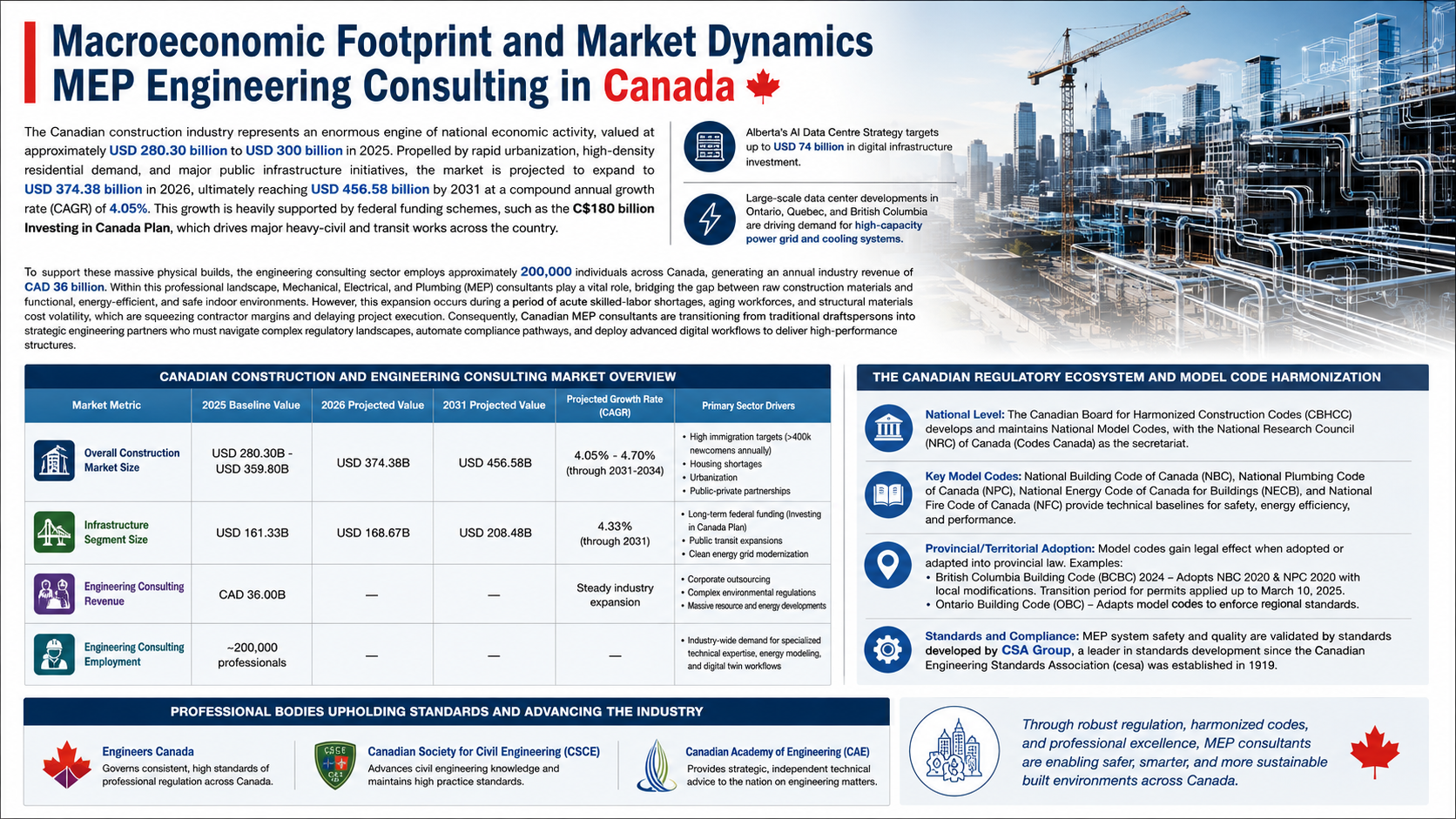
The Canadian construction industry represents an enormous engine of national economic activity, valued at approximately USD 280.30 billion to USD 300 billion in 2025. Propelled by rapid urbanization, high-density residential demand, and major public infrastructure initiatives, the market is projected to expand to USD 374.38 billion in 2026, ultimately reaching USD 456.58 billion by 2031 at a compound annual growth rate (CAGR) of 4.05%. This growth is heavily supported by federal funding schemes, such as the C$180 billion Investing in Canada Plan, which drives major heavy-civil and transit works across the country. Concurrently, regional initiatives like Alberta’s AI Data Centre Strategy, which targets up to USD 74 billion in digital infrastructure investment, and large-scale data center developments in Ontario, Quebec, and British Columbia are creating immense demand for high-capacity power grid transmission, distribution upgrades, and complex cooling systems.
To support these massive physical builds, the engineering consulting sector employs approximately 200,000 individuals across Canada, generating an annual industry revenue of CAD 36 billion. Within this professional landscape, Mechanical, Electrical, and Plumbing (MEP) consultants play a vital role, bridging the gap between raw construction materials and functional, energy-efficient, and safe indoor environments. However, this expansion occurs during a period of acute skilled-labor shortages, aging workforces, and structural materials cost volatility, which are squeezing contractor margins and delaying project execution. Consequently, Canadian MEP consultants are transitioning from traditional draftspersons into strategic engineering partners who must navigate complex regulatory landscapes, automate compliance pathways, and deploy advanced digital workflows to deliver high-performance structures.
On a professional level, the interests and standards of the engineering community are upheld by regulatory and advocacy bodies such as Engineers Canada, which governs consistent high standards of professional regulation, and the Canadian Academy of Engineering (CAE), which provides strategic technical advice to the nation. Societies like the Canadian Society for Civil Engineering (CSCE) work in parallel to maintain high practice standards. To contextualize the scale of this economic and professional landscape, the table below delineates the core segments, projected growth paths, and primary drivers within the Canadian built environment.
| Market Metric | 2025 Baseline Value | 2026 Projected Value | 2031 Projected Value | Projected Growth Rate (CAGR) | Primary Sector Drivers |
| Overall Construction Market Size | USD 280.30B – USD 359.80B | USD 374.38B | USD 456.58B | 4.05% – 4.70% (through 2031-2034) | High immigration targets (>400k newcomers annually), housing shortages, urbanization, public-private partnerships. |
| Infrastructure Segment Size | USD 161.33B | USD 168.67B | USD 208.48B | 4.33% (through 2031) | Long-term federal funding (Investing in Canada Plan), public transit expansions, clean energy grid modernization. |
| Engineering Consulting Revenue | CAD 36.00B | — | — | Steady industry expansion | Corporate outsourcing, complex environmental regulations, massive resource and energy developments. |
| Engineering Consulting Employment | ~200,000 professionals | — | — | — | Industry-wide demand for specialized technical expertise, energy modeling, and digital twin workflows. |
The Canadian Regulatory Ecosystem and Model Code Harmonization
Designing functional MEP systems in Canada requires adherence to a complex, multi-tiered regulatory framework. At the national level, the Canadian Board for Harmonized Construction Codes (CBHCC) is responsible for developing, approving, and maintaining the National Model Codes, with the National Research Council (NRC) of Canada’s Codes Canada group acting as the secretariat to provide administrative and technical publishing support. These model codes—including the National Building Code of Canada (NBC), the National Plumbing Code of Canada (NPC), the National Energy Code of Canada for Buildings (NECB), and the National Fire Code of Canada (NFC)—serve as technical baselines to promote consistency across the country’s provinces and territories.
Because constitutional authority over building regulations resides with provincial and territorial governments, National Model Codes do not possess direct legal effect until they are adopted or adapted into provincial law. For instance, the British Columbia Building Code (BCBC) 2024 was established by adopting Book I (General) and Book II (Plumbing Systems) based on the NBC 2020 and NPC 2020 editions, with modifications designed to meet local municipal requirements. A transition period was implemented, allowing project permits applied for up to March 10, 2025, to proceed under existing guidelines, provided construction continues to completion without interruption. In Ontario, the Ontario Building Code (OBC) similarly adapts model codes to enforce regional energy and safety standards, requiring MEP consultants to maintain comprehensive regional knowledge to satisfy localized “authority having jurisdiction” (AHJ) requirements.
This regulatory environment is undergoing a transition. The historical model codes, such as the NBC 2015 and NECB 2017, are being replaced by the NBC 2020 and the highly anticipated National Building Code of Canada 2025. These updated documents are published by the NRC and are accessible electronically through the NRC Publications Archive, with printed formats distributed through the NRC Virtual Store to guide builders through updated structural and energy provisions. Within these codes, the safety, quality, and performance of MEP components are validated by standards developed by organizations like the CSA Group, which traces its lineage back to the establishment of the Canadian Engineering Standards Association (CESA) in 1919. These referenced CSA standards dictate the exact material limits, testing methodologies, and performance criteria that systems must satisfy to comply with code objectives.
The Structural Mechanics of Objective-Based Codes and Standards
Since 2005, Canadian National Model Codes, such as the NPC 2020, have utilized an objective-based format. This structural framework is designed to move away from rigid prescriptive mandates, allowing MEP consultants the design flexibility to innovate as long as they can demonstrate that their systems meet specific qualitative objectives. This objective-based format is organized into three distinct divisions.
Division A defines the scope of the code and contains the core objectives, functional statements, and conditions necessary to achieve compliance. For example, the NPC establishes four primary objectives: safety, health, protection of the building or facility from water and sewage damage, and environmental protection. Division B contains acceptable solutions, which are the technical and quantitative requirements deemed to satisfy the qualitative objectives outlined in Division A. These technical requirements are linked to functional statements, which describe the specific operational functions a system must perform, and intent statements, which detail the exact hazard or failure mode a requirement aims to prevent. Finally, Division C contains the administrative provisions necessary to govern code enforcement and application.
Rather than maintaining a list of acceptable proprietary products, the codes reference external consensus standards to define material compliance. The National Energy Code of Canada for Buildings (NECB) 2020 highlights this objective-based evolution by introducing substantial updates to energy performance standards. Key revisions in the NECB 2020 include the extension of code application to cover building alterations and tenant improvements inside existing structures, and a significant reduction in maximum thermal transmittance values ($U$-values) for fenestration and opaque building assemblies to enhance envelope performance. Furthermore, the update introduces optional whole-building airtightness testing as a compliance path for air leakage requirements, updates lighting power densities to reflect improvements in high-efficacy LED products, and eliminates complex trade-off compliance paths for HVAC and service water systems. To support long-term decarbonization goals, the NECB 2020 establishes a new 4-tier energy performance compliance path designed to provide a progressive framework for reaching net-zero energy consumption.
Municipal Carbon Reduction Frameworks and the Toronto Green Standard
While national and provincial codes set minimum acceptable performance baselines, municipal governments are enacting highly progressive local standards to achieve rapid decarbonization. The Toronto Green Standard (TGS) Version 4, which came into effect on May 1, 2022, serves as the primary mechanism for aligning new private and city-owned developments with Toronto’s Net Zero by 2040 Climate Strategy. This is a critical focus for the city because buildings account for approximately 56% to 57% of Toronto’s total greenhouse gas emissions. To drive early-stage design changes, the City Council accelerated emission limits for subsequent versions (Version 5 in 2025 and Version 6 in 2028) so that all buildings constructed on or after 2030 are near-zero emissions.
The TGS v4 relies on three key metrics: Total Energy Use Intensity (TEUI), Thermal Energy Demand Intensity (TEDI), and Greenhouse Gas Intensity (GHGI). To achieve the voluntary Tier 2 or Tier 3 certifications—which grant developers access to the Development Charge Refund Program—projects must implement strict energy-saving designs and high-performance envelopes. By 2026, the Tier 2 requirements are set to become mandatory, which will legally require all developers to conduct detailed life-cycle assessments. To manage this complex modeling overhead, MEP consultants are partnering with technology organizations, such as SolidCAD, to leverage platforms like One Click LCA to automate life-cycle assessments and accurately track carbon performance from concept to construction drawings.
Under TGS v4, whole-building Life-Cycle Assessments (LCAs) are mandatory for all new city-owned facilities to verify that material emissions and efficiency targets are met. For mid-to-high-rise residential and non-residential developments, materials emissions assessments must cover life-cycle stages A1 through A5 (cradle-to-installation) in accordance with the CaGBC’s Zero Carbon Building Standard (ZCBS) v2 methodology, demonstrating at least a 20% reduction in upfront embodied carbon compared to a baseline building. In the low-rise residential sector, developments are restricted to an absolute materials emissions intensity of less than 250 kgCO2e/m2. To summarize these highly technical performance paths, the table below contrasts the energy, thermal, and greenhouse gas targets across the different TGS v4 tiers.
| Development Category & TGS Version 4 Tier Level | TEUI Target (kWh/m2/yr) | TEDI Target (kWh/m2/yr) | GHGI Target (kg CO2e/m2/yr) | Additional Key Performance Requirements |
| Multi-Unit Residential (> 6 Storeys) | ||||
| * Tier 1 (Mandatory Baseline) | 135 | 50 | 15 | Level 2 EV charging for 100% of residential spaces, 40% indoor potable water reduction, green/cool roof integration. |
| * Tier 2 | 100 | 30 | 15 | Material emissions assessment (A1-A5 stages), identify low-carbon structural or envelope alternatives. |
| * Tier 3 | 75 | 15 | 15 | Whole-building LCA showing $\ge 20\%$ embodied carbon reduction, climate-positive landscape design. |
| Multi-Unit Residential (≤ 6 Storeys) | ||||
| * Tier 1 (Mandatory Baseline) | 130 | 40 | 15 | Outdoor irrigation potable water reduction of 60%, 80% green roof coverage or solar PV integration. |
| * Tier 2 | 100 | 25 | 15 | Mandatory life-cycle carbon tracking, use of low-carbon sustainable materials. |
| * Tier 3 | 70 | 15 | 15 | High-performance thermal boundaries, optimized heat recovery systems, near-zero building footprint. |
| Commercial Office | ||||
| * Tier 1 (Mandatory Baseline) | 130 | 30 | 15 | 25% of parking spaces equipped with Level 2 EV charging outlets, high-efficiency mechanical filtration. |
| * Tier 2 | 100 | 22 | 15 | Materials assessment for structure and envelope, optimized building envelope air tightness. |
| * Tier 3 | 65 | 15 | 15 | Advanced mechanical heat pump installations, integrated on-site renewable energy systems. |
| Commercial Retail | ||||
| * Tier 1 (Mandatory Baseline) | 120 | 40 | 10 | Low-flow water fixtures, smart energy metering, waste management and recycling systems. |
| * Tier 2 | 90 | 25 | 10 | Upfront embodied carbon reporting, optimized mechanical system ventilation. |
| * Tier 3 | 70 | 15 | 10 | Zero-emissions building design, high-performance glazes and cool exterior surface coatings. |
High-Performance Building Envelopes and Advanced HVAC Systems Integration
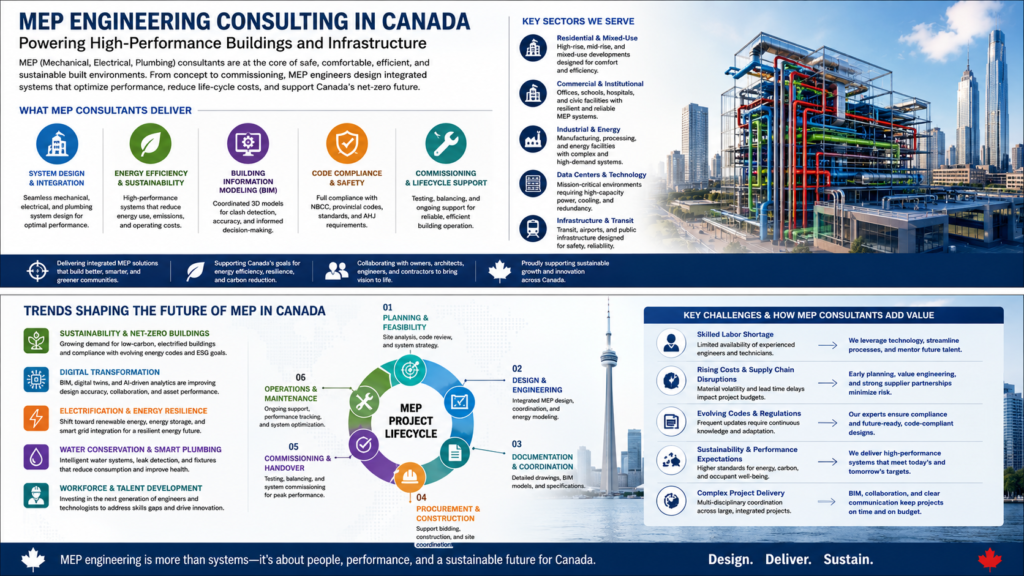
The strict operational limits enforced by the TGS v4 and NECB 2020 require a holistic approach to building systems design, wherein the performance of the building envelope directly dictates the sizing and configuration of the mechanical HVAC systems. In extreme Canadian climates, where winter temperatures regularly plunge below $-20^\circ\text{C}$ ($-4^\circ\text{F}$), space heating represents the largest component of building energy consumption and operational carbon emissions. Historically, buildings relied on fossil-fuel combustion (such as natural gas boilers) to handle these peak thermal demands, but modern GHGI limits are forcing a transition toward complete mechanical electrification.
The primary technology driving this transition is the Cold-Climate Heat Pump (CCHP). Modern CCHP units incorporate advanced vapor-injection scroll compressors and variable-speed drives, allowing them to extract thermal energy from outdoor air and maintain high heating capacities at temperatures as low as $-18^\circ\text{F}$ ($-28^\circ\text{C}$). However, integrating these systems requires careful coordination between mechanical and electrical consultants. Electrical engineers must evaluate and design high-capacity electrical connections to handle the substantial starting and operating currents of the heat pump compressors, as well as the electric resistance coils utilized for supplemental backup heat during extreme winter peaks.
Furthermore, mechanical consultants must design systems to minimize these peak loads. By complying with the reduced maximum thermal transmittance ($U$-values) for opaque walls and fenestration mandated under NECB 2020, and implementing optional whole-building airtightness testing, engineers can minimize building air leakage and heat loss. This high-performance envelope dramatically reduces the required TEDI, allowing mechanical consultants to specify smaller, more cost-effective heat pumps, eliminate oversized backup systems, and lower overall installation costs while maintaining excellent thermal comfort.
Specialized MEP Engineering in Healthcare Facilities and Infection Prevention
Inside healthcare facilities (HCFs), the design and operation of MEP systems have a direct impact on patient safety, infection control, and clinical outcomes. These specialized projects are guided by professional societies such as the Canadian Healthcare Engineering Society (CHES), which represents approximately 1,000 healthcare engineers and associates nationwide. Healthcare MEP systems must satisfy rigorous engineering requirements published by the CSA Group, specifically the CSA Z317 and CSA Z8000 series, which are evaluated during mandatory Infection Prevention and Control (IPAC) reviews for capital funding.
Plumbing systems in hospitals are governed by CSA Z317.1 (Special requirements for plumbing installations in health care facilities) to mitigate the risk of waterborne pathogens like Legionella and Pseudomonas. Under this standard, MEP consultants must design facilities to prevent water stagnation by eliminating dead legs and outlining water safety management plans. Standard plumbing fixtures must utilize seamless, non-porous materials compatible with hospital-grade disinfectants, and lavatory faucets must be aligned to prevent direct water discharge onto the drain opening, which reduces the aerosolization of bacteria from drain traps. Water closets require hands-free infrared activation, and domestic hot water must be stored and circulated at temperatures that prevent pathogen growth, incorporating point-of-use thermostatic mixing valves to prevent patient scalding.
During active construction, renovation, or maintenance inside occupied HCFs, consultants must adhere to CSA Z317.13 (Infection control during construction, renovation, and maintenance of health care facilities). Mechanical engineers must coordinate with clinical IPAC professionals to design temporary negative-pressure ventilation zones. These systems utilize HEPA filtration units to capture dust and fungal spores, discharging the filtered air directly outdoors to prevent pathogen migration into sterile patient-care areas. This multidisciplinary team (MDT) dynamic is critical to executing systematic risk assessments and implementing preventive controls.
Furthermore, the operational standard CSA Z317.12 (Cleaning and disinfection of health care facilities) and the upcoming CSA Z317.12:25 / CSA Z8000:24 standards have introduced a progressive focus on automated, non-manual disinfection technologies. To address dry-surface biofilms and aerosolized pathogens, MEP consultants are designing integrated upper-air Germicidal UV (GUV) systems in corridors and automated UV-C room disinfection systems inside high-use restrooms and clinical spaces. These complex technological systems cannot simply be purchased off-the-shelf; they must be designed, commissioned, and validated by certified “EIP (Environmental Infection Prevention) Qualified Personnel” who possess the specialized engineering and physics background required to prove compliance and protect occupant health.
Technological Convergence in Canadian MEP: BIM, Prefabrication, and Digital Twins
To navigate skilled-labor shortages, compress project schedules, and minimize material waste, Canadian MEP consulting firms are actively integrating advanced digital technologies. The industry is shifting from traditional 2D drafting toward advanced Building Information Modeling (BIM) workflows and Virtual Design and Construction (VDC). Prominent firms, such as Silicon Engineering Consultants Canada, leverage software platforms like Autodesk Revit, AutoCAD MEP, and Navisworks to generate data-rich 3D models.
These BIM workflows utilize parametric modeling, automated document generation, and advanced clash-detection tools. This allows mechanical, electrical, and plumbing systems to be integrated with structural frames and exterior facades, eliminating intra-disciplinary errors before construction begins. These coordinated models are also used for “MEP Prefabrication Services,” producing detailed 2D and 3D CAD drawings that allow components to be manufactured in off-site facilities and assembled on-site with high precision, reducing material wastage and on-site labor demands.
The adoption of these digital tools is transforming the Canadian construction landscape. A KPMG survey in 2025 revealed that 90% of Canadian construction leaders believe advanced digital technologies—including AI, data analytics, BIM, and digital twins—can substantially boost construction efficiency and labor effectiveness. By establishing in-house digital centers of excellence and utilizing cloud-based collaboration tools, MEP consultants can perform real-time clash coordination, automate bill-of-materials generation, and run early-stage energy and solar simulations to deliver optimal building performance.
Strategic Pathways and Industry Recommendations MEP Engineering Consulting in Canada
The role of the Canadian MEP consulting engineer has transformed from a support designer into a critical champion of building efficiency, safety, and regulatory compliance. To maintain a competitive edge in a rapidly consolidating, high-tech engineering consulting market, MEP firms should prioritize several strategic initiatives:
- Invest in Advanced BIM and VDC Competency: Consulting firms must establish continuous training pathways in Autodesk Revit, Navisworks, and parametric modeling. Eliminating intra-disciplinary clash errors during the design phase is the most effective method to control costs, optimize raw materials, and facilitate off-site modular prefabrication.
- Acquire Specialized Environmental Infection Prevention Credentials: Hospital capital projects require certified engineering expertise. Firms should train and certify engineering staff as “EIP Qualified Personnel” to properly design, commission, and audit automated UV-C and upper-air GUV disinfection systems in accordance with the latest CSA Z317 and CSA Z8000 series standards.
- Incorporate Early-Stage Life-Cycle Assessments: With municipal standards like the Toronto Green Standard making materials emissions assessments and whole-building LCAs mandatory, MEP consultants must leverage software partnerships with platforms like One Click LCA and SolidCAD. Integrating carbon modeling at the concept stage enables the selection of low-carbon materials and ensures compliance with ZCBS v2 guidelines.
- Develop Competency in Low-Carbon Electrification: As building envelopes become more airtight and thermal transmittance limits are tightened under the NECB 2020, mechanical engineers must master the integration of Cold-Climate Heat Pumps. This requires close collaboration with electrical engineers to design robust, energy-efficient power connections and backup heating systems that satisfy strict municipal GHGI limits without inflating capital costs.
By focusing on these technical and regulatory competencies, Canadian MEP consultants can successfully navigate a demanding and volatile construction market. Through the integration of advanced digital tools and low-carbon design strategies, modern consulting engineers are uniquely positioned to shape a resilient, sustainable, and highly functional built environment across Canada.