

Articles

In the discipline of building science, the thermal performance of a structure is not a static variable but a dynamic equilibrium influenced by climate, construction materials, and occupant behavior. Heating and cooling load calculations represent the foundational mathematical process used to quantify the amount of energy required to maintain a comfortable indoor environment regardless of outdoor conditions. Without a precise load analysis, HVAC systems are likely to be either undersized—leading to comfort failures—or oversized—leading to inefficient short-cycling, poor humidity control, and premature equipment degradation.
The Science of Thermal Equilibrium: Why Load Calculations Matter
The primary objective of a load calculation is to determine the “peak demand” of a building. This represents the worst-case scenario: the hottest summer afternoon for cooling and the coldest winter night for heating.
A useful analogy for understanding these loads is the “bucket” concept. Heat gain (cooling load) is like water being poured into a bucket from multiple taps; the cooling system must “drain” that heat at a matching rate to prevent the “water level” (temperature) from rising. Conversely, heat loss (heating load) is like a hole in the bucket; the heating system must refill the bucket as fast as heat escapes to maintain a steady state. Professional heating and cooling load calculations aim to make that “hole” smaller through better insulation and control the “taps” through efficient design.
Key Components of HVAC Load Calculations
Load calculations are divided into two distinct categories: external loads (from the building envelope) and internal loads (from inside the space).
External Loads: The Building Envelope
External loads are driven by the temperature difference ($\Delta T$) between the interior and exterior, as well as solar radiation.
- Conduction and Convection: Heat transfer through walls, roofs, windows, and doors. This is governed by the $U$-value (thermal transmittance) of the materials.
- Solar Radiation: Radiant energy entering through fenestration (windows and skylights). This is often the largest component of a cooling load.
- Infiltration: Uncontrolled air leakage through cracks in the building envelope, which adds both sensible heat and moisture.
Internal Loads: People, Lights, and Equipment
In modern, well-insulated buildings, internal gains often rival external loads in magnitude.
- Occupancy: Human bodies emit both sensible heat (body temperature) and latent heat (respiration and perspiration).
- Lighting: Every watt of lighting energy is eventually converted into heat within the conditioned space.
- Appliances and Equipment: Computers, servers, and kitchen appliances contribute significantly to the cooling load but are typically excluded from heating load calculations to ensure the heater can handle the space on its own.

Comparison of Load Factors: Heat Gain vs. Heat Loss
| Component | Included in Cooling Load (Heat Gain) | Included in Heating Load (Heat Loss) | Impact |
| Solar Radiation | Yes (Primary Source) | No (Conservative Design) | Increases cooling needs; reduces heating needs. |
| Occupancy | Yes | No (Conservative Design) | Adds heat/moisture; reduces heating needs. |
| Ventilation | Yes (Heat & Humidity) | Yes (Cold Air) | Increases both heating and cooling loads. |
| Appliances | Yes | No | Adds heat; can cause cooling system overloads. |
| Infiltration | Yes | Yes | Significant source of heat gain/loss. |
Manual J vs. ASHRAE: Understanding Professional Standards
The industry utilizes two primary methodologies for determining loads, depending on the building’s occupancy and scale.
Manual J: The Residential Gold Standard
Developed by the Air Conditioning Contractors of America (ACCA), Manual J is the required standard for residential structures in most national building codes. It is optimized for single-family homes and small multi-unit buildings, focusing on room-by-room sizing to ensure consistent comfort across different zones.
ASHRAE: The Commercial Standard
For complex commercial and industrial facilities, the ASHRAE (American Society of Heating, Refrigerating and Air-Conditioning Engineers) standards are used. These methods, such as the Heat Balance (HB) or Radiant Time Series (RTS), utilize advanced math models to account for complex building dynamics and variable operating schedules.
Step-by-Step Calculation Methodology
A professional load analysis follows a structured progression to ensure no heat source is overlooked.
- Gather Data: Collect architectural plans, insulation R-values, window U-values, and local climate data (design temperatures).
- Calculate Envelope Load: Use the formula $Q = U \times A \times \Delta T$, where $Q$ is the heat transfer, $U$ is the thermal transmittance, $A$ is the area, and $\Delta T$ is the temperature difference.
- Determine Internal Gains: Assign heat values (Watts or BTU/h) to occupants, lighting, and equipment.
- Calculate Ventilation Load: Use the formula $Q_{sensible} = 1.08 \times CFM \times \Delta T$ for Imperial units or $Q_{sensible} = \dot{V} \times \rho \times c_p \times \Delta T$ for SI units.
- Determine Total Load: Sum the sensible heat (temperature) and latent heat (moisture) to arrive at the total required capacity in Tons or kW.
Common Pitfalls and How to Avoid Them
The most dangerous mistake in HVAC design is relying on “rules of thumb,” such as “500 square feet per ton.” This ignores modern insulation levels and window orientations, often resulting in systems that are $30-50\%$ oversized.
- Neglecting Insulation Levels: Failing to account for actual R-values can lead to massive inaccuracies in the envelope load calculation.
- Inaccurate Window Data: Windows are the weakest link in the thermal envelope. Misidentifying high-performance glazing can cause significant errors in solar gain estimates.
- Ignoring Latent Loads: In humid climates, moisture removal is as critical as temperature reduction. Failing to calculate latent loads leads to “clammy” indoor environments and potential mold growth.
Software Tools for Precision Engineering
Modern HVAC layout plans are developed using sophisticated software that automates the iterative process of load analysis.
| Software | Best For | Key Capability |
| Carrier HAP | Commercial Load Analysis | Hourly analysis and energy modeling for complex systems. |
| Trane Trace 3D Plus | Concept Design | 3D visualization of building geometry and thermal loads. |
| Manual J Speed-Sheets | Residential Projects | Quick, code-compliant residential load calculations. |
| Hysopt | Hydronic Optimization | Simulates real-life system dynamics to prevent oversizing. |
| EnergyPlus | Research & Policy | Granular control over every component of building physics. |
Integrating Loads into the Broader MEP Strategy
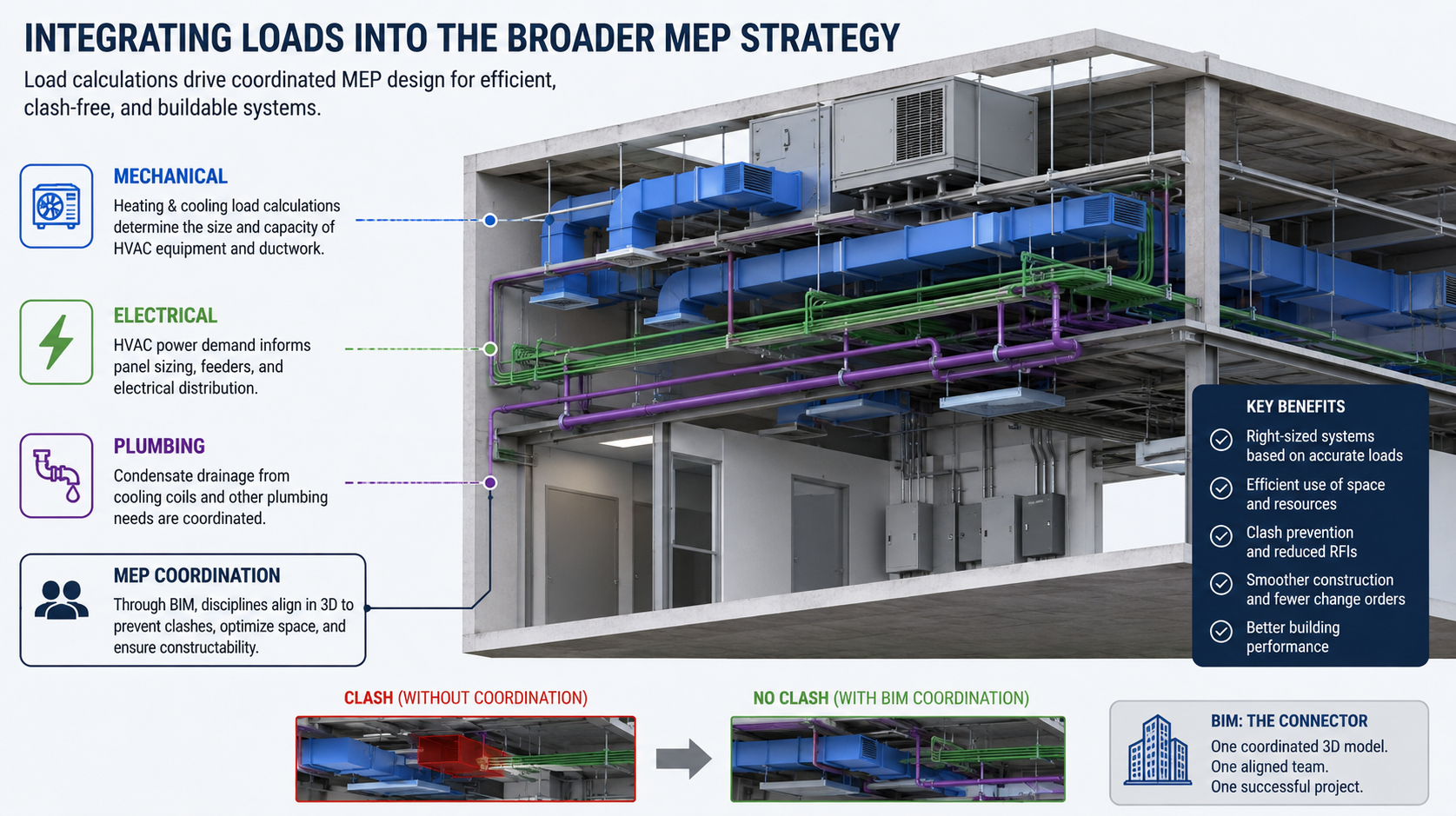
Load calculations do not exist in a vacuum. They are a core component of a larger MEP plan service that coordinates mechanical needs with electrical and plumbing capacity.
For example, once the heating and cooling loads are established, the electrical engineer must size the panels and feeders to handle the HVAC equipment’s power demand. Similarly, the plumbing team must plan for condensate drainage from cooling coils. This multidisciplinary coordination, often facilitated through Building Information Modeling (BIM), prevents spatial “clashes” where ducts might interfere with electrical conduits or structural beams.