

Articles

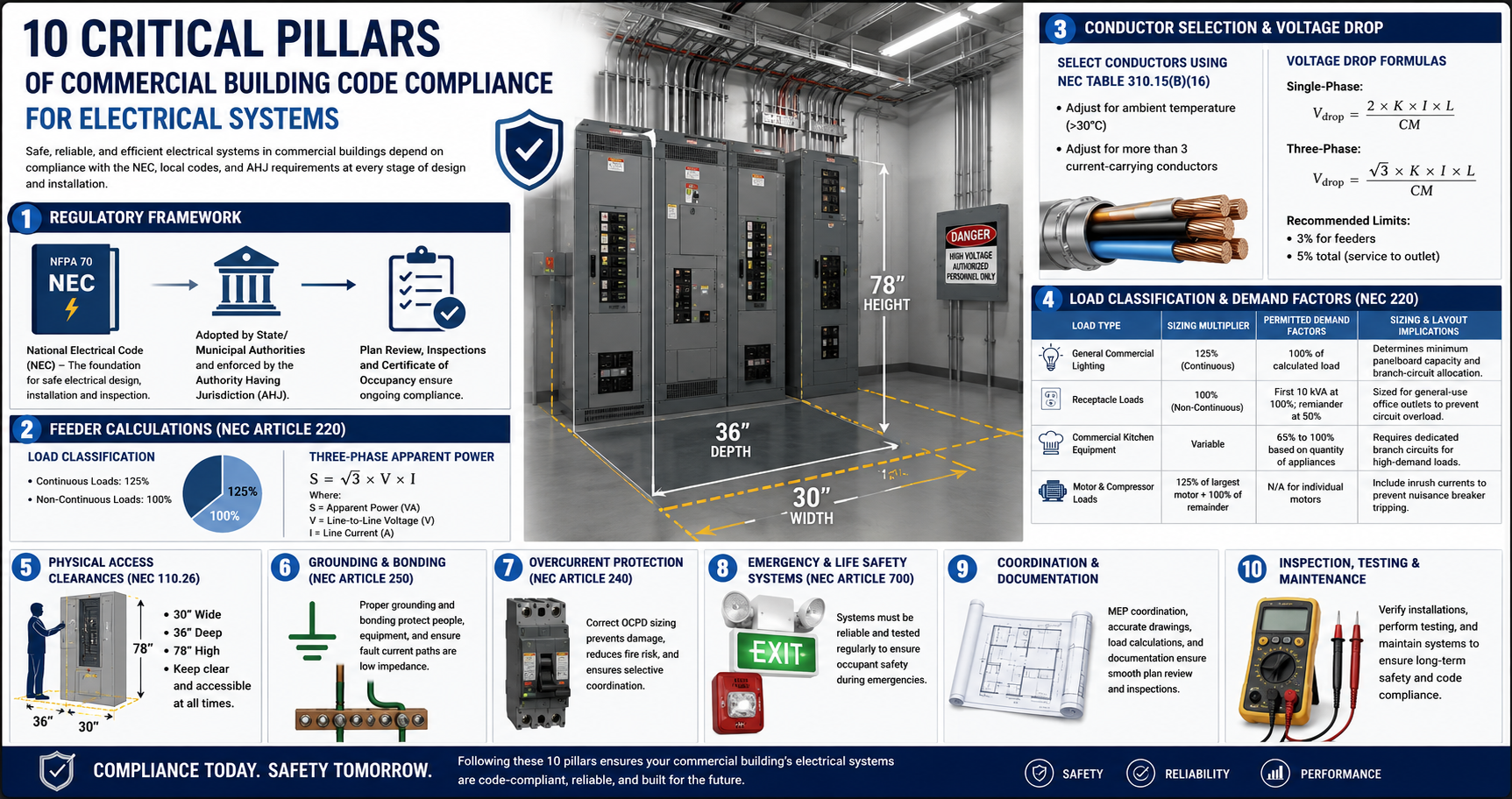
Safe engineering design relies heavily on commercial building code compliance for electrical systems because modern structural layouts demand high-voltage power distribution, sophisticated life safety controls, and continuous operations to maintain safety and economic value. As commercial buildings grow in structural scale and incorporate smart automation, renewable generation, and electric vehicle charging systems, the density of electrical infrastructure escalates.
Achieving commercial building code compliance for electrical systems requires navigating a complex regulatory landscape. This analysis outlines the primary technical pillars, calculation methodologies, safety clearances, and multidisciplinary coordination processes necessary to secure complete building code compliance.
Regulatory Frameworks of Commercial Building Code Compliance for Electrical Systems
The regulatory baseline for commercial electrical design in the United States is the National Electrical Code (NEC), published by the National Fire Protection Association (NFPA) as NFPA 70. Revised on a strict three-year cycle to integrate new technologies and address historical safety data, the NEC serves as the benchmark for safe electrical design, installation, and inspection. Because the NEC is not a federal statute, it becomes legally binding only when adopted by state or municipal legislative bodies.
The local building department, electrical board, or fire marshal—acting as the Authority Having Jurisdiction (AHJ)—is responsible for reviewing design plans, conducting field inspections, and issuing certificates of occupancy. The structure of the NEC is designed to address general installation requirements in Chapters 1 through 4, specialized occupancies and machinery in Chapters 5 through 7, and communication systems in Chapter 8.
In modern commercial projects, achieving electrical compliance is an iterative process that requires early coordination with other architectural and engineering disciplines. For developers and contractors, securing comprehensive MEP Plan Services is a critical first step. These services coordinate the design of mechanical, electrical, and plumbing systems into a single plan, preventing spatial conflicts and ensuring that all installations comply with building and life safety codes.
Feeder Calculations for Commercial Building Code Compliance for Electrical Systems
To establish compliance under NEC Article 220, design engineers must perform comprehensive load calculations that dictate the sizing of conductors, switchboards, panelboards, and the primary service entrance. Under-sizing electrical service infrastructure leads to dangerous thermal loading and premature system failure, while over-sizing introduces unnecessary equipment costs and escalates arc flash hazards.
Sizing Continuous and Non-Continuous Loads
The NEC requires a distinct division between continuous and non-continuous loads during service and feeder calculations. A continuous load is any load that operates at its maximum current for three hours or more, such as general commercial office lighting or mechanical ventilation systems. Non-continuous loads operate on transient or intermittent schedules.
- Continuous Loads: Must be calculated at 125% of their connected rated current to prevent excessive heat buildup at terminal connections.
- Non-Continuous Loads: Are calculated at 100% of their rated current.
When evaluating balanced three-phase commercial systems, engineers calculate apparent power (S, in volt-amperes) using the following formula:
S=3×V×I
Where:
- S is the apparent power in volt-amperes (VA).
- V is the line-to-line voltage in volts (V).
- I is the line current in amperes (A).
The total design load of a feeder serving multiple devices must equal at least 125% of the largest motor load plus the sum of all other loads, adjusted for permitted demand factors.
Conductor Selection and Voltage Drop
Conductors are selected based on the ampacity values outlined in NEC Table 310.15(B)(16). These values must be adjusted for ambient temperatures exceeding 30∘C and for raceway configurations containing more than three current-carrying conductors. Because commercial systems often feature long conduit runs, designers must manage voltage drop to prevent equipment damage and energy loss.
While the NEC does not formally mandate a specific voltage drop limit for general branch circuits, it recommends keeping the voltage drop within 3% for feeder conductors and 5% overall from the service entrance to the final outlet. The math governing voltage drop is expressed as:
- For Single-Phase Systems:
Vdrop=CM2×K×I×L
- For Three-Phase Systems:
Vdrop=CM3×K×I×L
Where:
- K represents the direct-current resistivity of the conductor material (typically 12.9Ω-cmil/ft for copper and 21.2Ω-cmil/ft for aluminum at 75∘C).
- I is the maximum design load current in amperes (A).
- L is the one-way circuit length in feet (ft).
- CM represents the cross-sectional area of the conductor in circular mils (cmil).
| Load Classification | Sizing Multiplier | Permitted Demand Factors (NEC Article 220) | Sizing and Layout Implications |
| General Commercial Lighting | 125% (Continuous) | 100% of calculated load | Dictates minimum panelboard capacity and branch-circuit allocation. |
| Receptacle Loads | 100% (Non-Continuous) | First 10 kVA at 100%; remainder at 50% | Sized for general-use office outlets to prevent circuit overload. |
| Commercial Kitchen Equipment | Variable | Sized at 65% to 100% based on the quantity of connected appliances | Requires dedicated branch circuits to handle high-demand heating and refrigeration units. |
| Motor and Compressor Loads | 125% of largest motor + 100% of remainder | Not applicable for individual motors | Standard calculations must incorporate inrush currents to prevent nuisance breaker tripping. |
Physical Access Clearances for Commercial Building Code Compliance for Electrical Systems
NEC Section 110.26 dictates strict working space clearances around electrical equipment likely to require examination, adjustment, or maintenance while energized. These requirements ensure that maintenance technicians have unhindered access and a safe exit route, preventing them from being pinned against grounded surfaces during an arc flash incident.
Defining the Three Spatial Conditions
The required depth of the working space is determined by the nominal voltage-to-ground and the physical characteristics of the surrounding surfaces, categorized into three conditions:
- Condition 1: Exposed live parts on one side of the workspace and no grounded parts on the other.
- Condition 2: Exposed live parts on one side and grounded parts on the other. In commercial facilities, walls constructed of concrete, brick, tile, or metal are legally classified as grounded surfaces.
- Condition 3: Exposed live parts on both sides of the working space, with the operator working between them.
| Nominal Voltage to Ground | Depth: Condition 1 | Depth: Condition 2 | Depth: Condition 3 | Width and Height Rules |
| 0 to 150 Volts | 3.0 feet (914 mm)[cite: 6] | 3.0 feet (914 mm)[cite: 6] | 3.0 feet (914 mm)[cite: 6] | Width must be at least 30 inches (762 mm) or the width of the equipment, whichever is greater. |
| 151 to 600 Volts | 3.0 feet (914 mm)[cite: 6] | 3.5 feet (1.07 m)[cite: 6] | 4.0 feet (1.22 m)[cite: 6] | Height must be at least 6.5 feet (1.98 m) or the height of the equipment, whichever is greater. |
Access, Illumination, and Headroom Regulations
The working space must remain clear of storage and other utility piping. Additionally, the entrance to the working space must meet the following spatial rules:
- Egress Width and Direction: For equipment rated 1200 Amps or more and over 6 feet wide, there must be at least one entrance to the working space measuring at least 24 inches wide and 6.5 feet high at each end of the workspace. Personnel doors must open outward in the direction of egress and be equipped with panic hardware or fire exit bolts.
- Illumination: Dedicated lighting must be provided around all service equipment, switchboards, and panelboards. This lighting cannot be controlled solely by automatic sensors, ensuring that service technicians are never left in total darkness during an equipment failure.
- Dedicated Equipment Space: The physical space above switchboards and panelboards must be reserved exclusively for electrical installations. No foreign piping, ductwork, or leak protection systems can occupy the space directly from the floor to a height of 6 feet above the electrical equipment, protecting high-voltage systems from potential plumbing leaks.
System Grounding and Equipment Bonding Systems
Grounding and bonding represent two distinct electrical protection strategies governed by NEC Article 250, designed to eliminate voltage differences and prevent catastrophic shock hazards.
Grounding Topologies
Grounding connects the system’s neutral conductor to the physical earth, establishing a zero-voltage reference plane that stabilizes voltage during lightning strikes or utility surges. The grounding electrode system must consist of multiple interconnected electrodes, such as:
- Concrete-encased electrodes (Ufer grounds).
- Metal underground water pipes.
- Driven ground rods.
These components must achieve a resistance to ground of 25Ω or less, or be supplemented with an additional electrode to guarantee structural protection.
Bonding Systems
Bonding connects all metallic non-current-carrying parts—such as conduit runs, panelboards, structural steel, and plumbing networks—to establish an electrically continuous path. This continuous loop forms an effective ground-fault current path, designed to facilitate the rapid operation of overcurrent protective devices (OCPDs) during a fault.
If the bonding system is incomplete, a stray current can energize exposed metal framing, turning structural assemblies into active shock hazards. In specialized environments such as healthcare clinics or data centers, engineers must specify isolated grounding systems to isolate sensitive diagnostic and server hardware from transient ground loop noise.
When planning complex commercial structures, developers should utilize professional Electrical Engineering Services to ensure grounding and bonding layouts are engineered correctly from the start. These services deliver precise schematics, single-line diagrams, and circuit calculations that establish compliant grounding paths, protecting building occupants and sensitive digital assets.
Emergency Power and Critical Standby System Compliance
Commercial structures require robust backup power systems to support life safety equipment and preserve continuity during utility grid failures. These installations are regulated under NEC Articles 700 and 701, which establish strict performance and separation guidelines.
| System Classification | Permitted Transfer Delay | Common Applications | Feeder Separation Requirements |
| Emergency Systems (NEC Article 700) | ≤10 seconds | Exit signs, emergency lighting, fire pumps, ventilation fans | Must be kept physically separate from all other electrical wiring and conduits |
| Legally Required Standby (NEC Article 701) | ≤60 seconds | Elevators, sewage ejector pumps, communications, HVAC control | May share raceways or enclosures with general power systems, though separation is recommended |
| Optional Standby (NEC Article 702) | No specific time limit | Data center processing, general refrigeration, convenience power | Fully integrated within standard distribution panels |
Battery and Generator Requirements
Emergency standby generators must have a fuel supply capable of operating the system under full load for at least 2 hours (or longer, depending on local municipal fire codes). Automatic transfer switches (ATS) must be listed for emergency use and be capable of isolating normal utility feeds from backup sources to prevent backfeeding into the utility grid.
All backup power installations require monthly diagnostic testing under load, with detailed records maintained on-site to satisfy inspection criteria.
Preventive Maintenance and Enforceable NFPA 70B Protocols
A major shift in commercial electrical compliance occurred in 2023, when NFPA 70B transitioned from a voluntary “Recommended Practice” to an enforceable “Standard”. Consequently, municipal inspectors and safety agencies such as the Occupational Safety and Health Administration (OSHA) can issue direct citations to commercial building owners who fail to demonstrate compliance with mandated maintenance schedules.
The Electrical Maintenance Program (EMP)
Building owners must develop and execute a comprehensive Electrical Maintenance Program (EMP). The EMP must outline:
- An index of all electrical assets.
- A clear definition of qualified personnel responsible for maintenance.
- Explicit inspection schedules based on equipment condition assessments.
Under NFPA 70B, equipment is categorized into three conditions to determine the appropriate inspection frequency:
Assessment
Good
12 to 60 Months
Degraded
Dynamic Testing & Monitoring
Critical
Visual Inspection Every 6–12 Months
| Electrical Component | Maintenance Action | Mandatory Inspection / Test Interval (NFPA 70B) | Compliance Standard / Reference |
| Switchboards and Switchgear | Thermal imaging, insulation resistance testing, torque checking | Every 12 to 36 months based on environment and condition | NFPA 70B Chapter 11; identifies internal heat anomalies. |
| Molded Case Circuit Breakers | Contact resistance, visual check for mechanical binding | Every 24 to 60 months depending on equipment class | NFPA 70B Chapter 17; prevents switch failures. |
| Dry-Type Transformers | Cleaning, moisture inspection, acoustic noise evaluation | Every 12 to 36 months under normal operation | NFPA 70B Chapter 15; tracks winding degradation. |
| Emergency Generators | Fuel stability analysis, battery health check, transfer switch timing | Weekly visual inspections; monthly full-load testing | NFPA 110 and NFPA 70B Chapter 32; ensures emergency start. |
Hazard Communication and Arc Flash Mitigation via NFPA 70E
While NFPA 70 (NEC) dictates safe installation practices, NFPA 70E focuses on protecting personnel from the hazards of arc flash and electrical shock during active maintenance.
Arc Flash Hazard Analysis
Commercial installations require a detailed arc flash hazard analysis for all panels, switchboards, and motor control centers likely to require service while energized. This study calculates the potential incident energy release (measured in calories per square centimeter, cal/cm2) at a standard working distance.
The resulting data determines the boundaries of the hazard zones and defines the specific level of Personal Protective Equipment (PPE) that technicians must wear.
Event
(cal/cm²)
Warning Label Requirements
NEC Section 110.16 mandates that commercial equipment rated 1200 amps or higher must be permanently marked with an arc-flash hazard warning label. This label must display:
- The nominal system voltage.
- The calculated clearing time of the service overcurrent protective devices.
- The exact date the label was applied.
Lockout/Tagout (LOTO) Procedures
Workplace safety guidelines dictate that commercial electrical equipment be de-energized and verified to be in a zero-energy state before servicing. This requires structured Lockout/Tagout (LOTO) processes that account for:
- Multiple voltage sources feeding a single enclosure.
- Automatic transfer switch logic that can re-energize circuits unexpectedly.
- Building automation controls with remote restart capabilities.
- Stored energy within high-capacity capacitors and uninterruptible power supplies (UPS).

Energy Efficiency Integration under Standard ASHRAE 90.1
Modern electrical compliance extends beyond physical safety to encompass energy conservation goals governed by the International Energy Conservation Code (IECC) and ANSI/ASHRAE/IES Standard 90.1.
Lighting Control Mandates
Commercial lighting design represents a major focus of energy efficiency codes. Standard 90.1 sets strict limits on Lighting Power Density (LPD)—the maximum electrical wattage of lighting allowed per square foot for different building types and areas. Additionally, the standard requires:
- Automatic Shut-Off Controls: All spaces must have automatic devices (such as occupancy sensors or programmed schedule controls) to turn off interior lighting when a space is vacant.
- Reduced Timeout Limits: The 2022 edition of Standard 90.1 reduced the permissible timeout duration for occupancy sensors from 20 minutes to 10 minutes in many spaces.
- Daylight-Responsive Controls: Continuous dimming controls must be integrated into all spaces where natural daylighting is available.
Automatic Receptacle Control
To curb passive energy draws from plugged-in office equipment, energy conservation codes mandate automatic control of 125V, 15-amp, and 20-amp receptacles. At least 50% of all general-use receptacles in private offices, open-plan workspaces, conference rooms, and printing rooms must be automatically de-energized when unoccupied. This control can be achieved through:
- Occupancy sensor-controlled circuits.
- Automated scheduling systems integrated into smart breaker panels.
- Integration with a centralized Building Automation System (BAS).
Renewable Energy Integration
The latest editions of ASHRAE 90.1 introduce prescriptive requirements for on-site renewable energy generation in new commercial projects. Commercial designs must include a minimum capacity of on-site solar photovoltaic (PV) arrays or wind generation systems. This requires electrical designers to allocate physical space on roofs and coordinate system inputs within main distribution panelboards.
| Standard / Edition | Permissible Occupancy Sensor Timeout | Daylight Harvesting Mandates | Controlled Receptacle Requirement |
| ASHRAE 90.1-2016 | 20 minutes maximum timeout | Stepped dimming allowed in perimeter daylight zones | 50% of receptacles controlled in offices and conference rooms |
| ASHRAE 90.1-2019 | 20 minutes maximum timeout | Continuous dimming required in all daylight zones | Expands receptacle controls to open offices |
| ASHRAE 90.1-2022 | 10 minutes maximum timeout | Continuous dimming required; includes exterior zones | Incorporates adaptive smart metering and demand-response load shedding |
Global Frameworks for Commercial Building Code Compliance for Electrical Systems
Commercial projects located outside the United States must satisfy regional wiring and system design regulations. The most common international standards include the British Standard BS 7671 (Wiring Regulations) and the Australian Standard AS/NZS 3000.
| System Metric | USA Standard (NEC / NFPA 70) | UK Standard (BS 7671) | Australian Standard (AS/NZS 3000) |
| Primary Code Name | National Electrical Code | IET Wiring Regulations (18th Edition) | Wiring Rules |
| Standard Phase Voltage | 120V/208V/277V/480V | 230V/400V | 230V/400V |
| Frequency | 60Hz | 50Hz | 50Hz |
| Grounding Reference | System Grounding / Equipment Grounding | Earthing (TN-S, TN-C-S, TT arrangements) | Multiple Earthed Neutral (MEN) System |
| Safety Device Sizing | Overcurrent protection per load calculations | Mandatory disconnections and surge protection devices (SPDs) | Mandatory residual current devices (RCDs) on final circuits |
United Kingdom (BS 7671 Wiring Regulations)
BS 7671 establishes detailed frameworks for the earthing arrangement of commercial premises, distinguishing between TN-S (separate neutral and protective earth), TN-C-S (combined neutral and protective earth), and TT systems. The code enforces strict maximum disconnection times—typically 0.4 seconds for final sub-circuits and 5 seconds for distribution boards—to protect occupants from electric shock.
Additionally, building owners must schedule regular testing to generate an Electrical Installation Condition Report (EICR) to verify ongoing safety.
Australia and New Zealand (AS/NZS 3000 Wiring Rules)
AS/NZS 3000 utilizes the Multiple Earthed Neutral (MEN) earthing approach. The rules mandate that all commercial sub-circuits up to 32A be protected by residual current devices (RCDs) with a trip threshold of 30mA or less to mitigate shock risks.
Testing protocols under AS/NZS 3000 Section 8 require visual checks, continuity tests of earthing paths, insulation resistance measurements, polarity checks, and loop impedance verifications to confirm correct system operation.
Multidisciplinary MEP Clash Detection and Plenum Zoning
A primary challenge in commercial building design is resolving spatial conflicts between mechanical, electrical, plumbing, and structural elements within the ceiling plenum. MEP systems typically represent 40% to 60% of total construction costs, and spatial coordination errors are responsible for approximately 40% of all construction Requests for Information (RFIs).
The Spatial Priority Matrix
When physical conflicts arise within the ceiling grid, designers must prioritize systems based on flexibility. The following priority matrix outlines the routing hierarchy:
Constraints
Inflexible Sloped Lines
Beams & Slabs
High Volume Air Delivery
Highly Flexible
By prioritizing gravity drainage and large HVAC ducts, designers reduce structural penetrations and maintain necessary clearances. Electrical conduits and cable trays, while highly flexible, must maintain dedicated paths to prevent electromagnetic interference (EMI) with communication lines and ensure proper physical separation from heat-producing mechanical ductwork.
In commercial spaces with high heating and cooling demands, electrical design must align with mechanical requirements. Proper coordination using HVAC Layout Plans ensures that high-draw mechanical loads, such as duct heaters, blowers, and chillers, are supported by correctly routed and sized electrical branch circuits. This collaborative approach prevents overloaded circuits and ensures balanced thermal zones throughout the facility.
3D Building Information Modeling (BIM)
To avoid high field-coordination costs—averaging $4,200 for every clash resolved during active construction—design teams utilize 3D Building Information Modeling (BIM) platforms. Specialized software such as Autodesk Revit MEP and Navisworks Manage allows designers to build a federated model of all building systems.
Regular clash detection routines identify spatial conflicts early in the design phase:
- Hard Clashes: Physical intersections (e.g., a structural beam routing through a main electrical cable tray).
- Soft Clashes: Violations of clearance zones required for equipment maintenance or code compliance (e.g., HVAC units blocking access to electrical control panels).
- Workflow Clashes: Scheduling conflicts during on-site installation.
Conclusions and Regulatory Recommendations
Securing commercial building code compliance for electrical systems is an ongoing operational commitment rather than a static construction goal. As state and local jurisdictions adopt updated versions of the National Electrical Code, energy conservation codes, and mandatory maintenance standards like NFPA 70B, facility owners and engineering teams must proactively adapt their design and maintenance strategies.
To minimize risk and ensure safe, compliant, and efficient commercial operations, project stakeholders should implement the following engineering recommendations:
- Integrate MEP Planning Early: Engage professional design coordination during the schematic design phase to resolve spatial conflicts within the ceiling plenum, reducing construction rework and change orders.
- Conduct Complete Arc Flash Studies: Execute detailed hazard analyses to apply compliant warning labels, define safe working boundaries, and ensure on-site personnel are equipped with correct PPE.
- Establish a Compliant Maintenance Program (EMP): Transition facility operations to satisfy the mandatory, enforceable guidelines of NFPA 70B, utilizing thermal imaging and electrical testing to document system health.
- Design for Energy Conservation: Optimize lighting layouts and integrate automatic receptacle controls to satisfy modern ASHRAE 90.1 energy guidelines.
Through rigorous calculation, precise spatial coordination, and systematic preventive maintenance, developers and facility managers can protect occupants, secure structural assets, and build high-performing, code-compliant commercial properties.