

Articles


Choosing MEP design-build services simplifies the construction of complex commercial developments. Modern non-residential properties—ranging from high-rise offices and multi-family retail spaces to institutional facilities—require an extraordinary level of infrastructure coordination. Mechanical, Electrical, and Plumbing (MEP) systems act as the life-support network of these structures, governing climate control, power distribution, water delivery, and critical life-safety systems.
Historically, commercial developers relied on a fragmented approach, hiring separate engineering consultants and installation contractors. This division often led to communication bottlenecks, on-site structural clashes, and unexpected budget blowouts. Today, integrated MEP design-build services offer a streamlined, highly coordinated alternative that bridges the gap between design theory and real-world construction.
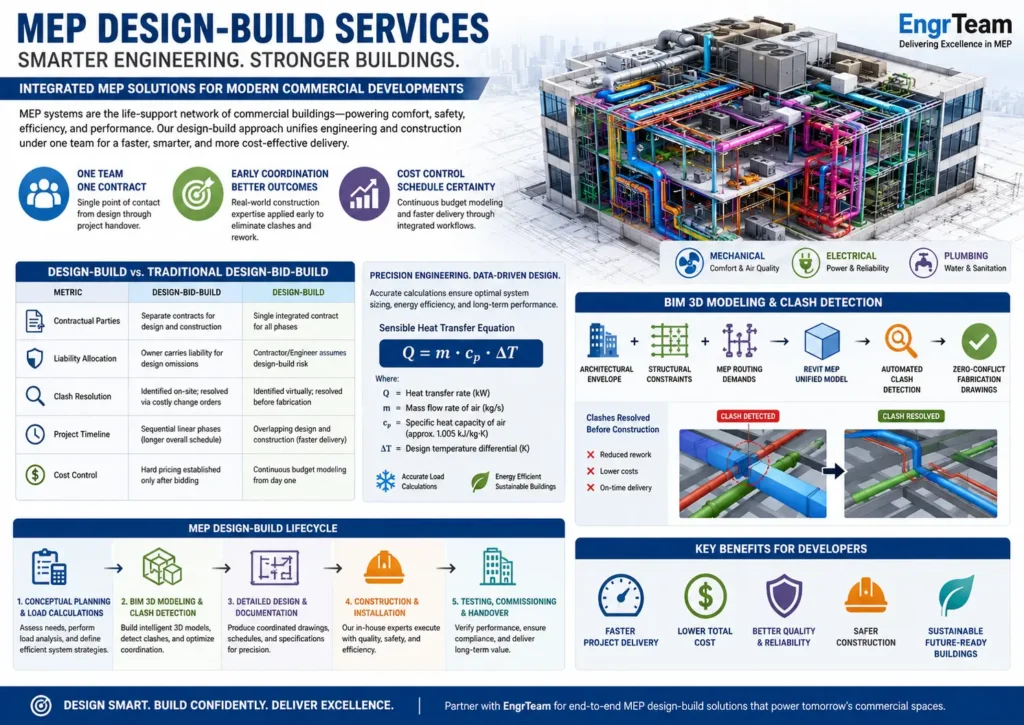
The term “design-build” refers to a project delivery system where a single entity is contractually responsible for both the design and construction phases of a build. When applied to mechanical, electrical, and plumbing engineering, this approach places the licensed engineers of record and the mechanical/electrical trade contractors under one unified team. This collaborative alignment begins at the conceptual stage and continues through building handover.
Instead of navigating separate contracts, developers work with a single point of contact. This integrated methodology leverages real-world construction expertise during the initial drawing phases, ensuring that conceptual diagrams are structurally viable and financially realistic. Specialized providers like EngrTeam deliver professional mep plan services that synchronize custom MEP layouts with digital rendering, structural engineering, and sustainable practices. This coordination ensures every technical detail aligns with the developer’s operational targets and budget parameters.
The Mechanics of Design-Build vs. Traditional Design-Bid-Build
To understand why commercial developers are increasingly adopting integrated workflows, it is helpful to compare design-build with the traditional design-bid-build (DBB) model.
| Metric | Design-Bid-Build | Design-Build |
| Contractual Parties | Separate contracts for design and construction | Single integrated contract for all phases |
| Liability Allocation | Owner carries liability for design omissions | Contractor/Engineer assumes design-build risk |
| Clash Resolution | Identified on-site; resolved via costly change orders | Identified virtually; resolved before fabrication |
| Project Timeline | Sequential linear phases (longer overall schedule) | Overlapping design and construction (faster delivery) |
| Cost Control | Hard pricing established only after bidding | Continuous budget modeling from day one |
In a traditional DBB framework, the building owner first hires an architectural firm, which subcontracts the MEP engineering. Once drawings are complete, the project is sent to bid. This linear process often results in bidding contractors discovering design errors, mismatched spatial configurations, or uncoordinated routing in the field.
Under the design-build model, because the engineering team and installation mechanics collaborate from the schematic design phase, spatial and functional limitations are identified early. If an HVAC duct conflicts with a structural support beam or a fire sprinkler line, the issue is resolved on a digital screen, not with a blowtorch on the construction floor.
Core Phases of the MEP Design-Build Lifecycle
The execution of high-performing MEP design-build services rests on a multi-phase engineering process. Each phase is designed to build upon the last, maximizing spatial efficiency, budget control, and speed.
Phase 1: Conceptual Planning and Load Calculations
Before drafting blueprints, design-build engineers conduct detailed spatial and occupancy assessments. Because every non-residential occupancy class—from office spaces to commercial kitchens—demands distinct operational criteria, precise calculations are essential to prevent system oversizing.
For example, mechanical design engineers use precise thermodynamics to calculate heating and cooling loads, ensuring compliance with ventilation requirements like those outlined in Standard 62.1 by ASHRAE. The sensible heat transfer rate for an air-handling system can be evaluated using the thermodynamic relationship:
Q = m × cp × ΔT
Where:
- Q = heat transfer rate in kilowatts (kW)
- m = mass flow rate of air in kilograms per second (kg/s)
- cp = specific heat capacity of air at constant pressure (approximately 1.005 kJ/kg·K)
- ΔT = design temperature differential across the cooling or heating coil in Kelvin (K)
Phase 2: Interdisciplinary BIM 3D Modeling and Clash Detection
Modern commercial construction relies heavily on Building Information Modeling (BIM). Design-build teams utilize advanced platforms, such as Revit MEP, to build an interactive, data-rich 3D representation of the property.
Because structural framing, gravity drainage pipes, electrical conduits, and large HVAC duct runs must share limited plenum ceiling spaces, spatial coordination is critical. By running automated clash detection algorithms inside the unified BIM environment, engineers identify physical interferences between trades before any materials are purchased. This spatial optimization minimizes material waste, saves on-site labor, and guarantees a clear path for installers.
Phase 3: Construction Documentation and Code Compliance
Once the virtual 3D model is coordinated, the team produces finalized construction documents and stamped engineering drawings. These plans must adhere to a complex hierarchy of national model codes and state-level amendments. Licensed Professional Engineers (PEs) stamp these plans to secure municipal building permits.
Key regulatory systems that design-build teams navigate include:
- The International Code Council (ICC): The base standards for structural safety and systems compliance, including the International Building Code (IBC), International Mechanical Code (IMC), and International Plumbing Code (IPC). Developers can review updated adoption databases directly via the International Code Council (ICC) portal.
- The National Electrical Code (NEC): Documented as NFPA 70, this code governs the safe installation of commercial electrical service entrances, grounding networks, and distribution panels.
- Life-Safety Standards: Governed by the National Fire Protection Association (NFPA), including NFPA 13 for water-based fire sprinkler layouts and NFPA 72 for advanced fire alarm networks.
Phase 4: Prefabrication and Off-Site Modular Assembly
One of the greatest operational advantages of design-build engineering is its natural integration with modern manufacturing. Because the 3D model is geometrically accurate, the team can prefabricate complex mechanical, electrical, and plumbing assemblies in a controlled off-site facility.
Common prefabricated components include:
- Multi-trade plenum racks containing pre-insulated ductwork, electrical conduits, and domestic water lines.
- Pre-wired and pre-piped mechanical skids, such as boiler sets or chilled water pumping stations.
- Pre-assembled electrical room components, including switchgear and distribution panels mounted on modular framing.
Once constructed, these modular components are shipped directly to the job site for rapid installation. This strategy decreases on-site labor density, reduces construction safety hazards, and shortens project schedules.
Phase 5: Commissioning and Operational Handover
A building’s construction does not end when the last pipe is glued or wire connected. System commissioning verifies that all integrated components perform according to the original design intent and operational specifications.
During this stage, sensors, air-handling fans, emergency backup generators, and automatic transfer switches are systematically tested under various simulated load conditions. Proper commissioning reduces initial operational friction, lowers commercial energy bills, and provides building engineers with accurate as-built drawings for long-term maintenance.
Why Energy Efficiency and Sustainability Drive Design-Build Decisions
State and municipal energy mandates require commercial buildings to minimize greenhouse gas emissions and conserve operational energy. Design-build services are uniquely suited to meet these green standards because energy modeling is integrated directly into the initial layout decisions.
Engineers analyze energy conservation measures (ECMs) against the baseline criteria of ASHRAE Standard 90.1, which serves as the benchmark for energy code compliance across the United Stat
(VRF, Heat Pumps, LEDs)
Energy Limits
(Insulation, Cool Roofs)
(Solar PV Arrays, Storage)
Carbon Limits
(Demand Ventilation)
Several sustainable technologies are optimized through design-build engineering:
- Variable Refrigerant Flow (VRF) Systems: Highly efficient climate-control networks that capture waste heat from cooling zones and redistribute it to areas requiring warmth.
- Demand-Controlled Ventilation (DCV): Smart systems that monitor carbon dioxide CO₂ levels inside heavily occupied spaces, adjusting fresh outdoor air intake in real-time to conserve thermal energy.
- Renewable Energy Integration: Pairing on-site solar photovoltaic (PV) arrays, microgrids, and battery backup systems directly with the building’s electrical main service.
Furthermore, design-build firms are navigating complex macro-environmental transitions, such as the phase-down of R-410A refrigerants and the transition to environmentally friendly, low-Global Warming Potential (GWP) A2L mildly flammable alternatives. Handling these specialized compounds requires modified equipment selections, proper duct venting, and specialized leak detection sensors—all of which are seamlessly integrated under a design-build umbrella.
Navigating Commercial Sector Challenges with Integrated Engineering
The commercial construction sector frequently faces supply chain volatility, tight timelines, and a shrinking pool of skilled trade labor. MEP design-build services provide direct solutions to these persistent macroeconomic pressures.
- Early Material Procurement: In a fragmented bid model, materials cannot be ordered until the design is completely finalized and bid out. Under design-build, long-lead equipment—such as commercial chillers, switchgear, and backup generators—can be specified and ordered during early design phases, shielding developers from supply chain delays and sudden material inflation.
- Mitigating Labor Shortages: Prefabrication shifts labor hours from the construction site into controlled manufacturing facilities. This reduces overall labor requirements on-site, bypasses local workforce shortages, and improves quality control.
- Optimized Cost Balancing: Throughout the design process, cost-estimators and field managers perform continuous financial modeling. This ensures that the proposed systems are selected not just for low initial installation cost, but also for minimal lifetime operational expenses (OpEx).
Conclusion: Partnering for Project Success
MEP design-build services represent a significant evolution in commercial real estate development. By combining engineering design, spatial coordination, regulatory compliance, and installation expertise under one unified framework, this project delivery method helps developers navigate the complexities of modern construction.
Whether you are designing a high-performance commercial property, upgrading an aging HVAC infrastructure, or targeting net-zero certification, partnering with an experienced integrated engineering team ensures your project is built to last. Seamless communication, advanced 3D BIM coordination, and a focus on long-term efficiency transform mechanical, electrical, and plumbing blueprints into high-performing, high-value assets.