

Articles
- Building Design, Commercial Building Projects, Construction Engineering, Energy Efficiency & Sustainability, HVAC, HVAC Design, HVAC System Design, Mechanical Engineering, MEP design services, MEP Engineering, MEP Engineering, MEP Engineering services, MEP Layout Plans, MEP Services, MEP Technical Guides, Professional Engineering Consultation, Technical Compliance & Planning
The Definitive Guide to HVAC System Design for USA: 10 Core Codes, Standards, and Engineering Practices

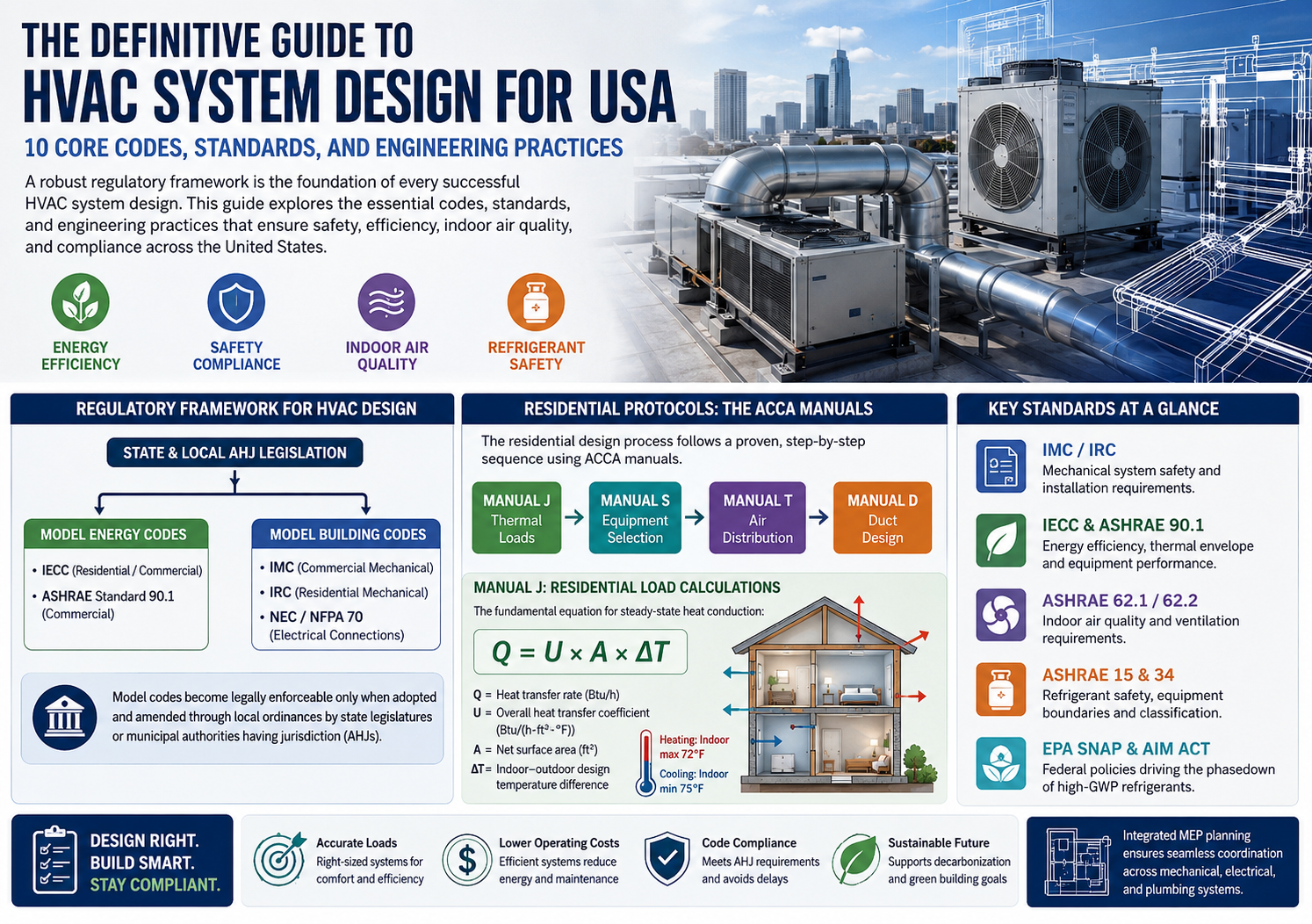
For any HVAC system design for USA, compliance with a robust regulatory framework is the baseline for success. Heating, ventilation,
Table of Contents
For any HVAC system design for USA, compliance with a robust regulatory framework is the baseline for success. Heating, ventilation, and air-conditioning (HVAC) systems are historically the most resource-intensive utilities in modern buildings, typically accounting for approximately 50% of total building electrical energy use and up to 70% of base landlord electrical operating costs. As energy codes become more demanding, and building systems move toward electrification, carbon reduction, and airtight envelopes, the standard of care required of mechanical engineers has risen significantly. Achieving an efficient mechanical utility layout in the United States requires navigating an interlocking network of model codes, referenced standards, and local amendments.
For projects seeking to streamline this multidisciplinary coordination, leveraging professional MEP plan services from specialized firms like EngrTeam ensures that all mechanical, electrical, and plumbing elements are fully integrated from the earliest schematic phases. A precise HVAC layout plan must be synchronized with electrical engineering services to ensure code-compliant power supply and control interlocks. This technical report examines the foundational thermal, structural, and regulatory frameworks that govern the execution of modern HVAC layouts across the United States.
Regulatory Foundations of HVAC System Design for USA
Mechanical installations in the United States are governed by an interlocking framework of model codes and voluntary consensus standards. It is critical for practicing engineers to distinguish between “codes” and “standards”. Model codes—such as those published by the International Code Council (ICC)—carry no legal authority on their own. They become legally binding only when adopted, amended, and enacted through local ordinances by state legislatures or municipal authorities having jurisdiction (AHJs). Standards, such as those developed by the American Society of Heating, Refrigerating and Air-Conditioning Engineers (ASHRAE) or the Air Conditioning Contractors of America (ACCA), are technical reference documents containing specific design criteria and engineering calculations. These standards become legally enforceable when they are cited directly within the body of an adopted model code.
Model Energy Codes
- IECC (Residential / Commercial)
- ASHRAE Standard 90.1 (Commercial)
Model Building Codes
- IMC (Commercial Mechanical)
- IRC (Residential Mechanical)
- NEC / NFPA 70 (Electrical Connections)
The regulatory framework is divided into four functional domains: mechanical system safety, energy efficiency, indoor air quality, and refrigerant containment. Mechanical safety and installation parameters are governed by the International Mechanical Code (IMC) for commercial structures and the International Residential Code (IRC) for low-rise residential structures.
Energy efficiency is regulated by the International Energy Conservation Code (IECC) and ASHRAE Standard 90.1, which set minimum thermal envelope performance standards and equipment efficiencies. Indoor air quality is regulated by ASHRAE Standards 62.1 and 62.2, which dictate ventilation baselines. Refrigerant safety and equipment boundaries are defined by ASHRAE Standards 15 and 34, which align with federal environmental regulations such as the Environmental Protection Agency’s (EPA) Significant New Alternatives Policy (SNAP) program and the American Innovation and Manufacturing (AIM) Act of 2020.
Residential Protocols for HVAC System Design for USA: The ACCA Manuals
For residential applications, typically defined under the IRC as detached one- and two-family dwellings and townhouses up to three stories in height, the design sequence is legally anchored by ACCA’s technical manuals. Undergoing continual, rigorous review, these manuals establish the industry standard of care for quality residential design, equipment selection, and duct distribution. The residential design sequence is a linear, highly interdependent process where the output of each calculation serves as the direct input for the next phase.
[Manual J: Thermal Loads] ──> [Manual S: Equipment Selection] ──> [Manual T: Air Distribution] ──> [Manual D: Duct Design]
Manual J: Residential Load Calculations
The engineering process begins with ACCA Manual J (typically the 8th Edition), which dictates the calculation of residential heating and cooling loads. Manual J requires a component-by-component heat transfer analysis of the building envelope, incorporating the thermal transmittance of all wall, roof, ceiling, and floor assemblies. The fundamental thermodynamic equation for steady-state heat conduction is represented as:
Where Q is the heat transfer rate in Btu/h, U is the overall heat transfer coefficient in Btu/(h·ft2·°F), A is the net surface area in square feet, and ΔT is the design temperature difference between the indoor setpoint and the outdoor design condition.
The indoor design conditions are strictly capped by energy codes, which limit the heating calculation to a maximum indoor temperature of 72°F and the cooling calculation to a minimum indoor temperature of 75°F.
The calculations must also account for infiltration rates, solar heat gain coefficients (SHGC) of glazing, internal heat gains from occupants, and lighting loads. This process establishes the peak sensible load (the temperature-driven cooling requirement) and the peak latent load (the moisture-removal cooling requirement) for each zone.
Manual S: Equipment Selection
Once the thermal loads are established, the design team uses ACCA Manual S to select the heating and cooling equipment. Equipment must be selected based on the manufacturer’s expanded performance data, which details the capacity of the system under the specific operating conditions of the project. Selecting equipment based solely on nominal AHRI ratings is a common design error. Nominal ratings are based on standard laboratory test conditions, which rarely reflect real-world designs.
Manual S requires adjusting the sensible, latent, and heating capacities for actual entering wet-bulb temperatures, outdoor ambient dry-bulb temperatures, and altitude. This step prevents oversizing, which otherwise leads to short-cycling, high indoor humidity, and premature equipment wear.
Manual T: Room Air Distribution
ACCA Manual T governs room air distribution, outlining the criteria for selecting the type, size, and location of registers, diffusers, and grilles. Delivering the correct volume of conditioned air is ineffective if the air is not properly distributed within the occupied space.
Manual T ensures that the supplied air has sufficient velocity, throw, and spread to mix thoroughly with room air without creating drafts or stagnant zones. This step maintains comfortable conditions within the occupied zone, which is defined as the space from the floor up to six feet high.
Manual D: Duct Sizing and Friction Rates
The final step in the residential sequence is ACCA Manual D, which governs residential duct design. Manual D sizes the supply and return duct systems based on the available external static pressure of the selected blower. The design team calculates the total equivalent length (TEL) of the longest duct run, accounting for the straight physical lengths of ductwork plus the equivalent lengths of all fittings, dampers, coils, and grilles. This calculation establishes the design friction rate:
Available Static Pressure × 100
Friction Rate = ─────────────────────────────────
Total Equivalent Length
This design friction rate is applied to a duct calculator to size the ductwork, ensuring that the system delivers the required airflow to each zone without exceeding the blower capacity or generating excessive velocity noise.
| ACCA Manual | Primary Engineering Domain | Essential Calculation Inputs | Primary Calculation Outputs | Key Code Relevance |
| Manual J[cite: 9] | Residential Load Calculation | Envelope U-factors, glazing SHGC, infiltration, local outdoor design temperatures. | Peak sensible and latent cooling loads, peak heating loads in Btu/h. | Mandated by IRC Section M1401.3 and IECC Section R403.7. |
| Manual S[cite: 9] | Equipment Selection | Manual J calculated loads, manufacturer expanded performance data, entering wet-bulb and dry-bulb temps. | Specific equipment models, verified sensible and latent capacities under design conditions. | Mandated by IRC Section M1401.3 and IECC Section R403.7. |
| Manual T[cite: 12] | Room Air Distribution | Airflow volume (CFM) per room, target Noise Criteria (NC), room dimensions, register throw. | Selection and placement of supply registers, return grilles, and diffusers. | Ensures compliance with thermal comfort criteria in ASHRAE Standard 55. |
| Manual D[cite: 9, 15] | Residential Duct Design | Selected blower external static pressure, component pressure drops, duct layout geometry. | Duct cross-sectional dimensions, friction rate, trunk and branch sizing. | Mandated by IRC Section M1601.1 and IECC Section R403.7. |
| Manual N[cite: 9] | Light Commercial Load Calculation | Commercial envelope performance, indoor design temperatures, occupancy density, internal equipment gains. | Peak commercial thermal loads, ventilation load profiles. | Mandated by IMC Chapter 3 and IECC Section C403.2. |
Commercial Engineering Standards for HVAC System Design for USA
In commercial and multi-family residential structures, which are typically governed by the International Building Code (IBC) and the IMC, design protocols transition from ACCA manuals to ASHRAE standards. The commercial design process requires an understanding of complex structural-envelope interactions and highly variable internal heat gains.
ASHRAE Standard 183: Commercial Load Calculation Protocols
Peak heating and cooling loads for commercial facilities must be calculated in accordance with ASHRAE Standard 183. Standard 183 establishes the minimum rigorous methodologies for load calculations, requiring developers to evaluate peak heat losses and heat gains. Unlike residential structures, where loads are primarily driven by conductive and radiative transfer through the building envelope, commercial loads are heavily influenced by internal heat sources. These internal heat gains include:
- Lighting Power Densities (LPD): The heat generated by lighting systems, expressed in watts per square foot , which must comply with the maximum values permitted by Standard 90.1.
- Occupancy Densities: Heat generated by occupants, split into sensible and latent heat based on the activity level of the space (e.g., sedentary office work versus active athletic exercise).
- Process and Plug Loads: The heat generated by office equipment, computers, servers, commercial kitchen appliances, and manufacturing processes.
- Ventilation Thermal Loads: The heating and cooling required to condition large volumes of outdoor air to dilute indoor contaminants.
To ensure alignment across the design team, engineers document these requirements in a Basis of Design (BoD). The BoD is a formal design document that defines the intended function, performance, and operational criteria of the HVAC systems. It outlines the owner’s project requirements, the design indoor conditions (temperature, relative humidity, air filtration levels), selected climate zone data, design ventilation rates, and planned control sequences.
Building Energy Modeling (BEM) and Partial-Load Sizing
Commercial mechanical designs utilize Building Energy Modeling (BEM) to optimize equipment sizing and system selection. BEM tools simulate the thermodynamic behavior of a building across all 8,760 hours of the year. While standard load calculations focus solely on peak conditions (which typically occur for less than 2% to 5% of the year), BEM allows engineers to evaluate how a system performs under partial-load conditions, which occur during the remaining 95% to 98% of the year.
Components like heating coils, cooling coils, and fans operate at their peak efficiencies under full design loads, but their efficiency often decreases significantly under partial loads. BEM helps engineers select equipment with variable-capacity controls, such as variable-speed scroll compressors or multi-stage burners, that maintain high efficiency across a wide range of operational loads.
Furthermore, BEM helps evaluate hydronic systems. Because water stores nearly 1,000 times more thermal energy per unit volume than air, water-based systems can replace large air ducts with thin, insulated hydronic pipes. This reduces fan energy, saves ceiling plenum space, and lowers overall energy consumption.
Energy Conservation Pathways in HVAC System Design for USA
Commercial energy conservation is governed by two primary pathways: the International Energy Conservation Code (IECC) Commercial Provisions or ASHRAE Standard 90.1. Both are recognized national benchmarks for energy-efficient building design.
IECC Commercial
Prescriptive tables and direct code text compliance pathway.
ASHRAE Standard 90.1
Alternate compliance pathway commonly used for complex commercial buildings.
In jurisdictions that allow both compliance paths, the mechanical designer must select one and apply it consistently across all aspects of the building design, including the thermal envelope, mechanical systems, service water heating, and lighting systems.
IECC Section C403 vs. ASHRAE Standard 90.1: Core Mechanical Requirements
The prescriptive mechanical requirements of both IECC Section C403 and ASHRAE Standard 90.1 mandate several key system attributes:
- Thermostatic Controls: Temperature controllers must be configured with a of at least between the heating and cooling setpoints. This prevents simultaneous heating and cooling or rapid, energy-wasteful cycle shifting.
- Off-Hour Controls and Schedules: Building automation systems (BAS) must implement automatic time-of-day scheduling, night-setback, and night-setup controls to reduce conditioned airflow during unoccupied periods.
- Isolation Areas and Dampers: HVAC systems serving spaces larger than or structures spanning multiple stories must be divided into separate isolation areas. Each area must be equipped with automatic dampers controlled to shut off conditioned air supply, return, and outdoor ventilation intake when unoccupied.
- Specialized Thermal Control Loops: Heated vestibules and air curtains must utilize automatic controls to shut off their heating elements when the outdoor air temperature rises above Additionally, dedicated thermostats within vestibules must limit heating to a maximum of and cooling to a minimum of
Additionally, both energy codes require Demand Control Ventilation (DCV) for high-occupancy spaces. Standard 90.1 requires DCV for zones served by systems with air-side economizers, automatic modulating outdoor air dampers, or design outdoor airflow rates exceeding 3,000 CFM.
Advanced Energy Design Guides (AEDG) and Net-Zero Buildings
For projects striving to achieve performance beyond the minimum requirements of standard codes, ASHRAE’s Advanced Energy Design Guides (AEDG), developed with the support of the Department of Energy (DOE), provide prescriptive design pathways to achieve zero energy performance. A building is considered net-zero energy when, on an annual basis, it imports equal or less energy than it exports through on-site renewable energy sources.
The AEDG series outlines specific target Energy Use Intensity (EUI) thresholds, which represent the energy consumed per square foot per year, and provides over 200 strategies to help reach these targets. These strategies include:
- High-Performance Envelope Designs: Utilizing exterior insulation details, thermal break components, and low-conductance glazing to minimize conductive heat transfer and infiltration.
- Dedicated Outdoor Air Systems (DOAS): Decoupling the ventilation load from the sensible heating and cooling loads, allowing each system to operate at peak efficiency.
- Energy Recovery Ventilation (ERV): Transferring sensible heat and latent moisture between the incoming fresh air stream and the outgoing exhaust air stream, reducing the load on the heating and cooling plants.
- Building Automation and Controls: Implementing advanced sequences, such as optimal start/stop and automated shading control, to further reduce energy use.
Indoor Air Quality and Ventilation in HVAC System Design for USA
To maintain healthy and productive indoor environments, systems must comply with ASHRAE Standards 62.1 and 62.2. Standard 62.1 governs ventilation rates in commercial spaces, while Standard 62.2 establishes indoor air quality criteria for low-rise residential structures.
The Ventilation Rate Procedure (VRP) and Multi-Zone Systems
Standard 62.1 defines two primary compliance pathways for ventilation: the Ventilation Rate Procedure (VRP) and the Indoor Air Quality Procedure (IAQP). The VRP is a prescriptive design approach that determines the required intake of outdoor air based on zone occupancy and floor area. The breathing zone outdoor airflow (Vbz) is calculated as:
Where Rp is the outdoor airflow required per person (CFM/person), Pz is the zone population, Ra is the outdoor airflow required per unit area (CFM/ft2), and Az is the net zone floor area.
For multi-zone systems, where a single air-handling unit serves multiple spaces with different occupancy rates, the calculation must adjust for system ventilation efficiency (Ev). If some zones require a high fraction of outdoor air while other zones require very little, the system-level outdoor air intake (Vot) must be increased to ensure that the critical (most demanding) zone receives its required ventilation. This system efficiency adjustment is calculated using the multi-zone equations in Standard 62.1 to prevent under-ventilating critical spaces.
Air Cleaning, Filtration, and Pathogen Control
In addition to introducing outdoor air, modern systems must incorporate advanced air cleaning and filtration technologies to manage particulate and biological contaminants.
- Particulate Filtration (ASHRAE Standard 52.2): Standard 52.2 establishes the testing methodology to evaluate the performance of air-cleaning devices based on particle size removal efficiency. This standard rates filters on a Minimum Efficiency Reporting Value (MERV) scale from 1 to 16, which is based on the filter’s ability to capture particles between 0.3 and 10 microns. Modern energy codes and green building standards often mandate a minimum filtration level of MERV 13 for occupied spaces to capture fine particulate matter and airborne droplets.
- Ultraviolet Germicidal Irradiation (UVGI): To mitigate biological contaminants, designers can integrate UVGI systems. These systems are tested in accordance with ASHRAE Standard 185.1 (testing UV-C lights inside air ducts to inactivate airborne microorganisms) and ASHRAE Standard 185.2 (testing UV-C lamps to prevent biofilm buildup on cooling coils and drain pans).
- Active Indoor Air Quality Monitoring: Incorporating real-time sensors for carbon dioxide , volatile organic compounds (VOCs), and particulate matter provides continuous data to the BAS. This allows the system to modulate ventilation rates dynamically, maintaining indoor air quality while minimizing energy consumption.
Human Thermal Comfort in HVAC System Design for USA
The primary goal of an HVAC system is to maintain comfortable conditions for building occupants. This thermal comfort baseline is governed by ASHRAE Standard 55, which defines the combinations of indoor thermal environmental factors and personal factors that produce acceptable thermal conditions.
ASHRAE Standard 55 Parameters and the Comfort Zone
Standard 55 identifies six primary parameters that influence thermal comfort:
- Metability Rate (Met): The rate of chemical energy transformation by the human body, which is determined by the physical activity level of the occupant.
- Clothing Insulation (Clo): The thermal resistance provided by the clothing worn by occupants.
- Air Temperature: The dry-bulb temperature of the air surrounding the occupant.
- Mean Radiant Temperature (MRT): The uniform temperature of an imaginary black enclosure in which an occupant would exchange the same amount of radiant heat as in the actual environment. MRT is heavily influenced by surface temperatures, such as windows, uninsulated exterior walls, or exposed concrete slabs.
- Air Velocity: The rate of air movement across the occupant, which affects convective heat loss from the skin.
- Relative Humidity: The ratio of water vapor in the air to the maximum amount of water vapor the air can hold at that temperature, which affects evaporative cooling of the body.
Using these six variables, Standard 55 utilizes the Predicted Mean Vote (PMV) and Predicted Percentage of Dissatisfied (PPD) mathematical models to define a thermal comfort envelope. The PMV model predicts the average comfort vote of a large group of people on a scale from -3 (very cold) to +3 (very hot). The design target is typically a PMV between -0.5 and +0.5, which corresponds to a PPD of less than 10%, meaning that at least 90% of occupants find the thermal environment acceptable.
Dehumidification Challenges and Moisture Mitigation
Maintaining indoor relative humidity within the comfortable range of 30% to 60% can be challenging in hot-humid and mixed-humid climates. This is particularly true in low-load buildings, which feature high thermal insulation and airtight construction. In these structures, the sensible cooling load is low, but the latent load remains high due to ventilation requirements and internal occupant loads.
Standard cooling systems are typically controlled by a single thermostat that responds only to dry-bulb temperature. In a low-load home, the system may run only long enough to meet the temperature setpoint and then turn off before the cooling coil can remove sufficient moisture from the air. This leads to high indoor humidity, which violates the comfort criteria of Standard 55 and can cause mold growth and damage to the building envelope.
To address this issue, design teams can specify systems optimized for enhanced dehumidification. These configurations can modulate fan speeds to run longer cooling cycles at lower velocities, or they can use a dedicated outdoor air system (DOAS) to handle the latent ventilation load independently of the sensible cooling load.
Refrigerant Safety and Regulatory Compliance in HVAC System Design for USA
The HVAC industry is undergoing a significant transition driven by national environmental regulations and updated equipment safety standards.
ASHRAE Standard 34
Classifies Low-GWP Alternatives
- Mildly Flammable A2L Class
- Examples: R-32, R-454B
ASHRAE Standard 15
Safety Rules for Machinery Rooms
- Dedicated Leak Detection Systems
- Spark-Free Ventilation Interlocks
The Transition to Low-GWP and A2L Refrigerants
The AIM Act of 2020 requires a phasedown of high-Global Warming Potential (GWP) hydrofluorocarbon (HFC) refrigerants, such as R-410A, which have been standard in residential and commercial cooling systems for decades. In response, manufacturers are transitioning to low-GWP alternatives. Many of these alternative refrigerants are classified under ASHRAE Standard 34 as A2L refrigerants.
ASHRAE Standard 34 classifies refrigerants based on their safety group, which is determined by a combination of toxicity and flammability:
- Class A1: Lower toxicity and no flame propagation (e.g., R-410A, R-134a).
- Class A2L: Lower toxicity and mild flammability (e.g., R-32, R-454B). These refrigerants have a low burning velocity, a high minimum ignition energy, and are difficult to ignite.
- Class B-Class: Higher toxicity (e.g., ammonia, R-717).
ASHRAE Standard 15 Safety Requirements for Machinery Rooms
The design and installation of systems using A2L or B-class refrigerants must comply with the requirements of ASHRAE Standard 15. Standard 15 establishes safety guidelines to protect occupants and service personnel in the event of a refrigerant leak. When designing commercial systems with A2L refrigerants, mechanical engineers must incorporate specific safety features:
- Dedicated Leak Detection Systems: Mechanical rooms housing equipment with large refrigerant charges must be equipped with refrigerant concentration sensors. These sensors must be tested and certified to detect the specific refrigerant used in the space.
- Safety Interlocks: If a leak is detected, the sensor must automatically trigger safety interlocks to shut off the compressor, isolate the refrigerant charge, and activate mechanical ventilation to dissipate the gas.
- Spark-Free Ventilation Systems: The exhaust fans in mechanical rooms must be spark-free to prevent accidental ignition of the A2L refrigerant, and they must discharge directly to the outdoors.
- Clearance and Separation: Standard 15 defines specific spatial clearances and separation requirements between refrigeration equipment and open flames, hot surfaces, or electrical panels to prevent ignition sources.
Life-Cycle Operations and Commissioning in HVAC System Design for USA
To ensure that HVAC systems continue to operate efficiently and meet indoor air quality targets, design teams must plan for life-cycle operations, maintenance, and commissioning.
ASHRAE/ACCA Standard 180 and Preventative Maintenance
ASHRAE/ACCA Standard 180 establishes the minimum inspection and maintenance requirements for commercial building HVAC systems. Standard 180 provides systematic procedures to preserve a system’s ability to achieve acceptable thermal comfort, energy efficiency, and indoor air quality in both new and existing buildings.
Rather than relying on generic, cut-and-paste maintenance specifications, Standard 180 requires site-specific maintenance plans. These plans outline routine tasks, such as filter replacements, coil cleaning, sensor calibrations, and airflow testing, to prevent equipment degradation and operational drift.
ASHRAE Standard 211 and Energy Audit Protocols
To identify energy-saving opportunities in existing facilities, engineers follow the energy auditing protocols defined in ASHRAE Standard 211. Standard 211 defines consistent practices for conducting and reporting commercial building energy audits, which are categorized into three levels of detail:
- Level 1 Walk-Through Analysis: A basic assessment of energy bills and a walk-through of the facility to identify low-cost energy-saving opportunities.
- Level 2 Energy Survey and Analysis: A detailed evaluation of energy consumption patterns, including end-use breakdowns, and a cost-benefit analysis of proposed energy conservation measures.
- Level 3 Detailed Analysis of Capital-Intensive Modifications: A highly detailed assessment that utilizes building energy modeling and detailed engineering calculations to evaluate capital-intensive retrofits.
Standard 211 provides a common scope of work for these audits, establishing consistent methodologies and reporting requirements to help building owners make informed decisions.
Commissioning, Systems Manuals, and Ongoing Operations
Commissioning (Cx) is an engineering process that verifies that all building systems perform according to the owner’s requirements and design intent. This process is essential for modern, high-efficiency systems, which rely on advanced control sequences and automation.
To support commissioning and long-term operations, the design team must prepare comprehensive documentation:
- Systems Manuals (ASHRAE Guideline 1.4): A technical reference document that compiles the design intent, performance metrics, operating instructions, and maintenance requirements for all building systems.
- Field Testing of Controls (ASHRAE Guideline 11): Establishes protocols for field testing control components to verify that sensors, actuators, and controllers respond correctly to control commands.
- Risk Management for Biological Contaminants (ASHRAE Standard 188 & Guideline 12): Establishes risk management practices to prevent biological contamination, such as legionellosis, in building water systems and cooling towers.
Multi-Disciplinary Coordination for HVAC System Design for USA
Designing a high-performance HVAC system requires close coordination across all engineering disciplines to prevent spatial, structural, and electrical conflicts.
Mechanical Sizing
- Physical spaces for ducts, terminal units, and fans.
Electrical Sizing
- Motor loads, VFDs, power disconnects, and BAS controls.
Plumbing Layouts
- Water supply lines and drain paths for condensate.
For high-performance buildings, utilizing comprehensive MEP plan services from specialized firms like EngrTeam ensures that all of these elements are coordinated from the earliest design stages.
Coordinated Space Planning and Structural Considerations
Large mechanical equipment, such as air-handling units, chillers, and energy recovery ventilators, requires significant spatial allocation. The mechanical design team must coordinate with the architectural and structural teams to ensure that mechanical rooms are sized to accommodate equipment with adequate clearances for maintenance, coil pull-out, and filter access.
Additionally, the weight of large mechanical systems must be coordinated with structural designers to ensure that floor slabs, structural columns, and roof curbs are engineered to support the operating load of the equipment.
Electrical Load Coordination and Mechanical Safety
Developing a detailed HVAC layout plan requires close coordination with electrical design teams. Mechanical equipment, such as variable-speed compressors, fans, and pumps, requires dedicated electrical connections, motor starters, and local safety disconnects.
These requirements must be coordinated through professional electrical engineering services to ensure that electrical distribution panels, branch wiring, and overcurrent protection devices are sized correctly to handle the starting current and running loads of the equipment.
Furthermore, low-voltage control circuits and safety shutdowns must be coordinated to ensure that systems shut down automatically in the event of fire, smoke detection, or refrigerant leaks.
Plumbing Coordination and Condensate Management
Mechanical and plumbing teams must coordinate closely to manage water supply and drainage.
- Condensate Drainage: Cooling coils and high-efficiency condensing furnaces produce large volumes of acidic condensate during operation. Plumbing systems must be designed to capture, treat, and safely discharge this condensate to the building drainage system.
- Hydronic Water Make-Up: Hydronic heating and cooling loops require dedicated domestic water make-up connections, backflow preventers, and pressure-reducing valves to maintain target water levels and prevent system pressure drops.
- Cooling Tower Water Supply: Cooling towers require water treatment systems and make-up water connections to offset water loss from evaporation, drift, and blowdown processes.
By prioritizing this multidisciplinary coordination and following established industry codes and standards, design teams can deliver HVAC systems that offer high efficiency, safety, and long-term reliability.
Recent Posts
- Residential MEP Design Experts: The Ultimate Guide to Modern Home Engineering
- Commercial MEP Solutions in UK: Optimising Performance, Sustainability, and Regulatory Compliance
- MEP Engineering Granby: Comprehensive Guide to Mechanical, Electrical, and Plumbing Design
- Sizing HVAC the Smart Way: A Complete Guide to Cool Calc Manual J, S, & D
- Professional Engineering Hemel Hempstead: Comprehensive MEP & Building Services Solutions