

Articles

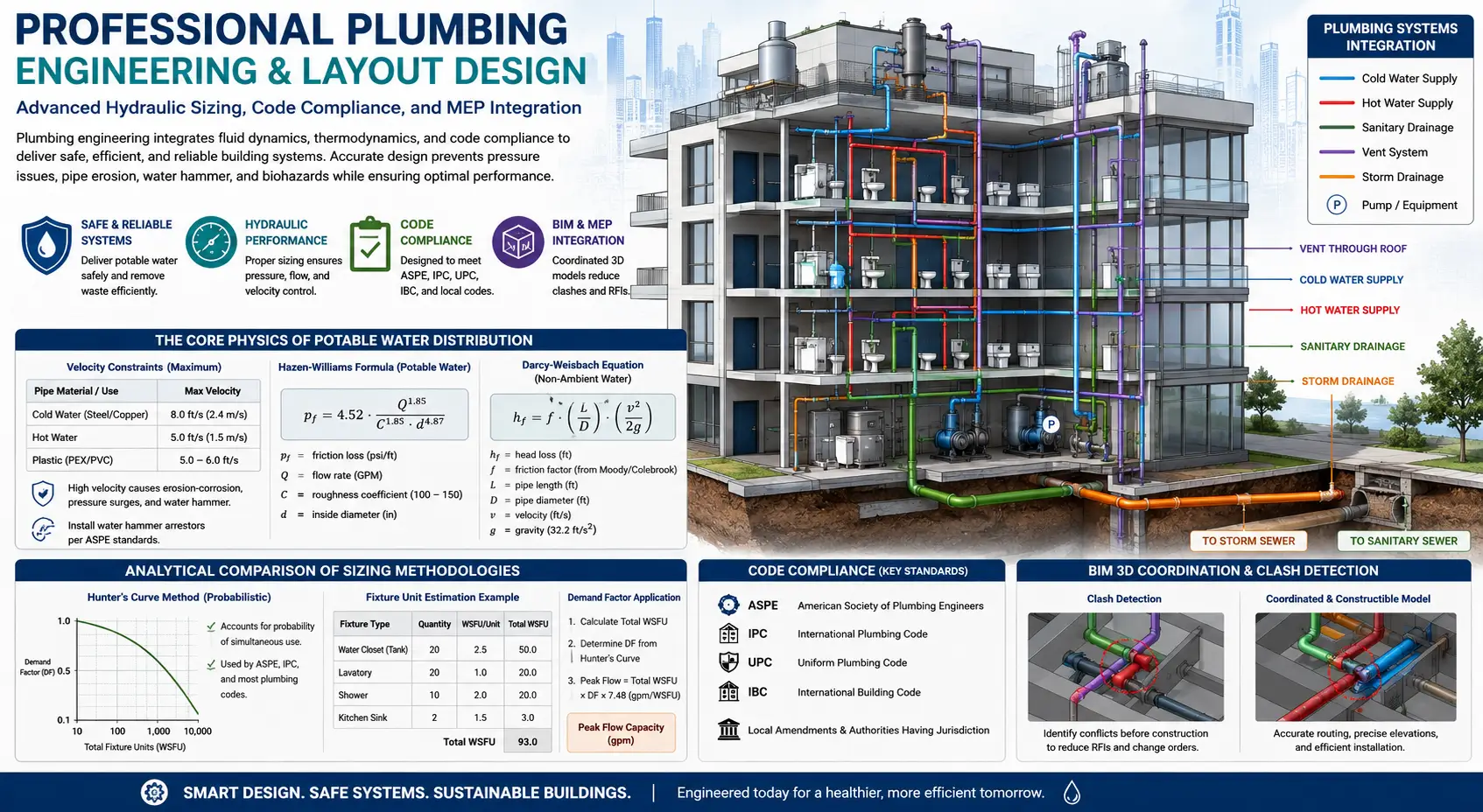
In the modern built environment, Professional Plumbing Engineering And Layout Design building systems function as integrated, living infrastructures. Within this paradigm, mechanical, electrical, and plumbing (MEP) layouts serve as the essential physical pathways that sustain occupancy, preserve health, and maintain structural integrity. Professional plumbing engineering and layout design require a deep understanding of fluid dynamics, thermodynamic principles, regulatory frameworks, and advanced spatial modeling. Neglecting these core parameters can lead to system failures, ranging from persistent pressure imbalances and premature pipe erosion to biological hazards such as Legionella pneumophila colonization.
Historically, plumbing was managed as a trades-based schematic design. Today, it is recognized as a complex application of fluid mechanics, mass transfer, and thermal energy management. Designers must coordinate water supply networks, sanitary drainage paths, venting loops, and storm drainage collectors with the architectural envelope and HVAC configurations. To navigate these technical demands and ensure project success, designers frequently utilize comprehensive industry references such as the engrteam.com/plumbing-system-design-guide/ to establish robust, professional-grade development workflows. This report examines the hydraulic principles, code mandates, calculation methodologies, and digital coordination standards that define plumbing engineering design.
The Core Physics of Potable Water Distribution Systems
Potable water supply systems must deliver safe water at adequate volumes, pressures, and velocities to all terminal fixtures within a building. Achieving this balance requires calculating the relationship between fluid pressure, pipe friction, gravitational forces, and velocity limits.
Volumetric Flow and Velocity Constraints
Potable water distribution systems are subject to strict velocity constraints to protect the piping network from structural degradation and control system acoustics. While elevated velocities can deliver higher flow rates through smaller, less expensive pipes, they also introduce significant physical risks. For example, high velocity increases the kinetic energy of the fluid, making the system vulnerable to erosion-corrosion. This process physically scours the protective copper oxide layer from pipe walls, leading to pinhole leaks.
To mitigate these risks, the American Society of Plumbing Engineers (ASPE) and major model plumbing codes establish maximum velocity thresholds based on pipe material, water temperature, and use cases:
Cold Water Lines (Steel/Copper): Typically limited to 8.0 ft/s (2.4 m/s) to control pressure surges and structural wear.
Hot Water Lines: Limited to a maximum of 5.0 ft/s (1.5 m/s). Elevated temperatures accelerate copper oxidation and erosion under high shear stresses, making hot water systems more susceptible to velocity-induced pipe wall thinning.
Plastic Pipelines (PEX/PVC): Often restricted to 5.0 to 6.0 ft/s to maintain hydraulic stability and prevent acoustic vibrations.
Excessive velocity also increases the risk of water hammer—a hydraulic shockwave generated when a fluid column is forced to stop suddenly, such as by a quick-closing solenoid valve. This kinetic energy transfer produces a localized pressure spike that propagates through the system, damaging joint connections, valves, and water heaters. To absorb these transient energy waves, engineers must install sized water hammer arrestors calculated in accordance with ASPE standards.
Dynamic Friction Head Loss Formulas
Calculating hydraulic resistance in potable water piping utilizes the empirical Hazen-Williams formula or the more mathematically rigorous Darcy-Weisbach equation. The Hazen-Williams formula is widely used for potable water sizing because it simplifies friction calculations for turbulent water flows at ambient temperatures:
Hazen-Williams Formula
pf = 4.52 × Q1.85 / (C1.85 × d4.87)
Where:
pf = Frictional pressure loss per linear foot of pipe (psi/ft).
Q = Volumetric flow rate (gallons per minute, GPM).
C = Pipe material roughness coefficient (typically 100 for unlined cast iron to 150 for copper and plastic).
d = Actual inside pipe diameter (inches).
For systems with non-ambient water temperatures, such as high-temperature commercial hot water loop recirculations, the Darcy-Weisbach equation is preferred. This equation accounts for fluid density, kinematic viscosity, and Reynolds number transitions.
Darcy-Weisbach Equation
hf = f × (L / D) × (v2 / 2g)
Where:
hf = Head loss due to friction (feet of head).
f = Dimensionless friction factor determined from the Moody diagram or the Colebrook-White equation.
L = Physical length of the pipe segment (feet).
D = Hydraulic internal diameter of the pipe (feet).
v = Mean fluid velocity (ft/s).
g = Acceleration due to gravity (32.2 ft/s2).
Analytical Comparison of Sizing Methodologies
Determining peak design flow rate is a fundamental challenge in potable water system design. Because it is highly improbable that every plumbing fixture in a building will operate at the same moment, engineers apply probability theory to size systems for realistic peak conditions rather than cumulative fixture capacity.
The Standard Hunter’s Curve Framework
In 1940, Roy Hunter of the National Bureau of Standards published report BMS 65, introducing a probabilistic framework for estimating peak water loads using Water Supply Fixture Units (WSFU). This method assigns a dimensionless numerical weight (WSFU value) to each plumbing fixture based on its water consumption rate, operational duration, and average time between uses.
Mathematically, Hunter modeled fixture operations as independent binomial events. The probability P that exactly k fixtures are active simultaneously out of a total population of n fixtures is calculated as:
P(X = k) = [n! / (k! × (n − k)!)] × pk × (1 − p)(n − k)
Where:
P(X = k) = Probability that exactly k fixtures are operating simultaneously.
n = Total number of plumbing fixtures.
k = Number of fixtures operating at the same time.
p = Probability that an individual fixture is in use.
The probability p is calculated as:
p = t / T
Where:
t = Operational duration of the fixture.
T = Average recurrence interval between fixture uses.
Sizing criteria are typically set at the 99th percentile, meaning there is only a 1% probability that actual water demand will exceed the calculated design flow rate.
The Limits of the 1940 Curve
While Hunter’s Curve has successfully prevented water supply shortages for over eighty years, it often leads to oversized piping in modern systems. Roy Hunter developed his model when standard flush-tank water closets consumed approximately $7$ gallons per flush (gpf). Modern high-efficiency fixtures operate with significantly lower consumption, such as $1.6\text{ gpf}$ to $1.28\text{ gpf}$, and ultra-high-efficiency flushometer valves use as little as $0.8\text{ gpf}$.
Applying the original 1940 Hunter’s Curve to modern buildings often results in design flow rates that are 100% higher than actual water use. This systemic oversizing increases capital costs for materials and leads to larger water volumes stagnating within the piping network. This stagnation reduces water velocity, accelerates disinfectant decay, and increases the risk of Legionella growth.
The Water Demand Calculator (WDC)
To address these limitations, the International Association of Plumbing and Mechanical Officials (IAPMO), the American Society of Plumbing Engineers (ASPE), and the Water Quality Research Foundation (WQRF) developed the Water Demand Calculator (WDC). The WDC uses a modified probability algorithm backed by residential water-use datasets to calculate flow rates for modern low-flow fixtures.
| Sizing Parameter | Traditional Hunter’s Curve Method (IPC/UPC) | Modern Water Demand Calculator (WDC) Method |
|---|---|---|
| Statistical Basis | 1940 Binomial Probability Theory | Advanced probability algorithms using modern water use data |
| Typical Toilet Flush Volume | 7.0 gallons per flush (gpf) | 1.28 to 0.8 gallons per flush (gpf) |
| System Sizing Tendency | Conservative; often oversized by up to 100% | Optimized; reduces pipe diameters by one or two sizes |
| Water Quality Impact | High water age; increased stagnation risks | Low water age; helps maintain disinfectant residuals |
| Primary Limitation | Inefficient energy usage in recirculating loops | Currently restricted to residential applications |
The WDC uses a database of water pulse characteristics to represent the water consumption patterns of modern plumbing systems:
perform these hydraulic calculations and ensure code compliance.
Residential Water Demand Characteristics
| Residential Fixture Category | Average Volumetric Flow Rate (q) | Average Pulse Duration (t) | Frequency of Use (T) | Nominal Pulse Volume (v = q × t) |
|---|---|---|---|---|
| High-Efficiency Toilet (HET) | 1.5 GPM | 2.0 minutes | 180 minutes | 3.0 gallons |
| Shower Head (Low-Flow) | 2.0 GPM | 8.0 minutes | 240 minutes | 16.0 gallons |
| Lavatory Faucet (Aerated) | 1.0 GPM | 0.5 minutes | 60 minutes | 0.5 gallons |
| Standard Clothes Washer | 3.0 GPM | 8.0 minutes | 480 minutes | 24.0 gallons |
To achieve optimal water velocity and pressure balance, designers frequently collaborate with specialized engineering firms to perform hydraulic calculations, optimize pipe sizing, and ensure full compliance with applicable plumbing codes and industry standards.
Sizing Domestic Water Supply Pipelines
Sizing a domestic water supply network requires a methodical approach to budget pressure throughout the system, ensuring adequate flow to the most hydraulically remote fixture.
POTABLE WATER SUPPLY SYSTEM SIZING
Pressure Sizing Step-by-Step
This structured procedure establishes pipe sizing criteria based on available pressure and frictional resistance:
1. Map the Riser Layout
Draft a schematic diagram detailing the physical routing of all water mains, vertical risers, and horizontal branches, identifying the most hydraulically remote fixture.
2. Sum Fixture Unit Values
Assign Water Supply Fixture Units (WSFUs) to each branch and riser segment based on applicable code values. Separate hot and cold water streams to calculate concurrent thermal loads.
3. Convert WSFUs to Design Flows
Use Hunter’s Curve to convert the total WSFU values into design flow rates expressed in gallons per minute (GPM).
4. Calculate Static Pressure Losses
Calculate static pressure changes based on the elevation difference between the water source and the highest plumbing fixture using the hydrostatic gradient:
Pstatic = 0.433 × Hvertical
Where:
Pstatic = Static pressure loss (psi).
Hvertical = Elevation change between the water source and the highest fixture (feet).
5. Determine Available Friction Pressure
Subtract all static and fixed pressure losses from the minimum available utility source pressure:
Pfriction = Psource − Pstatic − Pmeter − Pbackflow − Pfixture
Where:
Pfixture = Minimum operating pressure required at the terminal fixture (typically 15 psi for standard plumbing fixtures or 35 psi for flushometer valves).
6. Calculate Allowable Pressure Drop
Divide the available friction pressure by the total equivalent length of the pipe run, including an additional 50% to 100% allowance for fittings and valves, to determine the allowable pressure drop per 100 feet of pipe.
Equivalent Length = Measured Run × 1.50
Where:
Equivalent Length = Total effective pipe length after accounting for fittings, valves, and other components that create additional friction losses.
To illustrate this process, the following table details a sample pressure budget calculation for a six-story commercial building:
| Pressure Budget Component | Associated Pressure Value (PSI) | Sizing Influence / Notes |
|---|---|---|
| Municipal Street Main Pressure | +85.0 PSI (Minimum) | Baseline system entry pressure |
| Static Head Loss (65 ft vertical rise) | -28.1 PSI | Calculated as 65 ft × 0.433 psi/ft |
| Water Meter Pressure Loss | -6.5 PSI | Based on manufacturer performance curves at the design flow rate (GPM) |
| Backflow Preventer Pressure Loss | -10.0 PSI | Standard double-detector check assembly pressure loss |
| Terminal Fixture Requirement | -15.0 PSI | Minimum required operating pressure at the fixture |
| Remaining Available Friction Pressure | =25.4 PSI | Total pressure budget remaining for piping friction |
| Total Equivalent Length (180 ft × 1.50) | 270.0 equivalent feet | Standard fitting allowance factor |
| Allowable Friction Gradient | =9.4 PSI per 100 ft | Maximum design friction loss: 25.4 PSI ÷ 2.7 (hundred feet) |
Sanitary Drainage and Vent System & Professional Plumbing Engineering And Layout Design
Sanitary drainage systems operate as gravity-driven, open-channel flows rather than pressurized networks. Maintaining an equilibrium between liquid flow, solid waste transport, and atmospheric pressure is critical to prevent blockages and sewer gas infiltration into occupied spaces.
Self-Scouring Flow Dynamics
Sanitary horizontal lines must maintain a self-scouring velocity of at least $2.0\text{ ft/s}$ ($0.6\text{ m/s}$) to prevent solid waste from settling. If the slope is too flat, velocities drop, causing solids to accumulate and block the pipe. If the slope is too steep, water flows quickly and runs ahead of the solids, leaving them stranded in the horizontal drain.
DRAINAGE SLOPE VELOCITY DYNAMICS
The International Plumbing Code (IPC) defines minimum horizontal slopes to balance transport velocity across different pipe diameters:
- Pipes 2½ inches or smaller: Minimum horizontal slope of 1/4 inch per foot (2.1% slope).
- Pipes 3 to 6 inches: Minimum horizontal slope of 1/8 inch per foot (1.0% slope).
- Pipes 8 inches or larger: Minimum horizontal slope of 1/16 inch per foot (0.5% slope).
Drainage Fixture Units (DFUs) and Stack Sizing
Sanitary piping sizing is based on Drainage Fixture Units (DFUs). The capacity of building drains, horizontal branches, and vertical stacks is determined using code tables such as IPC Table 710.1(1) and Table 710.1(2):
| Nominal Pipe Size (Inches) | Max DFUs: Building Drain at 1/16 in/ft | Max DFUs: Building Drain at 1/8 in/ft | Max DFUs: Building Drain at 1/4 in/ft | Max DFUs: Vertical Soil Stack (3 intervals) |
|---|---|---|---|---|
| 1½ | — | — | 3 | 4 |
| 2 | — | — | 21 | 10 |
| 3 | — | 36 | 42 | 48 |
| 4 | — | 180 | 216 | 240 |
| 6 | — | 700 | 840 | 960 |
| 8 | 1,400 | 1,600 | 1,920 | 2,000 |
Note: Sourced from IPC Chapter 7 drainage tables. Any building drain serving a water closet must have a minimum diameter of 3 inches
Pneumatic Balance and Venting Systems
As waste cascades down a vertical soil stack, it acts like a piston, compressing the air column ahead of it and pulling a vacuum behind it. Without proper venting, this positive pressure can blow out fixture traps on lower floors, while the negative pressure can siphon the water seals from traps on upper floors.
Plumbing engineers design vent systems to keep pressure fluctuations within ±1.0 inch of water column (±249 Pa). Vent stacks must extend through the roof to the atmosphere, allowing sewer gases to escape and maintaining atmospheric pressure across all fixture traps. Horizontal piping layouts must be coordinated with these venting systems to ensure structural stability and long-term drainage performance. Designers frequently use professional modeling services like those at engrteam.com/plumbing-piping-layouts/ to produce coordinated drainage and venting isometric plans.
Stormwater Drainage and Roof Drain Engineering
Stormwater management requires accurate hydrological and structural engineering. Underestimating roof drainage parameters can lead to excessive water ponding, presenting a risk of structural deflection or roof collapse.
Primary and Secondary Sizing Under IPC Chapter 11
The sizing of vertical conductors, horizontal storm sewers, and gutters is governed by IPC Chapter 11. The process involves calculating the tributary roof area and determining the regional peak rainfall intensity.
The sizing of vertical conductors, horizontal storm sewers, and gutters is governed by IPC Chapter 11. The process involves calculating the tributary roof area and determining the regional peak rainfall intensity.
The first step is identifying the 100-year, 1-hour rainfall rate from local meteorological databases or IPC Appendix B. Designers must also check for local municipal amendments. For example, while standard maps show a 4 inches/hour rainfall intensity for a region, local codes may require designing for a 6 inches/hour rate to account for brief, severe cloudbursts.
The volumetric stormwater flow rate (Q) is calculated using the following formula:
Q = 0.0104 × R × A
Where:
- Q = Stormwater run-off flow rate (GPM).
- R = Design rainfall intensity (inches per hour).
- A = Horizontal tributary roof area (square feet).
- 0.0104 = Conversion factor relating rainfall depth per unit area to flow (1 GPM per square foot for 1 inch/hour of rainfall).
For pitched roofs or roofs bounded by adjacent walls, half the vertical wall area must be added to the tributary area, as wind-driven rain striking these walls is directed down onto the roof surface.
Horizontal and Vertical Run Calculations
The plumbing engineer must calculate pipe diameters based on the computed storm run-off flow rate. While horizontal lines run full, vertical lines flow partially full to allow for air entrainment and avoid vacuum siphoning.
Consider a project with a horizontal roof area of 100,000 sq ft in Dallas, Texas. While the IPC indicates a 100-year storm intensity of 4 inches/hour for Dallas, local municipal amendments require designing for 6 inches/hour. The design flow rate is calculated as:
Q = 0.0104 × 6 × 100,000 = 6,240 GPM
According to IPC design tables, a 4-inch vertical leader can handle 144 GPM at a 4 inches/hour rainfall rate. However, at the local 6 inches/hour design intensity, its capacity must be adjusted:
Leader Sizing Capacity = Base Capacity × (4 ÷ Rlocal)
Leader Sizing Capacity = 144 × (4 ÷ 6) = 96 GPM
The required number of 4-inch vertical leaders is calculated as:
Leaders Required = 6,240 GPM ÷ 96 GPM = 65 leaders
If the engineer instead selects a 6-inch vertical leader (with a base capacity of 10,200 sq ft of tributary area at 4 inches/hour), the design capacity is calculated as:
Adjusted 6-inch Leader Capacity = 10,200 × (4 ÷ 6) = 6,800 sq ft per leader
The required number of 6-inch leaders is calculated as:
Leaders Required = 100,000 sq ft ÷ 6,800 sq ft ≈ 15 leaders
For horizontal collectors sloped at 1/8 inch per foot handling this flow volume, a 12-inch pipe is required. Under IPC Section 101.5, pipe diameters must not decrease in the direction of flow. If upstream horizontal collectors are sized larger than the subsequent vertical drops, the vertical drop diameter must be increased to match the upstream collector.
Secondary Emergency Overflow Systems
To protect buildings from structural overloading if primary drains clog, codes require an independent secondary overflow system. The secondary overflow system must have the same flow capacity as the primary system (1:1 ratio) and discharge to an open, visible location on the building exterior, such as through a wall scupper, to alert facilities staff to a primary system blockage.
Thermal Performance, Building Codes, and Pathogen Control
Plumbing systems must balance occupant water demand with water efficiency and conservation standards. Water supply designs must coordinate thermal energy conservation, code compliance, and microbiological safety.
Legionellosis Risk Mitigation: ASHRAE Standard 188
Legionella pneumophila is a waterborne pathogen that causes Legionnaires’ disease, a severe form of pneumonia. The bacteria colonize bio-films in warm, stagnant water systems. Plumbing engineers manage this risk using ASHRAE Standard 188 and Guideline 12, which establish design criteria for building water systems:
- Temperature Range Controls: Maintaining cold water lines below 68°F (20°C) and hot water systems above 122°F (50°C). to suppress bacterial reproduction.
- Thermal Circulation Loops: Designing hot water systems with active recirculation pumps to prevent stagnant “dead legs,” ensuring hot water is continuously circulated back to the heating plant.
- Stagnation Prevention: Sizing water lines to maintain velocity and ensure regular water turnover, reducing the water age that leads to chemical disinfectant decay.
BIOLOGICAL COLONIZATION TEMPERATURE SCALE
Energy Code Compliance: IECC and ASHRAE Standard 90.1
To conserve energy, hot water distribution systems must comply with energy codes such as the International Energy Conservation Code (IECC) and ASHRAE Standard 90.1. These standards set requirements for hot-water piping insulation, maximum run lengths to fixtures, and heat traps on storage tanks.
IECC Section C406 offers prescriptive options for high-efficiency service water heating (C406.7), such as using waste heat recovery from air-conditioning systems to preheat incoming domestic water. Incorporating these energy-saving water systems, greywater recycling loops, and rainwater harvesting equipment helps buildings achieve sustainability standards and LEED certifications. To balance these energy efficiency rules with water safety codes, engineers often utilize green design support resources such as engrteam.com/plumbing-plan-services-for-sustainable-buildings/ to design self-sustaining, code-compliant water infrastructures.
CAD Systems, BIM Workflows, and Interdisciplinary Clash Detection
Plumbing systems must be physically integrated with structural and HVAC components. Unlike electrical conduit or flexible wiring, gravity-sloped drainage lines and large stormwater piping have rigid routing requirements that must be coordinated early in the design process to prevent field modifications.
Building Information Modeling (BIM) Integration
Modern engineering projects utilize Building Information Modeling (BIM) platforms, such as Autodesk Revit MEP, to create coordinated 3D models of plumbing systems. These models contain technical data such as DFU capacities, pressure drops, flow rates, and material specifications, allowing for real-time hydraulic analysis.
BIM coordination helps identify physical conflicts between plumbing systems and other building elements:
- Structural Conflicts: Sloped gravity drainage lines running through structural steel or shear walls.
- Mechanical Conflicts: Large-diameter rainwater leaders colliding with main HVAC supply ductwork.
- Electrical Clearance Violations: Water piping routed through dedicated electrical rooms or directly over electrical switchgear, violating NEC clearance rules.
Early identification of these conflicts in the digital model prevents expensive field modifications, project delays, and structural compromises during construction.
BIM COORDINATION WORKFLOW
For complex projects, developer teams often work with integrated engineering firms, utilizing portfolios like engrteam.com/portfolio-architectural to coordinate architectural, structural, and mechanical systems. This level of multi-disciplinary integration, supported by specialized firms like engrteam.com/services/, helps streamline the construction process and ensure long-term building performance.
Technical Sizing and Layout Constraints Matrix
The following multi-parameter matrix summarizes the design parameters, calculations, and coordination priorities across different building systems:
| Design Domain | Sizing Calculation Basis | Critical Physical Constraints | Model Code References | Key Structural Coordination Priorities |
|---|---|---|---|---|
| Potable Supply | Hunter’s Curve (WSFU) or WDC algorithm | Velocity limits: 8 ft/s (cold), 5 ft/s (hot) | IPC Chapter 6 / ASPE Handbook | Avoiding electrical clearances; coordinating thermal loops |
| Sanitary Waste | Drainage Fixture Units (DFUs) | Gravity slope requirements; self-scouring velocity of 2 ft/s | IPC Chapter 7 / Table 710.1(1) | Coordinating sloped runs with structural beams and floor trusses |
| Pneumatic Venting | Fixture counts and stack lengths | Pressure limits within ±1.0 inch of water column | IPC Chapter 9 / Table 906.1 | Coordinating roof penetrations and vertical shafts |
| Storm Drainage | Rational Method (Q = 0.0104 × R × A) | 100-year, 1-hour rainfall; 1:1 ratio for emergency overflow | IPC Chapter 11 / Table 1106.2 | Accommodating large rainwater mains in ceiling spaces |
| Service Hot Water | Peak heating loads | Stagnation control; ASHRAE Standard 188 pathogen controls | IECC C403 / ASHRAE 90.1 | Integrating water heaters with mechanical spaces and HVAC heat recovery units |
Actionable Conclusions for Design-Build Projects
Professional plumbing engineering requires a rigorous, data-driven approach to design building water and drainage systems. To ensure long-term functionality, safety, and code compliance, engineering teams should implement the following structural design practices:
- Transition to Modern Sizing Tools: Use the Water Demand Calculator (WDC) instead of the 1940 Hunter’s Curve for residential designs to prevent oversized piping, reduce material costs, and minimize water stagnation risks.
- Integrate Biological Controls Early: Apply ASHRAE Standard 188 parameters during the schematic design phase, incorporating thermal recirculation loops to prevent stagnant “dead legs” in the hot water network.
- Ensure Independent Stormwater Overflow: Design secondary emergency storm drainage systems with separate piping networks and visible outdoor discharge points to protect roofs from structural overloading during extreme weather.
- Prioritize BIM Clash Detection: Use coordinated 3D BIM models to identify and resolve physical conflicts between sloped gravity lines, structural elements, and mechanical systems before field installation.
By applying these hydraulic principles, calculation methods, and digital coordination workflows, engineering teams can deliver efficient, code-compliant plumbing systems that support sustainable building operations.