

Articles

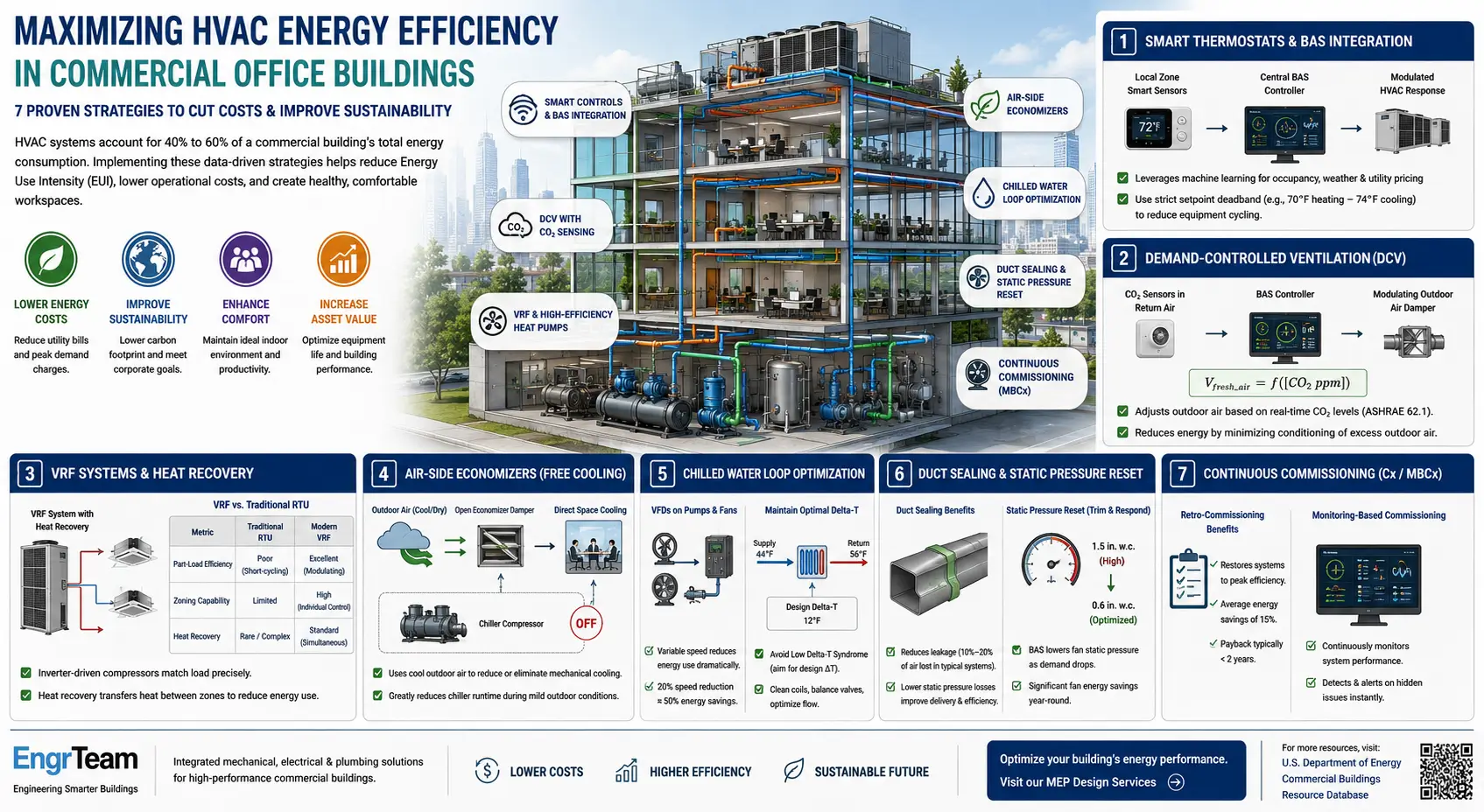
Maximizing HVAC energy efficiency in commercial office buildings is one of the most effective ways for facility managers and building owners to reduce operational costs and meet corporate sustainability goals. According to data from the U.S. Energy Information Administration (EIA), heating, ventilation, and air conditioning systems account for approximately 40% to 60% of a commercial building’s total energy consumption.
In a typical American office landscape—characterized by varying occupancy schedules, dense IT hardware loads, and large perimeter glass zones—an unoptimized HVAC configuration wastes significant energy. By shifting from a reactive maintenance model to an integrated, data-driven optimization strategy, facility operators can significantly lower their Energy Use Intensity (EUI) while maintaining an ideal indoor environment.
1. Upgrading Control Architecture: Advanced Smart Thermostats and BAS Integration
The first step toward building optimization involves upgrading legacy control loops. A major source of energy waste is running equipment at full capacity when office spaces are empty or only partially filled.
Transitioning to Intelligent Controls
Modern smart thermostats do much more than simply adjust temperatures based on basic time clocks. When integrated into a centralized Building Automation System (BAS), these smart devices utilize machine learning algorithms to evaluate real-time data:
- Historical Occupancy Trends: Learning when specific conference rooms or floor plates are active.
- Ambient Weather Forecasting: Factoring in external humidity and temperatures to adjust morning pre-cooling or pre-heating ramp times.
- Real-time Utility Pricing: Shifting thermal loads dynamically to avoid expensive peak-demand grid charges.
Optimizing Setpoint Strategies
Vfresh_air = f(CO₂ ppm)
When CO₂ concentrations remain well below the thresholds mandated by ASHRAE Standard 62.1 (typically around 800–1000 ppm), the BAS automatically adjusts the outdoor air dampers. This reduces the volume of unconditioned outdoor air introduced into the building, minimizing the thermal load on heating elements and chiller coils during periods of low occupancy.
2. Implementing Demand-Controlled Ventilation (DCV) Using CO₂ Sensing
Traditional mechanical systems are often balanced to supply a fixed volume of outdoor air based on a building’s maximum theoretical occupancy. This means an office is frequently ventilated as if it were completely full, even on slow remote-work days.
The Mechanics of Demand-Controlled Ventilation
To maximize HVAC energy efficiency in commercial office buildings, engineers rely on Demand-Controlled Ventilation (DCV). This approach uses real-time $CO_2$ sensor arrays installed across return air ducts and shared office zones to track actual occupancy levels.
3. Upgrading to Variable Refrigerant Flow (VRF) and High-Efficiency Heat Pumps
For mid-sized and corporate office structures undergoing major retrofits, replacing aging constant-volume packages with modern heat pump technologies yields exceptional energy savings.
The Efficiency of Variable Refrigerant Flow (VRF) Systems
VRF networks use inverter-driven scroll compressors to continuously modulate the flow of refrigerant to multiple indoor fan coil units. Instead of turning completely on or off, the system matches the building’s thermal load precisely.
| Metric | Traditional Unitary Rooftop Units (RTU) | Modern Variable Refrigerant Flow (VRF) |
| Part-Load Efficiency | Poor (Constant speed short-cycling) | Excellent (Inverter-modulated scaling) |
| Zoning Capability | Limited (Large structural zones) | High (Individual room control) |
| Heat Recovery Options | Rare / Requires complex ducting | Standard (Simultaneous heating/cooling) |
Leveraging Heat Recovery Technology
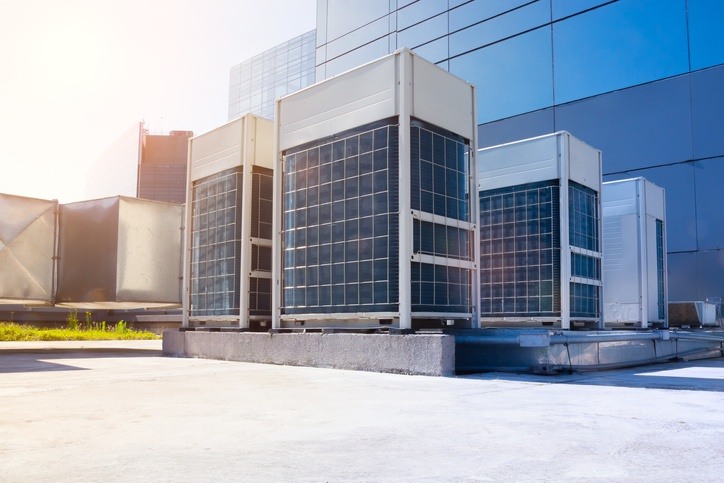
Advanced three-pipe VRF systems feature heat recovery capabilities. In an office building with a highly glazed exterior, the perimeter zones facing the sun may require cooling, while shaded interior zones or north-facing offices require heating. A heat recovery VRF system extracts heat from the spaces being cooled and transfers it directly to the zones requiring warmth, bypasses the main compressor circuit entirely and reducing energy use.
Achieving top-tier energy performance requires a cohesive building design. Ensuring your structural layout aligns perfectly with high-efficiency zoned ducting is critical. To see how optimized spatial planning supports energy reduction, read more about our technical HVAC Layout Plan Services.
4. Deploying Air-Side Economizers for Free Cooling
Many geographic regions across the United States experience moderate shoulder seasons where outdoor air is cooler and less humid than the air inside an occupied office building.
Enthalpy-Based Economizer Cycles
An air-side economizer utilizes adjustable dampers controlled by temperature and humidity sensors (enthalpy controls). When outdoor conditions meet comfort criteria, the mechanical cooling infrastructure cycles down, and the economizer dampers open to draw in up to 100% outdoor air.
(Cool/Dry)
Damper
Cooling
(OFF)
This “free cooling” strategy allows facilities to keep indoor spaces comfortable without running high-power chiller compressors or condenser fans. It is particularly effective in corporate office environments that generate high internal heat from computers, servers, and lighting systems even when it is cool outside.
5. Chilled Water Loop Optimization: VFDs and Delta-T Management
Large, multi-story commercial office high-rises generally rely on centralized chilled water plants utilizing centrifugal or screw chillers, cooling towers, and complex hydronic distribution loops.
Variable Frequency Drives (VFDs) on Pumps and Fans
Installing variable frequency drives on chilled-water pumps, condenser-water pumps, and cooling tower fans allows flow rates to scale dynamically with the building’s actual cooling demand. Cutting a pump’s motor speed by just 20% can reduce its energy consumption by nearly 50%, thanks to the cubic relationship defined by the fluid affinity laws.
Resolving Low Delta-T Syndrome
A common issue in large commercial chilled water systems is Low Delta-T Syndrome. This occurs when the temperature difference ($\Delta T$) between the entering and leaving chilled water is narrower than the system’s original design parameters (e.g., a $6^\circ\text{F}$ difference instead of a specified $12^\circ\text{F}$ design target).
Plaintext
- Fouled air handler coils reducing heat transfer efficiency.
- Improperly balanced 3-way modulating bypass valves.
- Overflowing water through coils during low-load conditions.
When Delta-T drops, the plant is forced to run extra chilled-water pumps and chillers just to move water volume, even though the total cooling capacity isn’t required. Addressing this issue through regular coil cleaning, balancing valve calibration, and smart control algorithms helps keep the central plant operating within its peak efficiency window.
6. Comprehensive Duct Sealing and Static Pressure Reset Strategies
Conditioning air efficiently means very little if that air leaks out of the supply duct network before reaching the occupied office cubicles and conference rooms.
Minimizing Duct Leakage Rates
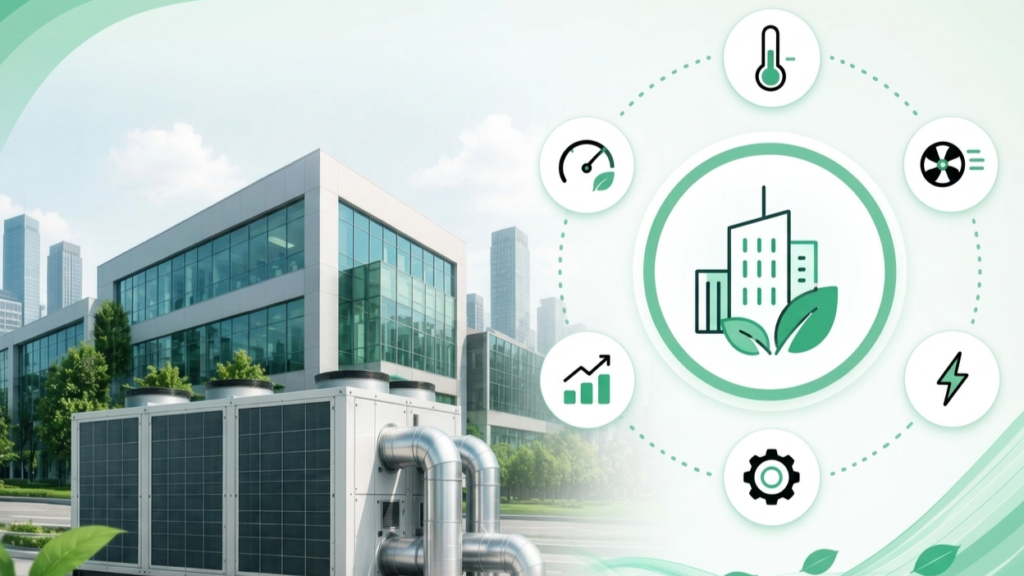
Studies by national laboratories indicate that typical commercial duct systems can leak between 10% and 20% of their conditioned air supply into unconditioned plenum spaces. Sealing joints with high-velocity mastic compounds or using automated aerosol-based duct sealing technologies minimizes static pressure drops and ensures air reaches its intended destination.
Implementing Static Pressure Resets (Trim and Respond)
In traditional Variable Air Volume (VAV) networks, the supply fan maintains a fixed static pressure inside the ductwork, typically around $1.5\text{ inches of water column (w.c.)}$.
By implementing an ASHRAE 90.1 compliant Trim and Respond algorithm, the BAS continuously monitors the position of all VAV box dampers throughout the building. If all dampers are partially closed, the system recognizes that the duct pressure is higher than necessary. The BAS then lowers the fan’s static pressure setpoint dynamically until at least one zone damper is fully open. Operating the central supply fan at a lower static pressure reduces fan motor energy use across the entire year.
7. Committing to Continuous Commissioning (Cx) and Retro-Commissioning
Over time, even the most efficiently designed commercial HVAC systems experience performance drift. Sensors lose calibration, valves develop leaks, and manual overrides entered during a hot summer day are often forgotten, permanently locking systems into high-energy operational states.
The Role of Retro-Commissioning
Retro-commissioning is a systematic process designed to identify and resolve operational integration issues within existing buildings. This engineering review focuses on restoring the facility to its peak efficiency without requiring major capital equipment replacements.
Industry Statistic: According to studies compiled by Lawrence Berkeley National Laboratory (LBNL), building retro-commissioning delivers an average energy savings of 15% in commercial office buildings, often yielding a simple payback period of less than two years.
Implementing Monitoring-Based Commissioning (MBCx)
Rather than performing an engineering review once every five years, modern facilities are adopting Monitoring-Based Commissioning (MBCx). This approach integrates software layers with the existing BAS to continuously analyze sensor data and instantly alert maintenance staff to hidden efficiency issues, such as a heating valve leaking warm water into a cooling coil loop.
Optimizing complex mechanical systems requires strong integration with the building’s main electrical infrastructure. Ensuring that variable speed drives, motor control centers, and smart automation systems are properly supported prevents power quality issues and equipment strain. For expert infrastructure planning, check out our Electrical Engineering Services.
Partnering for Optimized Commercial Efficiency
Improving HVAC energy efficiency in commercial office buildings demands a comprehensive approach that combines smart automation, updated mechanical systems, and data-driven maintenance strategies. Lowering a facility’s carbon footprint and reducing utility expenditures requires working with engineers who understand how building systems interact.
At EngrTeam, our mechanical and electrical engineering professionals design and implement high-efficiency commercial HVAC retrofits and new construction systems that cut operational costs while maintaining excellent occupant comfort.
Let us help you optimize your building’s energy performance. Visit our MEP Design Services to schedule a comprehensive facility engineering consultation. For additional technical benchmarks and efficiency standards, explore the U.S. Department of Energy Commercial Buildings Resource Database.