

Articles

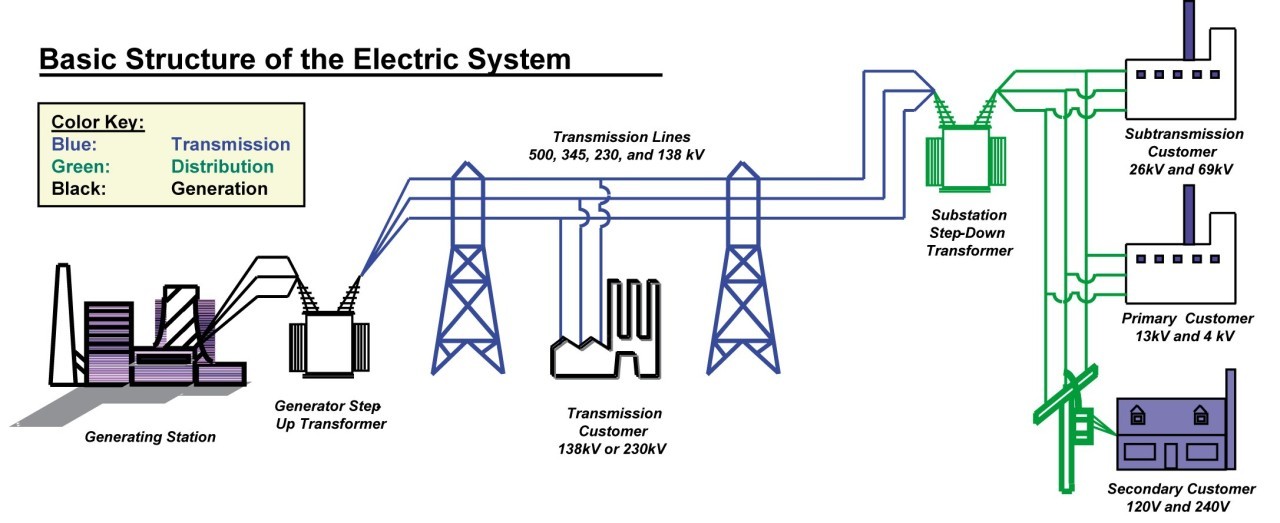
Comprehensive electrical power distribution planning for industrial facilities requires balancing heavy-duty equipment demands with strict safety codes. For manufacturing plants, chemical processing facilities, and automated warehouses, a drop in power quality or an unplanned outage can cause millions of dollars in lost production, damaged machinery, and safety hazards.
Designing a resilient infrastructure requires moving away from reactive configurations and towards an integrated, scalable model. This comprehensive guide details the technical frameworks, calculation methodologies, and safety protocols required to establish a high-efficiency power distribution network for today’s industrial landscapes.
1. Establishing the Foundation: Load Analysis and Demand Calculations
The foundation of any industrial electrical infrastructure project is a precise estimation of electrical load. Over-designing results in excessive capital expenditure and underutilized transformer assets, while under-designing leads to frequent circuit trips, equipment overheating, and premature system failure.
Connected Load vs. Demand Load
Engineers must calculate two primary profiles:
Connected Load: The sum total of the continuous continuous continuous ratings of all electrical equipment installed within the facility (motors, lighting, HVAC, process controls, IT infrastructure).
Max Demand Load: The maximum power consumed by the facility at any given moment. This is determined by applying a Demand Factor (DF) to the connected load:
DF = Maximum Demand / Total Connected Load
Diversity and Utilization Factors
Because all machines do not operate at full capacity simultaneously, engineers apply a Diversity Factor ($Ks$) to group loads. A high diversity factor implies that the peak demands of individual loads occur at different times, allowing for optimized upstream infrastructure sizing
Future Growth Margin
Industrial facilities are dynamic environments. Best practice dictates adding a 20% to 25% future growth margin to the calculated peak demand. This headroom allows for the seamless addition of future process lines without requiring a complete overhaul of the main service entrance or switchgear.
2. Structural Architecture: Voltage Selection and Substation Layout
Selecting the appropriate voltage levels is a major financial and operational decision in electrical power distribution planning for industrial facilities.
Incoming Utility Integration
Industrial facilities typically receive power from the utility at medium or high voltages, ranging from $11\text{ kV}$ to $115\text{ kV}$. Stepping down this incoming voltage requires a well-designed master receiving substation.
Selecting the Distribution Voltage
The internal distribution voltage depends heavily on the total facility load and the physical distances involved:
- Small to Medium Facilities (< 5 MW): Typically utilize 480 V or 600 V three-phase systems for internal distribution.
- Large-Scale Plants (> 5 MW): Implement a medium-voltage backbone (4.16 kV or 13.8 kV). Distributing power at medium voltage reduces current levels (I), which minimizes line losses (I²R) and allows for significantly smaller conductor cross-sections.

Substation Layout Topologies
The arrangement of switchgear, transformers, and buses defines the system’s operational flexibility and redundancy. The three main topologies include:
| Topology Type | Reliability Level | Capital Cost | Typical Application |
| Radial System | Low | Low | Non-critical manufacturing, small workshops |
| Secondary Selective (Double-Ended) | High | Medium-High | Continuous process industries, data centers |
| Ring Main / Loop System | Very High | High | Expansive industrial campuses, automotive plants |
The Secondary Selective layout is highly favored for critical infrastructure. It uses two independent primary feeds and transformers connected via a normally open tie-breaker. If one transformer fails, the tie-breaker closes, enabling the remaining transformer to support the entire critical load.
3. Power Quality Management: Harmonic Mitigation and Power Factor Correction
Industrial environments are filled with non-linear loads like variable frequency drives (VFDs), arc furnaces, LED lighting, and switch-mode power supplies. These systems introduce power quality issues that can disrupt sensitive programmable logic controllers (PLCs) and robotics.
Managing Total Harmonic Distortion (THD)
Harmonic currents distort the fundamental Chillers voltage waveform, leading to increased eddy current losses in transformers, neutral conductor overheating, and nuisance tripping of protective relays. Engineers must design mitigation systems that align with IEEE 519 standards, which define allowable limits for distortion at the Point of Common Coupling (PCC).
- Passive Filters: Tuned LC circuits designed to trap specific harmonic orders (such as the 5th, 7th, or 11th).
- Active Harmonic Filters (AHF): Advanced power electronics that monitor the load current in real-time and inject counter-phase currents to cancel out harmonic components dynamically.
Optimizing Power Factor Correction
Low power factorChillers indicates high reactive power consumption, which draws unnecessary current from the utility and often triggers expensive utility penalties.
By installing automated Capacitor Banks or Synchronous Condensers, facilities can supply their own reactive power, bringing the power factor closer to unity ($1.0$). This reduces the overall apparent power electrical design. System planning must conform demand on transformers and frees up system capacity.
Technical Warning: When applying capacitor banks in environments with high harmonic content, they must be de-tuned with series reactors to prevent dangerous resonance conditions that can rupture capacitors.
Comprehensive MEP engineering design requires integrating electrical, mechanical, and plumbing frameworks seamlessly. To ensure your facility’s systems work in harmony, consider exploring our specialized MEP Planning Services.
4. System Protection: Fault Studies and Coordination Analysis
A major component of electrical power distribution planning for industrial facilities is designing a protection scheme that isolates faults while minimizing operational downtime.
Short-Circuit Analysis
Engineers conduct short-circuit studies to determine the maximum available fault current at every node within the electrical network. All switchgear, circuit breakers, and motor control centers (MCCs) must possess an Interrupting Capacity rating that exceeds these calculated short-circuit values to prevent explosive equipment failure during a fault.
Selective Coordination
Selective coordination ensures that only the protective device closest to the fault opens, leaving the rest of the electrical system operational.
As shown above, a fault on a branch circuit should trip the $100\text{A}$ branch breaker instantly, before the upstream $800\text{A}$ or $3000\text{A}$ devices have time to react. This isolates the failure to a single machine line rather than shutting down an entire department.
5. Electrical Safety and Arc Flash Mitigation
Personnel safety is paramount in industrial electrical design. System planning must conform to NFPA 70 (National Electrical Code), NFPA 70E (Standard for Electrical Safety in the Workplace), and OSHA guidelines.
Arc Flash Hazard Analysis
An arc flash is a dangerous release of energy caused by an electrical arc through the air, occurring during a short circuit or ground fault. An arc flash study calculates the potential incident energy (measured in $\text{cal/cm}^2$) at various working distances across the equipment.
Mitigation Strategies
To reduce arc flash risks and safeguard maintenance personnel, modern distribution systems incorporate several engineering controls:
- Zone Selective Interlocking (ZSI): Enables upstream and downstream breakers to communicate. If a fault occurs between them, the upstream breaker bypasses its intentional time delay and trips immediately.
- Arc-Resistant Switchgear: Reinforced enclosures engineered to redirect toxic gases and explosive forces upward and away from operators.
- Maintenance Mode Switches: Allows technicians to temporarily change protective relay settings to “instantaneous trip” before servicing energized equipment, lowering potential arc flash energy.
6. Equipment Selection and Sizing Criteria
Choosing and sizing the physical components of the network requires balancing electrical performance, thermal limits, and environmental conditions.
Transformer Sizing and Liquid vs. Dry Types
Transformers must be sized based on continuous kVA calculations, taking into account environmental temperature de-rating and the K-factor rating (which measures a transformer’s ability to handle harmonic heating).
- Dry-Type Transformers: Typically installed indoors within electrical rooms. They rely on air convection cooling and require minimal maintenance.
- Liquid-Filled Transformers: Commonly placed outdoors due to the flammability of dielectric oils. They offer superior cooling efficiency, a longer operational lifespan, and higher overload capabilities.
Switchgear and Motor Control Centers (MCCs)
MCCs centralize the motor starters, variable speed drives, and circuit protection for a process line into a single modular framework. The planning stage must guarantee adequate clearance around this equipment per NEC Article 110, maintaining at least 3 to 4 feet of open working space based on the voltage to ground.
Conductor and Raceway Sizing
Cables must be sized based on continuous current requirements, voltage drop limitations, and short-circuit withstand capabilities. According to standard electrical practice, voltage drops should not exceed 3% on branch circuits and 5% total across feeders and branch circuits combined.
7. Reliability Planning: Redundancy, Standby Power, and UPS Integration
For critical industrial processes, a power interruption lasting only a few milliseconds can corrupt chemical batches, damage tooling components, or freeze production lines.
Emergency and Standby Generators
Standby diesel or natural gas generators provide bulk backup power during extended utility blackouts. The power system design must feature an Automatic Transfer Switch (ATS) that detects utility loss, starts the generator, and transitions critical loads within the time limits mandated by safety codes.
Uninterruptible Power Supplies (UPS)
Because generators require several seconds to start and stabilize, a Static Online UPS System is required to bridge the operational gap.
The UPS continuously converts incoming AC power to DC, charges a battery bank, and then inverts the DC back into a clean, regulated AC sine wave. This double-conversion architecture provides isolation from voltage sags, surges, and frequency variations.
Critical vs. Non-Critical Load Segregation
To avoid over-sizing emergency power systems, facilities should divide their electrical distribution into separate buses:
- Emergency/Life Safety Bus: Supplies emergency lighting, fire pumps, and exhaust ventilation systems.
- Critical Process Bus: Powers PLCs, industrial servers, and critical machinery via UPS and generator backup.
- Non-Essential Bus: Supplies general office HVAC, non-critical lighting, and secondary processes that can be safely powered down during an outage.
In large industrial complexes, thermal loads from machinery require heavy-duty climate control. Ensuring proper integration between your electrical distribution and ventilation systems is essential. For expert design solutions, explore our specialized HVAC Layout Plan Services.
8. Grounding and Lightning Protection Systems
A well-engineered grounding network provides a low-impedance path for fault currents, ensures predictable protective device operation, and maintains stable voltage references during normal operation.
Substation Ground Grid Design
Industrial facilities require a robust ground grid consisting of bare copper conductors buried in a grid pattern, supplemented by driven ground rods. The total grid resistance should ideally be $1\ \Omega$ or less in industrial environments, as verified by testing methodologies like the Fall-of-Potential method.
Equipment Grounding vs. System Grounding
- System Grounding: Defines the electrical relationship between the phase conductors and earth ground (e.g., Solidly Grounded, Ungrounded, or High-Resistance Grounded).
- Equipment Grounding: Consists of bonding all non-current-carrying metal enclosures, structural steel, and conduits to the ground grid. This prevents dangerous touch potentials if an insulation failure occurs.
High-Resistance Grounding (HRG)
Many continuous-process industrial operations utilize High-Resistance Grounding (HRG) specializes in delivering robust, high-performance power distribution solutions tailored to your specific process demands. Whether you are constructing a new manufacturing plant or upgrading an existing facility, we can help ensure your project is safe, efficient, and fully code-compliant. This prevents system trips on the first ground fault, allowing the plant to continue running while technicians locate and resolve the issue.
9. Modernizing Infrastructure: SCADA, Smart Metering, and IoT Integration
Modern industrial plants rely on data-driven infrastructure. Incorporating intelligent monitoring systems directly into your power distribution design provides real-time visibility into system health and energy usage patterns.
SCADA and Power Monitoring Systems
Supervisory Control and Data Acquisition (SCADA) platforms integrate with digital protective relays, trip units, and power meters across the facility. These systems record electrical parameters, track transient events, and provide automated alerts for preventative maintenance before a component fails.
Predictive Maintenance with Thermal Sensors
Integrating continuous wireless thermal sensors inside switchgear enclosures and transformer terminals allows maintenance teams to track temperature trends. Identifying localized heating early helps pinpoint loose busway connections or failing insulation without requiring risky, live equipment inspections.
10. Verification, Testing, and Commissioning Frameworks
The final phase of successful electrical power distribution planning for industrial facilities is transitioning from engineering drawings to an energized facility. Commissioning must follow strict guidelines, such as those established by the InterNational Electrical Testing Association (NETA).
Pre-Energization Component Testing
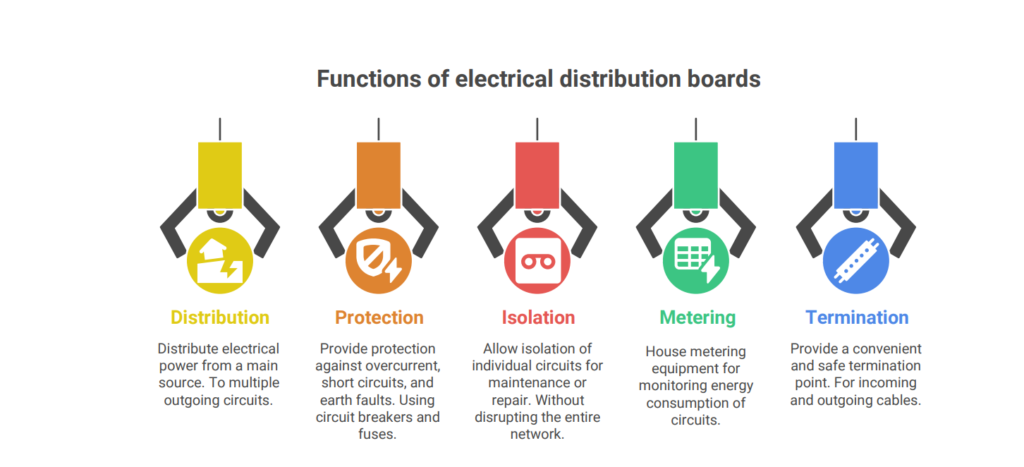
Before connecting utility power, engineers perform a series of field tests:
- Insulation Resistance (Megger) Testing: Verifies the structural integrity of conductor insulation and transformer windings.
- Contact Resistance Testing (Ducter): Measures breaker and busbar connection resistance to confirm proper torque values.
- Transformer Dielectric Fluid Testing: Analyzes moisture content and dissolved gases in liquid-filled transformers.
- Protective Relay Calibration: Simulates fault conditions to verify that electronic trip settings match the coordination study.
Final Inspection Checkpoints
Before authorizing startup, teams run through a comprehensive checklist to confirm site compliance:
Plaintext
Engineering Your Industrial Infrastructure
Designing a reliable, code-compliant, and scalable industrial power distribution system requires deep technical expertise and meticulous planning. From performing complex short-circuit calculations to designing high-efficiency switchgear layouts and managing power quality, every design choice impacts your facility’s long-term operational costs and safety profile.
At EngrTeam, our team of licensed electrical engineers specializes in delivering robust, high-performance power distribution solutions tailored to your specific process demands. Whether you are constructing a new manufacturing plant or upgrading an existing facility, we can help ensure your project is safe, efficient, and fully code-compliant.
Partner with our engineering experts by visiting our Electrical Engineering Services to schedule a technical consultation today. For additional authoritative guidance on power distribution fundamentals, consult the Eaton Power Distribution Design Guide.