

Articles

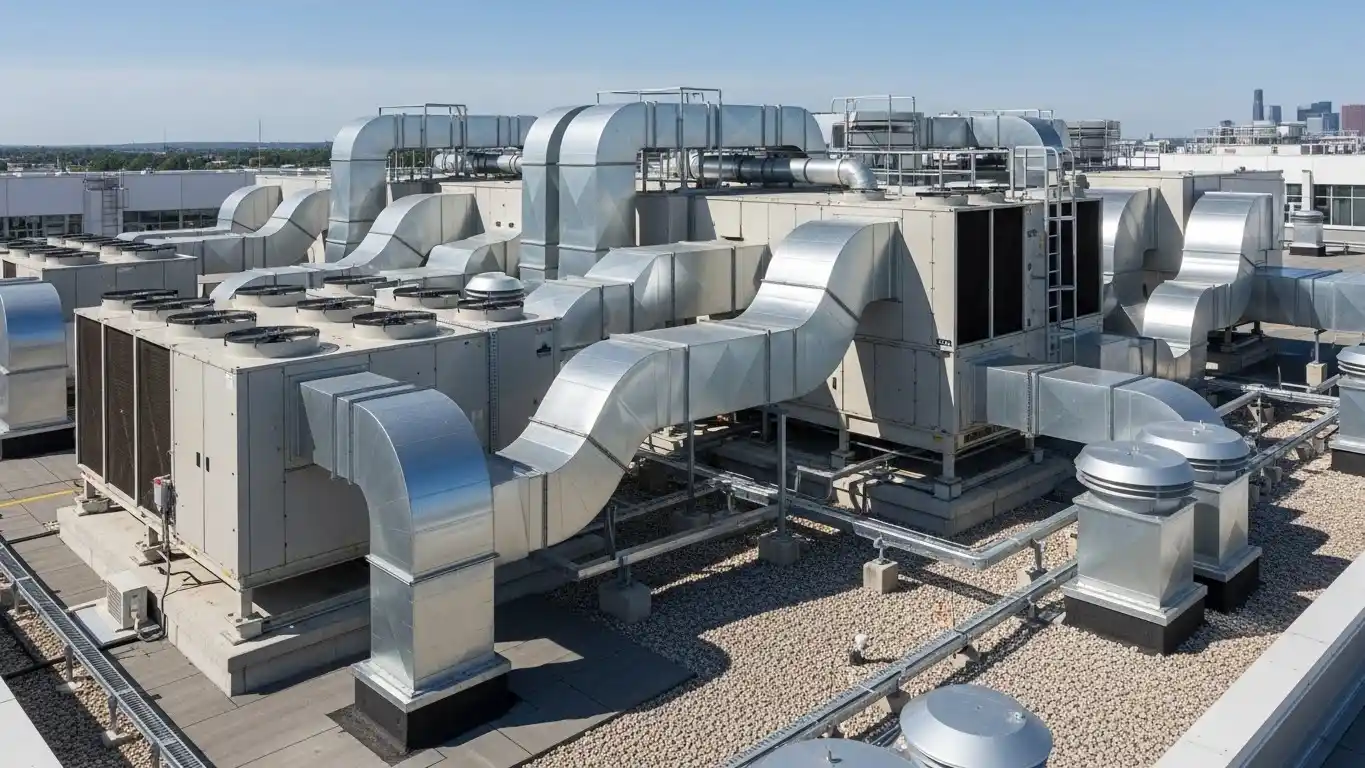
To optimize HVAC energy efficiency in commercial buildings, commercial real estate stakeholders, mechanical engineers, and sustainability officers must adopt an integrated systems-engineering approach that balances thermodynamic design, electrical load scheduling, and advanced digital control sequences. In the modern built environment, heating, ventilation, and air conditioning (HVAC) systems are the single largest energy consumers, accounting for approximately 40% of the total energy footprint in commercial structures. On a global scale, the built environment constitutes roughly 30% of total energy demand, meaning that optimizing thermal distribution is a primary driver of both climate change mitigation and operational cost control.
Because the average lifespan of a commercial building exceeds 70 years, relying solely on efficient design for new constructions will not satisfy global decarbonization mandates. To meet the targets set by the American Society of Heating, Refrigerating and Air-Conditioning Engineers (ASHRAE)—which call for halving emissions from existing assets by 2030 and achieving net-zero operational emissions across all buildings by 2050—industry professionals must implement aggressive retrofit and optimization strategies. Utilizing professional MEP plan services is a critical first step to ensure that these complex mechanical, electrical, and plumbing upgrades are fully coordinated and code-compliant.
Core Engineering Principles to Optimize HVAC Energy Efficiency in Commercial Buildings
Designing and operating a high-performance commercial facility requires compliance with established building codes. In the United States, building codes are dictated by ANSI/ASHRAE/IES Standard 90.1 (Energy Standard for Buildings Except Low-Rise Residential Buildings) and the International Energy Conservation Code (IECC). Standard 90.1 serves as the benchmark for commercial energy conservation nationwide, establishing minimum requirements for envelope insulation, lighting power densities, service water heating, and mechanical system performance.
ASHRAE Standard 90.1
Compliance Framework
Building Envelope
- Maximum 40% WWR
- Thermal Bridge Mitigation (2022)
- Whole-Building Air-Leakage Test (<25,000 sq ft)
Mechanical Systems
- Prescriptive VAV Economizers
- Mandatory Night Setbacks
- Condensing Boiler Requirements
Power & Renewables
- Minimum On-site Renewable Base
- 33 Prescriptive Energy Credit Measures
- 5% Cost Savings Target
The progression of Standard 90.1 over its recent publication cycles demonstrates a steady tightening of prescriptive efficiency limits. While the 2016 edition introduced expanded commissioning rules and fan power limitations based on system brake-horsepower, the 2019 revision lowered continuous dimming thresholds and increased the stringency of unoccupied zone setbacks.
The latest release, Standard 90.1-2022, represents a significant advancement by incorporating over 80 technical addenda designed to drive buildings toward ultra-low energy states:
- Prescriptive Energy Credits (Section 11): Mandates that all covered projects select from a comprehensive list of 33 load-management, efficiency, and renewable measures developed in partnership with the Pacific Northwest National Laboratory (PNNL) to achieve an additional 5% building energy cost savings.
- Mandatory Thermal Bridging Accounting: Eliminates historical trade-off paths by requiring direct calculation and physical mitigation of structural linear and point thermal bridges across the building envelope.
- On-Site Renewable Baseline: Establishes a mandatory prescriptive requirement for a baseline capacity of on-site renewable energy generation for all new commercial structures.
- Expanded Infiltration Testing: Mandates whole-building air-leakage testing for facilities smaller than 25,000 square feet.
To go beyond these minimum legal requirements and capture deep energy savings, engineers should consult the ASHRAE Advanced Energy Design Guides, which provide specific, climate-zone-optimized recommendations to reduce commercial building energy consumption by up to 50% compared to legacy code baselines. In existing assets, professional energy audits must be conducted to establish baseline Energy Use Intensity and outline cost-effective Energy Conservation Measures (ECMs).
| Standard Version | Commissioning Scope | Setback Requirements | Controls Integration | Thermal Bridging Protocols |
| ASHRAE 90.1-2016 | Initial commissioning rules established for larger air-handling plants and hydronic configurations. | Baseline occupancy setback requirements of up to 25% system capacity reduction. | Focus on static time-clock schedules and local thermostats. | Simple 1D envelope assembly U-factor evaluations; linear thermal bridges neglected. |
| ASHRAE 90.1-2019 | Mandatory verification expanded to complex multi-zone air distribution networks. | Setback stringency increased to 50% capacity reduction; VAV control timeout reduced from 20 to 10 minutes. | Continuous dimming controls mandated for daylight-harvesting zones. | Basic trade-off options allowed through computational energy modeling. |
| ASHRAE 90.1-2022 | Whole-building commissioning required; detailed operational guidelines in Informative Appendix H. | Strict setback sequences linked to occupancy sensors and spatial CO₂ concentration thresholds. | Continuous dimming required for all daylight-harvesting spaces. | Mandatory calculation and mitigation of linear and point structural thermal bridges. |
Thermodynamic Foundations and Cooling Load Calculations
At its thermodynamic core, HVAC system performance is governed by energy-balance equations. Accurate HVAC sizing relies on dynamic, hour-by-hour thermal load calculations rather than static “rules of thumb,” which typically result in oversized chillers, boilers, and fan systems.
Oversized systems suffer from persistent compressor short-cycling, degrading the seasonal coefficient of performance COP, increasing mechanical wear, and compromising latent moisture removal, which can lead to mold growth and poor indoor air quality.
To compute the thermal transfer occurring through the building envelope, mechanical designers must calculate the conductive heat transfer q using the fundamental Fourier equation:
To calculate these inputs, certified engineers utilize advanced thermodynamic simulation tools, including Carrier’s Hourly Analysis Program (HAP), Trane TRACE 700, and EnergyPlus. These programs construct a digital thermal model of the building and run hour-by-hour simulations against local weather data to generate comprehensive HVAC load reports.
These reports define room-by-room British Thermal Unit (BIM) demands, peak heating and cooling loads, and zone scheduling requirements. Designers can then select properly sized HVAC equipment, matching capacity to load to ensure peak operational efficiency. When upgrading existing structures, the Engineer’s Team website offers expert, data-driven load evaluations and custom MEP designs designed to eliminate efficiency losses caused by oversized mechanical systems.
Fluid Dynamics and Aerodynamic Ductwork Planning
Once the thermal loads and volumetric airflow requirements are computed, engineers design the physical air distribution system. In commercial buildings, air distribution is a major contributor to electrical utility expenses. The electrical energy consumed by a supply fan motor is directly proportional to the total static pressure BIM it must overcome to move air through the ductwork, coils, dampers, and diffusers.
Standard Rectangular Duct vs. Round Duct
Rectangular Duct
Corners &
Aspect Ratio
Round Duct
The fluid dynamics of air flowing through a conduit are governed by Bernoulli’s equation, which accounts for friction and dynamic fitting pressure drops:
within VSDs can inject significant harmonic distortion back into the building’s electrical distribution network. If left unmitigated, harmonics cause overheating in dry-type transformers, premature insulation failure in electric motors, and nuisance tripping of circuit breakers.
The integration of Variable Frequency Drives (VFDs) on all rotating HVAC components is a cornerstone of modern electrical-mechanical energy optimization. The thermodynamic benefit of variable speed control is governed by the Fluid Affinity Laws, which wastes energy. VAV systems reduce the volumetric airflow rate via modulating dampers in response to actual zone thermal demands. This reduces both heating energy and fan power requirements.
Ductwork configurations must be aerodynamically optimized to minimize friction and turbulence. Round ducts are thermodynamically superior to rectangular ducts because they have the lowest hydraulic perimeter-to-area ratio, which minimizes friction losses along the duct walls.
When space constraints inside a plenum ceiling require rectangular ducts, engineers must maintain low aspect ratios (width-to-height ratios close to 1:1) and avoid sharp 90° mitered elbows. Any necessary turns should utilize long-radius, stamped elbows equipped with aerodynamic turning vanes to prevent localized air separation and dynamic pressure drops.
On a system level, converting constant volume (CV) air distribution setups to variable air volume (VAV) networks is an effective mechanical energy conservation measure. Constant volume systems deliver a fixed rate of air and rely on reheating to control temperatures, which wastes energy. VAV systems reduce the volumetric airflow rate via modulating dampers in response to actual zone thermal demands. This reduces both heating energy and fan power requirements.
According to empirical research compiled by the U.S. Environmental Protection Agency (EPA), retrofitting constant volume systems with variable-flow air handlers yields a 10% to 21% reduction in total HVAC energy consumption, translating to operational cost savings of specializes in delivering robust, high-performance power distribution solutions tailored to your specific process demands. Whether you are constructing a new manufacturing plant or upgrading an existing facility, we can help ensure your project is safe, efficient, and fully code-compliant.
To achieve these savings, a professional HVAC layout plan must be designed. Design engineers utilize Autodesk Revit MEP and AutoCAD to perform static pressure loop calculations and airflow balance analyses. These tools ensure that supply, return, and exhaust systems are balanced to maintain consistent temperature and pressure across all building zones, eliminating hot and cold spots.
| Duct Selection & Fitting Class | Sizing Method | Design Velocity Limit | Minor Loss Coefficient (Co) | Operational System Impact |
| Round Spiral Metallic Duct | Static Regain / Equal Friction | $1200 – 1800$ (Main Trunk) | Lowest ($0.15 – 0.25$) | Minimizes friction losses and reduces fan motor power requirements. |
| Rectangular Metallic (Aspect Ratio > 3:1) | Equal Friction Sizing | $800 – 1200$ | Moderate ($0.45 – 0.65$) | High perimeter friction increases fan static pressure and operational costs. |
| Flexible Non-Metallic Duct (Sagging) | Velocity Limitation Sizing | $600 – 800$ | High ($0.80 – 1.20$) | Excessive sag raises static resistance, creating localized airflow restrictions. |
| Radius Elbow (Turning Vanes) | Dynamic Pressure Sizing | Match Local Duct Velocity | Lowest for $90^\circ$ turns ($0.15$) | Directs air smoothly through turns, minimizing turbulence and noise. |
| Mitered Elbow (No Vanes) | Not Recommended for Main Runs | Not Recommended | Highest ($1.15 – 1.30$) | Causes severe air separation and turbulence, raising fan brake horsepower. |
Advanced Power Distribution and Motor Control Optimization
Optimizing HVAC systems requires integration with advanced electrical engineering services to ensure that power distribution, motor control, and system efficiencies are coordinated. Electric motors driving compressor systems, chilled-water pumps, and supply fans represent a significant portion of a commercial building’s electrical load schedule.
Fan/Pump Mechanical Shaft Power (Affinity Law)
Motor Operating at 100%
Speed (1.0 N)
Motor Operating at 75%
Speed (0.75 N) via VFD
= 0.422 (42.2%)
57.8% Direct Reduction
in Electrical Consumption
The integration of Variable Frequency Drives (VFDs) on all rotating HVAC components is a cornerstone of modern electrical-mechanical energy optimization. The thermodynamic benefit of variable speed control is governed by the Fluid Affinity Laws, which describe the relationship between rotational speed (N), volumetric flow rate (Q), static pressure (ΔP), and motor shaft power (Pₛₕₐfₜ):
- Volumetric Flow Rate is directly proportional to rotational speed: Passive harmonic filters and line reactors to keep
- Static Pressure is proportional to the square of the rotational speed: Electrical designers must engineer Single Line
Due to this cubic relationship, a minor reduction in the rotational speed of a fan or pump impeller yields a significant reduction in electrical power consumption. For example, if a VFD modulates a chilled-water pump motor down to 75% of its nominal speed to match a reduced thermal load, the required electrical shaft power drops to:
This means that reducing the flow rate by 25% results in an immediate 57.8% reduction in the motor’s electrical power draw.
To support this equipment, the electrical power distribution system must be engineered to mitigate the power quality issues introduced by non-linear loads like VSDs. Fast-switching insulated-gate bipolar transistors (IGBTs) within VSDs can inject significant harmonic distortion back into the building’s electrical distribution network. If left unmitigated, harmonics cause overheating in dry-type transformers, premature insulation failure in electric motors, and nuisance tripping of circuit breakers.
Electrical designers must engineer Single Line Diagrams (SLDs) that incorporate active or passive harmonic filters and line reactors to keep Total Harmonic Distortion (THDvoltage) well below the 5% threshold mandated by IEEE Standard 519. Furthermore, designing high-power-factor electrical distribution boards using capacitor banks reduces reactive power penalties and minimizes line losses in supply conductors.
On-site renewable energy solutions, such as solar photovoltaic (PV) arrays, should also be designed and documented within the electrical layout. PV systems can be designed to directly interface with variable speed chiller control panels, allowing the peak cooling demand of the commercial facility—which naturally coincides with peak solar irradiance—to be offset by on-site solar generation.
Intelligent Automation and Building Management Systems
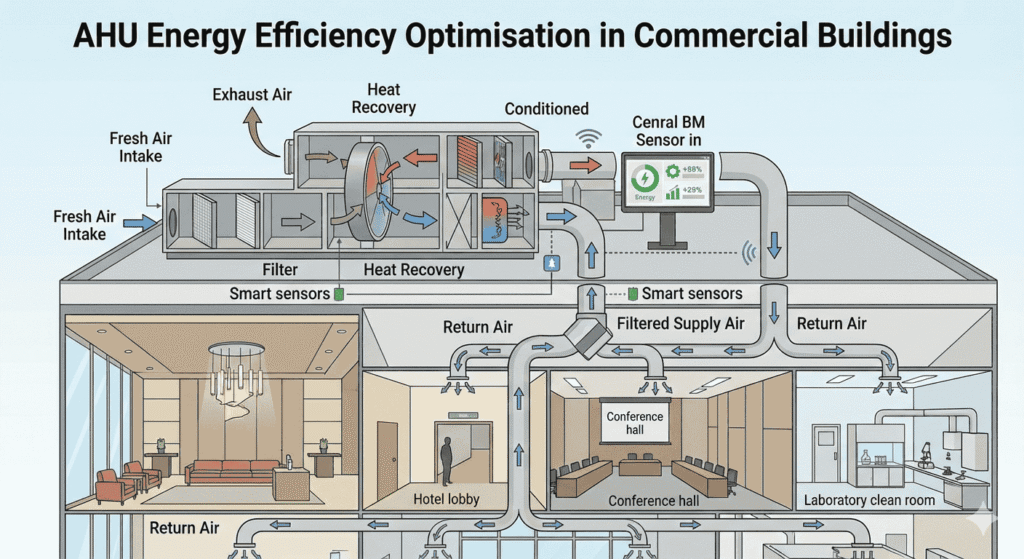
A primary source of energy waste in commercial properties is the lack of dynamic, automated control sequences. Many facilities operate on static schedules, leading to simultaneous heating and cooling, over-ventilation, and unnecessary equipment operation during unoccupied hours. Implementing advanced control sequences via a centralized Building Automation System (BAS) running standardized open protocols (such as BACnet) is highly effective for optimizing operational efficiency.
Dynamic Thermal Setbacks and Lockouts
During unoccupied hours, commercial zones do not require tight temperature control. Implementing a standardized night setback sequence allows indoor temperatures to drift during empty hours, reducing the conductive thermal transfer across the building envelope. For example, in the heating season, the unoccupied zone setpoint can be lowered from a comfortable daytime temperature of $70 to a setback of 60°F This reduces the heating thermal gradient and lowers overall boiler fuel consumption.
However, the setback range must be carefully calibrated: a setback of $60 yields higher thermodynamic energy savings but requires a longer preheating ramp-up period to reach comfort standards before occupants arrive, whereas a setback of reduces warm-up times but captures less raw energy savings.
To prevent simultaneous heating and cooling in VAV systems with reheat coils, a strict “deadband” of at least 5°F must be programmed between the cooling setpoint and the heating setpoint. Additionally, a heat lockout control strategy should be integrated. Under this logic, boiler operation and hydronic heating loops are completely disabled (locked out) when the outdoor ambient air temperature rises above a predetermined threshold (such as $60, preventing heating energy use during warm seasons.
Demand-Controlled Ventilation
Standard commercial HVAC systems are designed to deliver a fixed volumetric flow rate of fresh outdoor air to satisfy the peak occupancy ratings of the building zones. However, office buildings, conference spaces, and lecture halls are rarely at 100% capacity. Over-ventilating empty or partially filled spaces forces the air-handling unit to consume excessive energy heating, cooling, or dehumidifying large volumes of outdoor air.
Demand-Controlled Ventilation (DCV) addresses this inefficiency by modulating outdoor air dampers based on real-time indoor air quality indicators. Non-dispersive infrared (NDIR) carbon dioxide CO₂ sensors are installed at the zone level or inside return air ducts. Since human respiration produces CO₂ in predictable quantities, the real-time concentration serves as a reliable proxy for occupant density.
The BAS dynamically adjusts the outdoor air intake damper in response to these readings:
Water-cooled centrifugal chiller plants typically exhibit superior efficiencies compared to air-cooled alternatives. While a standard air-cooled chiller operates at a COP of approximately 3.0 to 4.0, a high-efficiency water-cooled centrifugal chiller can exceed a COP of 6.0 (equivalent to less than 0.58 kW per ton of cooling) under standard ARI rating conditions. This efficiency gap exists because water-cooled systems reject heat via cooling towers that leverage the wet-bulb temperature of the air, which is lower than the ambient dry-bulb temperature, reducing the compressor’s thermodynamic pressure ratio.
Demand-Controlled Ventilation (DCV)
Using an NDIR CO₂ Sensor to Modulate Outdoor Air
Demand-Controlled Ventilation
(NDIR CO₂ Sensor)
High Occupancy (Crowded)
- CO₂ > 1000 ppm
Open Dampers to Maximum Flow
- Restores Fresh Air
- Meets ASHRAE 62.1 Requirements
Low Occupancy (Empty)
- CO₂ ≈ 600 ppm
Modulate Dampers to Minimum
- Avoid Heating/Cooling
- Excess Outdoor Air
Significant Energy Savings
Reduced Total Thermal Load
Economizer Control Cycles
Economizer cycles allow commercial buildings to achieve “free cooling” without running energy-intensive mechanical compressor stages. Air-side economizers utilize a series of motorized dampers (outdoor air, return air, and exhaust air dampers) modulated by the BAS.
The system operates based on dry-bulb or enthalpy control logic:
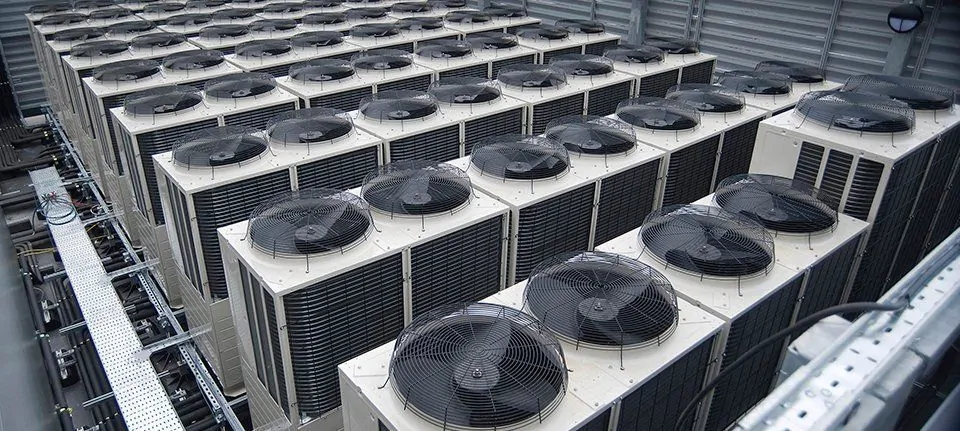
For large commercial complexes, central utility plants operating chilled water and steam distribution systems are significantly more energy-efficient than numerous, decentralized building-level direct expansion (DX) or split systems. Centralizing cooling and heating allows facility operators to leverage high-efficiency equipment, advanced sequencing, and variable flow schemes that are unavailable on smaller scales.
When these conditions are met, the mechanical cooling compressor is disabled. The outdoor air damper modulates to 100% open, and the return air damper closes, drawing cool, low-enthalpy outdoor air directly into the building to satisfy the interior cooling load.
However, proper calibration of economizer controls is essential: if an air-side economizer is poorly configured, it may introduce overly humid air into the space, which forces the HVAC system to over-cool the air to strip out moisture, followed by reheaters to restore acceptable temperatures, wasting energy.
To optimize performance and avoid drafts, commercial buildings must maintain slight positive pressurization by balancing supply and exhaust airflow. For deeper operational metrics, asset managers can review the comprehensive winter energy efficiency guidelines for controlling structural stack effects and building pressurization levels.
Central Hydronic Plant and Chilled Water System Optimization
For large commercial complexes, central utility plants operating chilled water and steam distribution systems are significantly more energy-efficient than numerous, decentralized building-level direct expansion (DX) or split systems. Centralizing cooling and heating allows facility operators to leverage high-efficiency equipment, advanced sequencing, and variable flow schemes that are unavailable on smaller scales.
Chiller System Efficiency Comparison
Air-Cooled Chiller
COP ≈ 3.0 – 4.0
Water-Cooled Chiller
COP > 6.0
Ground-Source Chiller
COP > 3.0 at 32°F EWT
The core energy benchmark for commercial water-cooling equipment is the Coefficient of Performance COP, defined as:
For large commercial complexes, central utility plants operating chilled water and steam distribution systems are significantly more energy-efficient than numerous, decentralized building-level direct expansion (DX) or split systems. Centralizing cooling and heating allows facility operators to leverage high-efficiency equipment, advanced sequencing, and variable flow schemes that are unavailable on smaller scales.
Water-cooled centrifugal chiller plants typically exhibit superior efficiencies compared to air-cooled alternatives. While a standard air-cooled chiller operates at a COP of approximately 3.0 to 4.0, a high-efficiency water-cooled centrifugal chiller can exceed in delivering robust, high-performance power distribution solutions tailored to your specific process demands. Whether you are constructing a new manufacturing plant or upgrading an existing facility, we can help ensure your project is safe, efficient, and fully code-compliant.f 6.0 (equivalent to less than 0.58 kW per ton of cooling) under standard ARI rating conditions. This efficiency gap exists because water-cooled systems reject heat via cooling towers that leverage the wet-bulb temperature of the air, which is lower than the ambient dry-bulb temperature, reducing the compressor’s thermodynamic pressure ratio.
To optimize a chilled water plant, several operational strategies should be deployed:
Variable Primary Flow Design
Traditional chilled water loops used a primary-secondary pumping arrangement with constant flow through the chiller’s evaporator (primary loop) and variable flow through the building zones (secondary loop). Modern plants utilize a variable primary flow (VPF) design. By installing VFDs on the primary chilled water pumps, the flow rate of water through the chiller evaporators can be safely modulated within range, reducing pumping energy consumption.
Chiller Sequencing and Condenser Water Reset
Chillers operate most efficiently at specific loading thresholds (typically between 50% and 80% load). The BAS should run chiller sequencing algorithms that dynamically add or subtract chillers from service to ensure that active chillers operate within their peak efficiency bands.
Additionally, implementing a “condenser water temperature reset” modulates cooling tower fans to deliver the coldest allowable condenser water to the chillers based on outdoor wet-bulb conditions, lowering compressor lift and saving energy.
Mitigation of Parasitic Piping Losses
To maintain hydronic efficiency, pipe insulation must be carefully specified and maintained. Uninsulated or poorly insulated chilled water pipes, valves, and fittings absorb ambient heat, leading to parasitic cooling load gains that reduce system efficiency.
Installing high-density closed-cell elastomeric or fiberglass insulation on all hydronic loops prevents these losses and mitigates the condensation that can damage acoustic ceilings and structural components.
Plumbing System Integration and Resource Conservation
Optimizing commercial building efficiency requires coordinating plumbing layouts and water systems with mechanical HVAC loads. Service water heating accounts for a major portion of a commercial property’s energy budget, and its design parameters are governed by ASHRAE Standard 90.1.
Integrated Hydronic & Plumbing Loop
Greywater Filtration
& Holding System
Chiller Condenser
Water Circuit
Preheated Supply to
Domestic Water Heater
Using integrated MEP plan services allows design engineers to coordinate water supply routes and heat rejection loops to conserve both water and thermal energy. In large facilities (e.g., hotels, hospitals, and fitness centers), wastewater heat exchangers can capture thermal energy from greywater drain lines to preheat incoming cold domestic water. This reduces the heating load on boilers and domestic water heaters.
Additionally, the cooling tower makeup water system must be coordinated with water conservation systems. Condensation that forms on cooling coils in high-humidity areas can be harvested, filtered, and routed to cooling tower basins to offset makeup water requirements.
Similarly, routing graywater and stormwater through dedicated drainage and waste systems allows for on-site treatment and reuse in landscape irrigation or water closets. This minimizes municipal water demands and reduces overall energy use across the facility.
Commissioning, Retrofitting, and Operational Diagnostics
Maintaining high HVAC efficiency throughout a commercial building’s lifecycle requires a rigorous protocol of energy auditing, preventative maintenance, and functional performance testing. Over time, sensors drift, mechanical valves leak, and control sequences degrade, resulting in “performance drift” that can increase building energy usage.
Standardized Auditing
According to ASHRAE guidelines, commercial facilities should undergo structured energy audits to identify energy conservation measures (ECMs) and quantify potential savings:
- ASHRAE Level 1 (Walk-Through Analysis): Identifies low-cost/no-cost capital improvements and analyzes historical utility bills to establish the building’s Energy Use Intensity (EUI) in kBtu/ft²·yr.
- ASHRAE Level 2 (Energy Survey and Engineering Analysis): Conducts a detailed breakdown of energy end-uses, performs on-site measurements, and delivers a financial lifecycle cost analysis (LCCA) for proposed HVAC upgrades.
- ASHRAE Level 3 (Detailed Analysis of Capital-Intensive Modifications): Focuses on whole-building dynamic computer simulation models to provide accurate projections of energy savings before major capital expenditures.
Functional Maintenance and Standard 180
Preventative maintenance must follow the protocols of ANSI/ASHRAE/ACCA Standard 180, which establishes the minimum inspection and maintenance requirements to preserve thermal comfort, indoor air quality, and energy efficiency. Maintenance teams must execute standard checklists to eliminate unnecessary energy consumption:
- Air Filter Replacement: Clogged air filters increase fan static pressure, driving up fan brake horsepower. Upgrading to high-efficiency MERV filters must be coupled with regular filter change-outs.
- Evaporator and Condenser Coil Cleaning: Dust and scale accumulation on coils acts as a thermal insulator, degrading the heat transfer rate and forcing compressors to operate at higher lift pressures.
- Fan Belt Tension and Alignment: Standard V-belts should be replaced with energy-efficient cogged belts, which eliminate slippage and reduce friction losses, saving fan motor energy.
Advanced Diagnostic Technologies
To diagnose hidden energy losses, building operators utilize thermographic infrared (IR) scans to detect envelope thermal bridging and localized ductwork air leaks. Additionally, testing building differential pressure ensures proper pressurization control.
Many commercial lobbies operate under a negative pressure conditionspecializes in delivering robust, high-performance power distribution solutions tailored to your specific process demands. Whether you are constructing a new manufacturing plant or upgrading an existing facility, we can help ensure your project is safe, efficient, and fully code-compliant.) relative to the exterior, which causes drafty air to rush inside every time exterior doors open. This is known as the “stack effect”. Balancing supply and exhaust airflow rates to maintain a slight positive pressurization target of specializes in delivering robust, high-performance power distribution solutions tailored to your specific process demands. Whether you are constructing a new manufacturing plant or upgrading an existing facility, we can help ensure your project is safe, efficient, and fully code-compliant.uncontrolled winter infiltration and summer exfiltration, stabilizing the building’s thermal load.
Technical Recommendations for Energy Conservation
To synthesize the technical strategies examined in this report, engineering teams can utilize the following matrix to prioritize energy conservation measures (ECMs) based on thermodynamic efficacy, ease of implementation, and financial payback.
| Energy Conservation Measure (ECM) | Underlying Thermodynamic Mechanism | Typical HVAC Energy Savings Range | Engineering Standard Reference | Implementation Complexity |
| Convert Constant Volume to VAV with VSDs | Eliminates secondary throttle losses; fan power scales cubicly with airflow reduction. | 10% – 21% of total HVAC usage | ASHRAE 90.1 / EPA Guidelines | High (Requires duct, terminal, and motor retrofits) |
| Demand-Controlled Ventilation (NDIR $CO_2$) | Modulates outdoor ventilation air intake based on real-time occupant density. | 5% – 15% of heating/cooling energy | ASHRAE Standard 62.1 / Standard 90.1 | Medium (Requires sensor integration & BAS programming) |
| Air-Side Economizer Implementation | Utilizes ambient cool air for free cooling, bypassing compressor cycles. | 10% – 30% of cooling energy | ASHRAE 90.1 Section 6.5.1 | Medium (Requires damper actuators and sensors) |
| Hydronic Chilled Water Pipe Insulation | Eliminates parasitic sensible heat gain across primary/secondary water loops. | 2% – 5% of chiller load | ASHRAE Standard 90.1-2022 Section 6 | Low (Physical application of insulation sleeves) |
| VAV Static Pressure Reset (Trim & Respond) | Dynamically lowers fan speed until the most critical zone damper is fully open. | 5% – 10% of fan power | ASHRAE 90.1 Prescriptive Path | Medium (Requires BAS DDC reprogramming) |
| Night Setback Setpoint Programming | Lowers the thermal gradient across the building envelope during unoccupied hours. | 5% – 12% of boiler fuel consumption | ASHRAE Standard 90.1 Setback Mandates | Low (Simple BAS software configuration adjustment) |
| Condensing Boiler Retrofit | Recovers latent heat of vaporization from combustion exhaust gas, raising efficiency. | 10% – 15% of heating energy | ASHRAE 90.1-2022 Mandate for Large Boilers | High (Requires physical boiler and vent replacement) |
| Positive Building Pressurization Control | Eliminates infiltration draft losses through exterior doors by balancing airflow. | 3% – 8% of space conditioning load | ASHRAE Standard 55 / Standard 62.1 | Medium (Requires sensor calibration & exhaust tuning) |
| Water-Cooled Chiller Condenser Reset | Lowers chiller lift pressure by tracking outdoor wet-bulb ambient temperatures. | 2% – 5% of compressor electricity draw | ASHRAE 90.1 System Performance Controls | Medium (Requires cooling tower VFD tuning) |
| Cogged V-Belt Fan Replacements | Eliminates mechanical belt slip and reduces internal belt friction losses. | 1% – 3% of motor energy consumption | ASHRAE Standard 180 Maintenance Tasks | Low (Simple physical maintenance swap-out) |
Conclusion
Optimizing HVAC energy efficiency in commercial properties is an interdisciplinary engineering challenge that bridges the gap between thermodynamic theory, regulatory compliance, and physical systems integration. By moving away from static design paradigms and adopting variable-flow technologies, high-fidelity HAP load modeling, and intelligent BAS control loops, commercial building owners and operators can achieve deep, sustained energy savings.
Implementing ASHRAE-compliant strategies—such as Standard 90.1 efficiency criteria, Standard 62.1 demand-controlled ventilation, and Standard 180 maintenance regimes—goes far beyond simple utility bill reductions. These practices directly extend equipment service life, maintain indoor air quality and thermal comfort, and significantly enhance net operating income (NOI) and overall asset valuation. Adopting these technical frameworks is a critical and cost-effective step for commercial real estate portfolios navigating path-to-net-zero emissions targets and local carbon compliance ordinances.