

Articles
MEP Engineer: The Essential Architect of Modern Building Systems

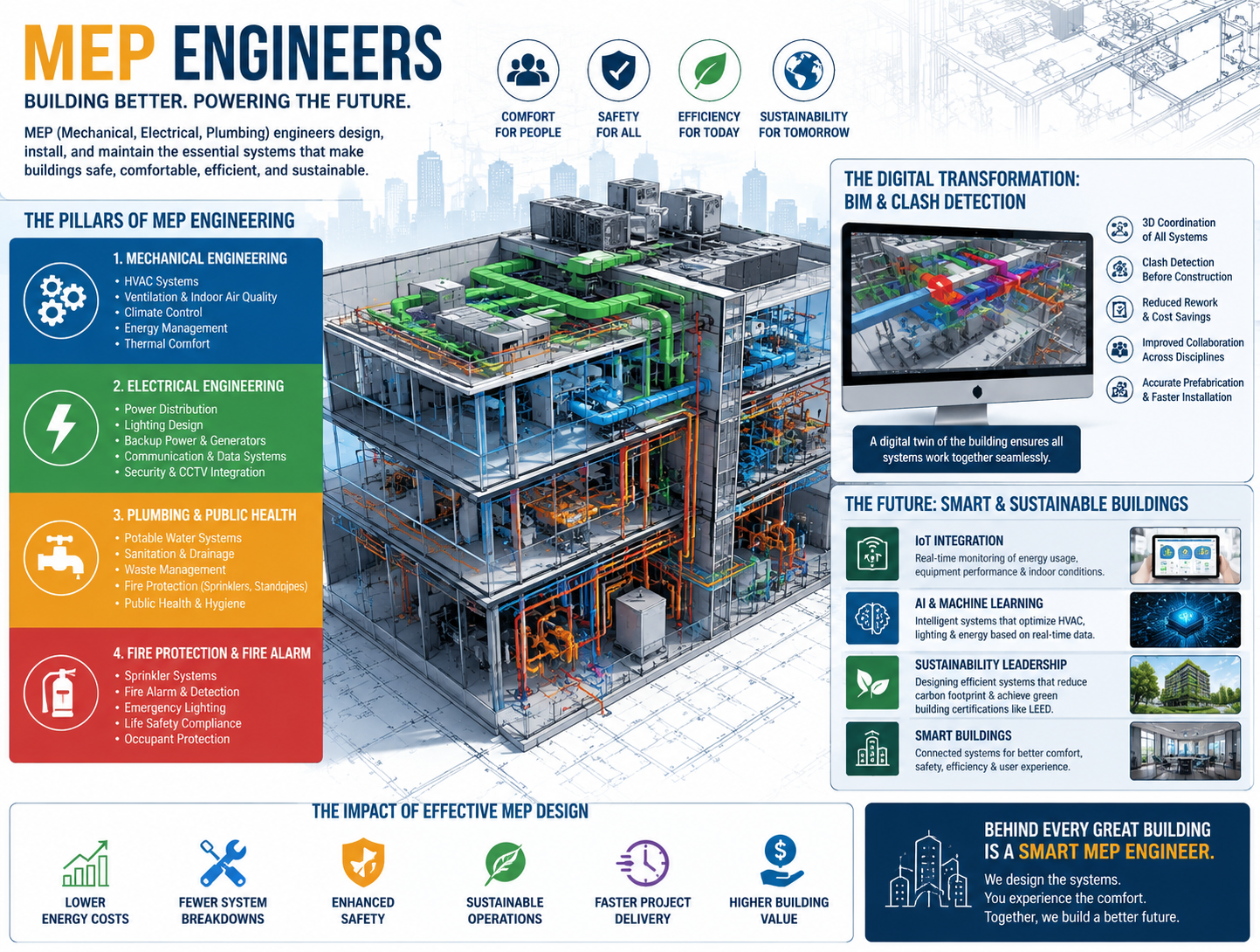
In the architectural world, a building’s MEP Engineers design often captures the public’s imagination through its facade, form, and aesthetic
Table of Contents
In the architectural world, a building’s MEP Engineers design often captures the public’s imagination through its facade, form, and aesthetic appeal. However, the true functionality, safety, and comfort of any modern structure rely on the silent, complex systems hidden within its walls. This is the domain of MEP Engineers.
MEP stands for Mechanical, Electrical, and Plumbing. MEP engineers are the professionals responsible for the design, installation, and maintenance of the systems that make buildings “alive” (Rimkus, 2026).
The Pillars of MEP Engineering
While the acronym is well-known, the scope of the discipline is expansive. A more accurate representation of the field in modern construction would include Fire Protection (FP) and Fire Alarm (FA) systems, which are essential for occupant safety (Rimkus, 2026).
1. Mechanical Engineering
Mechanical systems focus on the internal climate and energy efficiency of a structure. This encompasses:
- HVAC (Heating, Ventilation, and Air Conditioning): Ensuring thermal comfort and high indoor air quality (IAQ) (Red Engineering Design, 2026).
- Climate Controls: Integrating automated systems to manage temperature and airflow based on real-time occupancy data.
- Energy Management: Designing systems that reduce energy consumption, which is critical for meeting modern environmental standards.
2. Electrical Engineering
This discipline ensures the safe and reliable delivery of power.
- Power Distribution: Designing grids to handle high-voltage requirements and emergency power systems, such as backup generators (Rimkus, 2026).
- Lighting Design: Calculating lumen requirements for both functionality and aesthetic integration, increasingly utilizing smart lighting controls.
- Communication & Security: Integrating data cabling, Wi-Fi infrastructure, and CCTV systems to support a modern, connected building (Red Engineering Design, 2026).
3. Plumbing and Public Health
Plumbing is fundamental to public health.
- Potable Water: Ensuring the clean and efficient delivery of water to all parts of the building.
- Sanitation: Designing drainage and sewage systems that effectively and hygienically remove waste.
- Fire Protection: Developing specialized sprinkler systems and standpipes that are critical for life safety during emergency scenarios (Rimkus, 2026).
The Digital Transformation: BIM and Clash Detection
In the past, MEP design often suffered from poor coordination, leading to “clashes”—physical conflicts where, for example, a ventilation duct might intersect with a structural beam. Today, Building Information Modeling (BIM) has revolutionized the field (The BIM Engineers, 2023).
Why BIM is Indispensable
BIM allows engineers to create a “digital twin” of the building, where all systems are modeled together in a shared, 3D environment. This process enables clash detection, where software identifies potential interferences before construction begins (ENG, 2026).
- Reduced Rework: Identifying conflicts in the virtual phase saves significant time and prevents costly on-site modifications (The BIM Engineers, 2023).
- Improved Collaboration: With a unified 3D model, architects, structural engineers, and MEP contractors can ensure their systems fit together seamlessly (ENG, 2026).
- Prefabrication Accuracy: Coordinated models allow for off-site prefabrication of system components, which increases installation precision and speed (ENG, 2026).
The Future: Smart Buildings and Sustainability
As of 2026, the industry is seeing a major shift toward intelligent, high-performance buildings. MEP engineers are now at the center of this transition, acting as the bridge between traditional construction and cutting-edge technology (CADBIM Centre, 2024).
The Rise of Smart Technologies
- IoT Integration: By installing Internet of Things (IoT) sensors, MEP engineers allow building managers to monitor energy usage in real-time and predict equipment failure through predictive maintenance (CADBIM Centre, 2024).
- AI and Machine Learning: Advanced systems now use AI to autonomously optimize performance, such as adjusting HVAC settings based on real-time weather data or occupant density (CADBIM Centre, 2024).
- Sustainability Goals: MEP engineers are the primary drivers in achieving certifications like LEED, by designing systems that minimize carbon footprints and conserve vital resources like water (CADBIM Centre, 2024).
Conclusion
MEP engineers are the unsung heroes of the built environment. They bridge the gap between human needs and physical infrastructure, ensuring that the buildings we inhabit are not only functional and safe but also sustainable and prepared for the technological demands of the future.
What is the main difference between an MEP engineer and a general contractor?
An MEP engineer is a designer and consultant responsible for the technical plans and system specifications. A general contractor is responsible for managing the construction site, hiring the trades, and executing the plans created by the engineers.
Why is “clash detection” so critical for an MEP engineer?
Clash detection identifies spatial conflicts between mechanical, electrical, and plumbing systems during the design phase. Solving these in a 3D model takes minutes, whereas solving them during construction can cause massive delays and budget overruns.
Do MEP engineers only work on large skyscrapers?
No. While they are vital for large-scale commercial projects, MEP engineers work on a wide variety of structures, including hospitals, laboratories, data centers, and high-density residential buildings, all of which require complex, code-compliant systems.
How does an MEP engineer help with LEED or green certification?
They provide the performance data needed for these certifications by designing energy-efficient HVAC, low-flow plumbing, and smart lighting systems that significantly lower the building’s overall environmental impact.
Recent Posts
- 3D Mechanical Drafting Services: The Ultimate Guide to Precision Engineering Design and Modeling
- M and E BIM Coordinator Outsourcing: The Definitive Guide to Streamlining MEP Engineering
- Cannabis Cultivation Facility MEP Design: The Ultimate Engineering and HVAC Guide
- MEP Engineering Services for Warehouse: The Ultimate Design, Installation, and Optimization Guide
- Mechanical Engineering Plumbing Design: The Complete Industry Guide