

Articles

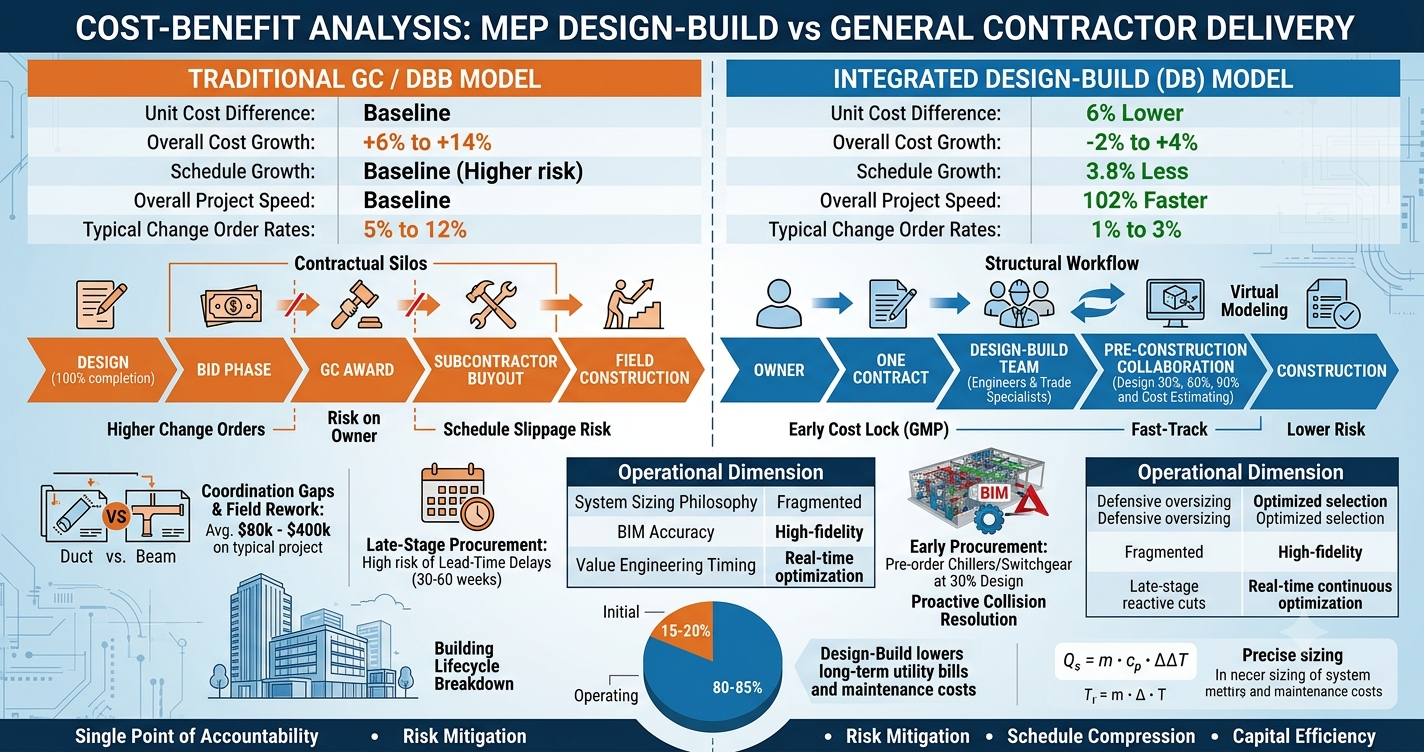
The cost-benefit analysis of MEP design-build vs. general contractor delivery pathways represents a critical decision-making framework for modern commercial developers seeking to optimize capital efficiency and mitigate structural risk. Mechanical, Electrical, and Plumbing (MEP) systems act as the primary life-support networks of modern physical structures, governing climate control, power distribution, water delivery, and critical life-safety systems. Historically, developers relied on traditional, sequential delivery methods managed by general contractors, assuming that fragmented bidding yielded the lowest initial cost. However, as building systems have grown highly integrated and technically sophisticated, a major industry shift toward collaborative project delivery methods has occurred.
Statistical forecasting indicates that design-build construction spending in the United States is yielding a compound annual growth rate of 5.2% over the 2022–2026 period, representing up to 47% of all non-residential construction spending. Within this framework, evaluating the financial, temporal, and operational trade-offs between hiring an integrated MEP design-build specialist versus a traditional general contractor utilizing sequential subcontractor bidding is a critical decision-making exercise. To execute this evaluation, developers utilize advanced engineering consultation available via the primary EngrTeam building services platform.
Comparative Structural Frameworks and Contractual Mechanics
Evaluating the financial viability of alternative delivery systems requires a thorough understanding of the underlying contractual structures and communication channels that govern them. The structural divergence between a traditional general contractor model and an integrated MEP design-build framework dictates the distribution of risk, the frequency of design modifications, and the speed of project execution.
The Sequential General Contractor Model
Under the traditional General Contractor (GC) model—often structured as Design-Bid-Build (DBB)—the project owner retains an architectural firm to develop the schematic design and detailed specifications for the building envelope and internal systems. The architect subsequently subcontracts the engineering design to independent MEP consultants. The output of this phase is an Issued for Construction (IFC) package, which is then put out to bid to multiple general contracting firms. The selected general contractor subsequently bids out the mechanical, electrical, and plumbing scopes to various trade subcontractors.
This linear sequence creates distinct contractual silos. The designer and the builder bear no contractual obligation to one another, and the project owner sits directly in the middle, retaining all liabilities associated with omissions, errors, or gaps in the design documentation. This adversarial structure frequently leads to communication breakdowns, schedule delays, and significant cost overruns when field conditions do not match the theoretical models of the independent design team.
The Unified MEP Design-Build Framework
Conversely, the integrated MEP design-build framework consolidates the design, engineering, and construction phases under a single contract with a single point of accountability. The building owner contracts directly with a design-builder, which can be an integrated firm or a general contractor paired with a specialized MEP design-build subcontractor. Under this methodology, the trade contractors do not merely execute what is drawn; instead, they are involved from pre-construction through project handover.
This approach often utilizes Progressive Design-Build (PDB), a highly collaborative variant that functions in two distinct phases. In Phase 1, the design-builder collaborates with the owner to define project parameters, validate constructability, and establish detailed cost estimates at incremental design milestones, typically at 30%, 60%, and 90% completion. Once design clarity is achieved, the design-builder submits a commercial proposal, often structured as a Guaranteed Maximum Price (GMP). If the parties cannot reach an agreement on the final scope or cost, the owner retains an “off-ramp” right, allowing them to terminate the agreement and bid the fully engineered package through a traditional construction model. This contractual flexibility minimizes early-stage financial exposure while capturing trade-driven design efficiencies.
Detailed Financial Cost-Benefit Analysis of MEP Design-Build vs. General Contractor Procurement
A quantitative cost-benefit analysis of MEP design-build vs. general contractor delivery pathways reveals clear, measurable performance advantages in favor of the integrated design-build approach. Decades of empirical research conducted by the Design-Build Institute of America (DBIA) and the Construction Industry Institute (CII) across thousands of commercial capital projects confirms that design-build consistently outperforms traditional general contracting on cost, schedule, and quality metrics.
Quantitative Performance Metrics
Data comparing the cost, schedule, and quality outcomes of Design-Build (DB) against traditional General Contractor (GC) delivery methods, such as Design-Bid-Build (DBB) and Construction Manager at Risk (CMAR), reveals a consistent performance advantage in favor of the integrated approach.
| Performance Dimension | Traditional GC / DBB Model | Construction Manager at Risk (CMAR) | Integrated Design-Build (DB) Model |
|---|---|---|---|
| Unit Cost Difference | Baseline | Comparable to DBB | 6% Lower Unit Cost |
| Overall Cost Growth | +6% to +14% | +2% to +6% | -2% to +4% |
| Schedule Growth | Baseline (Higher risk of delay) | 1.9% Less than DBB | 3.8% Less than DBB |
| Overall Project Delivery Speed | Baseline | 61% Faster than DBB | 102% Faster than DBB |
| Construction Phase Speed Only | Baseline | 13% Faster than DBB | 36% Faster than DBB |
| Typical Change Order Rates | 5% to 12% of Contract Value | 3% to 6% of Contract Value | 1% to 3% of Contract Value |
| Timing of Final Cost Lock | After 100% Design Completion | At 60% to 90% Design | At 60% to 80% Design |
These statistics challenge the conventional assumption that independent competitive bidding through a traditional general contractor results in lower capital expenditure. While the upfront bid package of a general contractor may initially appear less expensive, the competitive bidding premium has historically shrunk to a nominal 1% to 3% advantage. This marginal upfront saving is routinely wiped out by change orders, design reconciliation delays, and the high cost of project schedule slippage.
Schedule Compression and Operational ROI
The operational benefits of schedule compression are directly linked to the financial performance of the asset. By utilizing concurrent engineering and construction techniques, design-build reduces the overall design-to-delivery timeline by an average of 33% compared to traditional linear methods. This timeline compression yields substantial financial benefits:
- Reduced Financing Costs: Shortening the construction period minimizes the accumulation of interest on construction loans, directly lowering the project’s overall financing costs.
- Accelerated Revenue Generation: Early project completion allows developers to lease commercial spaces, start manufacturing lines, or occupy facilities months ahead of schedule, significantly improving the net present value (NPV) of the asset.
- Lower Administrative Overhead: Minimizing the time spent on-site reduces the developer’s soft costs, including project management fees, job site security, and temporary utility expenses.
Risk Profiling and the Financial Impact of Change Orders
Understanding where capital leaks occur during construction requires a detailed examination of the risk profile borne by the project owner under each delivery model.
Coordination Gaps and Rework Costs
In a traditional general contractor arrangement, independent engineering consultants design systems in a theoretical environment. These consultants often design around nominal clearances and general spatial assumptions without knowing which specific manufacturers’ equipment the general contractor will ultimately purchase. When the successful general contractor awards bids to individual mechanical, electrical, and plumbing trade partners, those partners bring different equipment with varying dimensions and maintenance clearance requirements to the site.
This mismatch regularly results in coordination gaps. For example, an architectural layout may show ductwork passing through a structural opening that is physically blocked by structural elements, or an electrical conduit run that conflicts directly with plumbing sanitary lines. On a typical $5 million commercial project, resolving these coordination gaps in the field during active construction yields an average of $80,000 to $400,000 in physical rework, change orders, and schedule delays.
With MEP design-build, these coordination gaps are mitigated during the design phase. The engineers and trade specialists work under a unified contract to build highly detailed digital models before materials are ordered or work begins on-site. Since the installer is directly involved in creating the drawings, constructability issues are resolved proactively inside the virtual environment rather than through reactive field modifications.
The Defensive Sizing Premium
A major point of financial exposure in traditional delivery is the systematic oversizing of mechanical and electrical infrastructure. Because independent design consultants face liability for system performance but do not bear construction costs, they tend to build large safety factors into their calculations. This conservative approach leads to oversized chillers, boilers, ductwork, and electrical switchgear.
By utilizing professional MEP plan services, developers can align real-world installation metrics with precise design criteria to avoid this defensive sizing premium. The engineering team collaborates directly with estimators and construction personnel to design systems optimized for actual installation costs and operational efficiency. Mechanical engineers utilize real-world equipment performance data and advanced thermal analysis tools to develop highly coordinated HVAC layout plans that maximize efficiency.
For instance, the thermodynamic sensible heat transfer rate (Qs) inside an air-handling system is calculated using the following engineering relationship:
Qs=m˙⋅cp⋅ΔT
In this equation, Qs represents the sensible heat transfer rate, m˙ represents the mass flow rate of the air, cp represents the specific heat capacity of air, and ΔT represents the targeted temperature differential across the thermal boundary. By coordinating directly with the construction team during initial planning, engineers can leverage highly accurate parameters for structural insulation, air infiltration, and internal equipment loads. This direct feedback loop eliminates the compounding safety factors that independent consultants apply to cover design uncertainties.
The resulting design minimizes upfront material costs while ensuring the systems run at their peak efficiency, reducing long-term energy consumption. This precise system optimization is further enhanced by integrating specialized electrical engineering services, ensuring that electrical distribution panels, backup power systems, and transformer capacities are engineered to match actual mechanical loads.
Supply Chain Integration and Procurement Buyout Dynamics
The commercial real estate market is highly sensitive to material cost inflation and equipment procurement lead times. Under traditional general contractor delivery, procurement buyout occurs late in the project lifecycle, exposing developers to market volatility and schedule risks.
100%
(8–14 Weeks)
Buyout
Placed
Lead-Time Delays
30%
Long-Lead Items
Chillers / Switchgear
60%
Design Detail
Construction Begins
Critical mechanical and electrical infrastructure components—such as commercial chillers, switchgear, custom variable refrigerant flow (VRF) systems, and standby generators—regularly face manufacturing lead times of 30 to 60 weeks. Under a sequential traditional model, discovering a 40-week lead time after the contract award can halt a project, adding carrying costs, interest expenses, and developer overhead.
In an integrated MEP design-build model, procurement is treated as an active part of the design phase. The design-build team can identify long-lead items at 30% design completion, specify the exact equipment required, and issue purchase orders immediately with the owner’s approval. This early procurement strategy insulates the developer from mid-project equipment price hikes and ensures that critical components arrive on-site exactly when needed, keeping the construction schedule on track.
BIM Coordination, Clash Detection, and Digital Twins
A core technical advantage of the integrated MEP design-build approach is the seamless deployment of Building Information Modeling (BIM) across the design and construction workflows. While independent engineering consultants frequently generate 2D schematics or basic 3D representations, they rarely coordinate their digital work with the specific physical constraints of the trade contractors’ field execution models.
Proactive Collision Resolution
In a traditional general contractor model, structural, mechanical, electrical, and plumbing drawings are generated in isolation. This isolation often leads to spatial conflicts that are only discovered during active construction on the job site. When these collisions occur, construction halts while field teams generate Requests for Information (RFIs) and design consultants draft modifications. The resulting delays and rework drive up costs and disrupt the project timeline.
Conversely, an integrated design-build team utilizes advanced BIM platforms, such as Revit MEP, to build a collaborative, data-rich 3D representation of the property before construction begins. Design engineers and trade specialists work together to map out systems and run advanced clash detection algorithms to resolve physical conflicts in the virtual model.
By resolving these spatial conflicts digitally, the team ensures that materials can be prefabricated off-site with high precision, eliminating field modifications and significantly reducing job-site waste.
Transition to Operational Digital Twins
The benefits of collaborative BIM extend far beyond the construction phase. The highly coordinated 3D models developed during design-build can easily be transitioned into operational “Digital Twins” for the building owner. These digital assets integrate equipment performance specifications, maintenance schedules, and spatial data into a single, interactive platform.
For facility managers, this detailed digital resource streamlines operations, accelerates troubleshooting, and lowers lifetime maintenance costs, ensuring that the building’s infrastructure performs efficiently over its operational lifespan.

Life-Cycle Cost Analysis and Sustainable Building System Performance
When executing a comprehensive cost-benefit analysis of MEP design-build vs. general contractor delivery pathways, developers must evaluate both initial capital expenditures and long-term operating costs. Research shows that initial construction costs represent only 15% to 20% of a commercial building’s total lifetime cost of ownership, while energy, water, and maintenance expenses account for the remaining 80% to 85%.
Life-Cycle Performance of Alternative Procurement Models
The long-term operational performance of a building’s physical systems is heavily influenced by the procurement model selected during the planning phase.
| Operational Dimension | Traditional General Contractor Model | Integrated MEP Design-Build Model |
|---|---|---|
| System Sizing Philosophy | Defensive, conservative oversizing to limit liability | Optimized system selection to lower capital and operating costs |
| BIM/As-Built Accuracy | Fragmented, non-coordinated drawings; high variance | High-fidelity, clash-detected models; precise as-builts |
| Value Engineering Timing | Late-stage, reactive cuts that compromise performance | Real-time, continuous optimization during design |
| System Commissioning | Fragmented handoff; higher risk of post-occupancy issues | Integrated, continuous testing from design to handover |
| Building Lifetime Value | Higher operating costs; faster equipment depreciation | Optimized energy efficiency; extended equipment lifespans |
The Pitfalls of Late-Stage Value Engineering
In a traditional general contractor model, cost control is often reactive. When initial competitive bids exceed the developer’s budget, the project undergoes “value engineering” (VE). Because the design is already complete, VE at this stage typically involves cutting high-performance components, such as premium-efficiency HVAC units, smart building controls, or renewable energy integrations.
While these late-stage cuts may reduce upfront capital costs, they inevitably lead to higher utility bills, more frequent maintenance issues, and shortened equipment lifespans over the life of the building.
With MEP design-build, value engineering is built directly into the design process. Because estimators, engineers, and construction personnel collaborate from day one, cost-performance trade-offs are evaluated in real time as the design develops.
This continuous feedback loop allows the design team to optimize systems for both upfront cost and long-term energy efficiency, ensuring that developers achieve high-performance results without sacrificing future operational ROI.
Market Dynamics, Labor Tightness, and Delivery Demands
The commercial construction industry is navigating an increasingly challenging operational environment characterized by tight labor markets, rising material costs, and complex regulatory requirements. These macroeconomic pressures have significantly weakened the performance of traditional general contracting models, accelerating the industry’s shift toward collaborative, design-build project delivery.
Traditional GC Models
Design-Build
Skilled Labor Shortages and Subcontractor Availability
The construction industry continues to face a persistent shortage of skilled MEP trade professionals. In tight labor markets, high-performing subcontractors prefer working under design-build contracts rather than traditional low-bid arrangements.
Under design-build, subcontractors are treated as key design partners, allowing them to optimize their labor resources and plan fabrication schedules months in advance. Conversely, the traditional general contractor model often fosters adversarial relationships over design gaps and changes, making it harder for GCs to secure top-tier trade partners in a highly competitive market.
Navigating Strict Building and Energy Codes
Modern commercial projects must comply with increasingly stringent building codes, indoor air quality standards, and municipal energy-use regulations. For example, mechanical engineers must design systems that comply with strict ventilation standards, such as ASHRAE Standard 62.1, and meet local energy efficiency mandates.
Meeting these rigorous requirements requires seamless coordination between architectural design, structural engineering, and MEP systems. Traditional general contracting models, with their fragmented workflows and separate design and construction phases, are ill-suited to manage this level of technical complexity.
By unifying design and construction under a single contract, MEP design-build provides the interdisciplinary coordination needed to ensure compliance with modern regulatory standards without driving up costs or delaying project schedules.
Diagnostic Decision Matrix for Capital Projects
To assist commercial developers in selecting the optimal project delivery model, the following diagnostic framework outlines the key variables that influence the success of each approach.
| Diagnostic Parameter | General Contractor (Design-Bid-Build) Preferred | MEP Design-Build Preferred |
|---|---|---|
| Initial Design Maturity | 60% to 100% complete at procurement | 0% to 30% complete (requires early collaboration) |
| Schedule Criticality | Standard timeline; delays do not incur heavy penalties | Fast-track; delays result in severe financial exposure |
| System Specialization | Simple, highly repetitive shell-and-core structures | Complex processes, data centers, laboratories, or food processing |
| Owner Staff Experience | Highly experienced internal engineering and management teams | Limited internal staff capacity; requires single-point accountability |
| Regulatory & Funding Environment | Mandated public bidding guidelines requiring low-bid selection | Private developments or alternative public-private partnerships |
Conclusions and Strategic Recommendations
This comprehensive cost-benefit analysis of MEP design-build vs. general contractor delivery pathways demonstrates that the integrated design-build model delivers superior financial, temporal, and operational performance over traditional general contracting. While traditional general contracting appears to offer lower upfront costs during the initial bidding phase, its fragmented structure frequently results in hidden costs through design gaps, field rework, and delayed project delivery.
By unifying design and construction under a single contract, MEP design-build reduces coordination errors, speeds up project timelines, and provides cost certainty much earlier in the development lifecycle. The single point of accountability shifts design risk away from the project owner, while early collaboration between designers and tradesmen allows for continuous cost estimating and proactive procurement. This collaborative approach ensures that equipment is ordered early, protecting the project from supply chain delays and keeping construction moving forward.
Ultimately, developers of complex, high-performance commercial and industrial properties can optimize their capital investment by choosing the integrated MEP design-build pathway. Partnering with integrated firms early in the design process allows developers to capture structural cost savings, compress project schedules, and ensure their building systems operate at peak efficiency for years to come. gbateam.comIs Design-Build Right for My Project? – GBA